The year 2016 will go down as an interesting one, but was it magnificent, horrible or stupid? Or perhaps all three
Annus mirabilis? 🇬🇧
For some people, 2016 was a good year, an annus mirabilis. If you voted for Trump or are brexiteer who voted to leave the European Union, 2016 was a good year.
Whatever camp you are in, it is hard not to agree with Dan Jones analysis that 2016 was an annus stupidus[1] – a silly season that was twelve whole months long. Where else would seeing a cartoon of Boris Johnson getting “diplomatic” with Donald Trump been unremarkable – (see picture top right)? Here’s hoping for some sanity to return in 2017. Have a happy and sane holiday, and a prosperous new year.
Along with 16 million other people on the 23rd June 2016 I voted to remain in the European Union (EU). I believe the benefits of EU membership exceed the costs. Free trade and free movement have been beneficial to me personally, many of those around me, as well as the wider UK economy [1]. I even married an EU migrant too, so I love Europe in more ways that one. Life outside the EU is very difficult to imagine, professionally, financially, culturally and personally.
So when I woke up to Brexit EuroDoom last Friday, to find I was in a minority outnumbered by 17 million leavers who disagreed, I felt sick. After a gloomy week of miserable soul searching, I realised I didn’t have the foggiest notion who my Member of European Parliament (MEP) was or how they got elected. Although not a student of (or expert in) politics or economics, I don’t believe I am apathetic or unaware. I follow the news, vote in general elections and write letters to my MP. I try to understand what is going on in politics and bend my head around the dismal science of economics. But until this week, I had little or no idea how the European Parliament (EP), let alone the European Commission (EC) or lots of other acronyms starting with E, actually work in practice.
Now if you are also a participant in the failing (?) European project, do YOU know who your MEP is? Any idea what they actually do? The chances are you don’t because Euroignorance is widespread [2]. Fortunately, Professor Google can help us. In Manchester, the MEPs for the North West Region of the UK comprising Cumbria, Lancashire, Merseyside, Greater Manchester and Cheshire are:
Unfortunately, I’d only heard of two of those MEPs beforehand, and neither of them because of their activity during the EU referendum. Nuttall I’d heard of because the comedian Stewart Lee performed a brilliant satirical piece mocking Nuttall’s views on immigration [3]. Woolfe I’d heard of because his campaign leaflet came through my letterbox during the 2015 general election. How did they get elected as MEPs because I can’t remember seeing their names on a ballot paper?
MEPs are elected using the D’Hondt method [4], a form of proportional representation (PR) used in the European elections in 2014 and elsewhere. As of 2016, the three largest UK parties in the European Parliament are: UKIP (24 MEPs), Labour (20 MEPs) and The Conservatives (19 MEPs). Isn’t it remarkable that so many of these MEPS were neither seen or heard during the almost entirely fact-free® debate [1] preceding the UK EU referendum?
So what is the nature of an MEPs power? Back in 1998, a politician by the name of Tony Benn proposed five democratic questions to understand the powerful:
“If one meets a powerful person–Rupert Murdoch, perhaps, or Joe Stalin or Hitler–one can ask five questions:
what power do you have?
where did you get it?
in whose interests do you exercise it?
to whom are you accountable?
how can we get rid of you?”
According to Benn, anyone who cannot answer the last of those questions does not live in a democratic system. [5] Personally, I’d like to get rid of UKIP from the European parliament. How can I do this? While I can’t vote for individuals, I can vote for political parties. However, turnout in european elections is often embarrassingly low, in the UK a pathetic 35.6% showed up in 2014. Which means two thirds of UK voters were unaware or didn’t care who their MEP was, including me. My bad. You could call this democratic deficit, not one where people can’t vote but one where people are unaware or don’t bother.
Right now, it is really hard to see how any good can come of what is unfolding in Great Britain and Europe. Brexit leaves the sector I work in, and many others, facing huge uncertainty [6,7,8]. Let’s hope one thing will happen, a reformed EU where those in power are more engaged and accountable to the people they claim to represent. Personally, I am not in a position to judge if the European Union has a democratic deficit or not [9,10]. Neither can I judge if the European Union is as anti-democratic as some eurosceptics have suggested [11, 12,13]. But I do know something has gone badly wrong with the EU if many europeans have no idea of who their parliamentary representatives are and how they can exercise their democratic rights to get rid of them using the ballot box.
If you are staying in the European Union you have a duty to find out who your MEP is and ask them the five democratic questions above. You better do it quickly before risking a Frexit, Czechout, Swexit, Departugal, Grexit, Bygium, Italeave or bidding Austria La Vista.
Martin Durkin (2016) Brexit: The Movie (warning: contains Nigel Farage and dubious opinions europhiles will find offensive, factual content is highly questionable in places)
* Disclaimer, like I’ve already said, my grasp of politics and economics is pretty basic. I have made every reasonable effort to get the facts right but correct any mistakes I might have made below. These are personal views, which do not necessarily reflect those of my employer.
2015 has been a busy year in the School of Computer Science at the University of Manchester (@csmcr). Here is a brief summary of some key activities during 2015 that will be of interest to employers and alumni, with a quick look ahead at what is coming in 2016 including:
IMHO, generally hackathons are a good thing, especially for students, but there are some thorny issues around Intellectual Property and unpaid labour that many people brush under the carpet. So if you’re organising or attending a hackathon in 2016, make sure you are clear about who owns the IP.
I’ll be doing a talk on “Improving the troubled relationship between Scientists and Wikipedia” (see slides below) with help from John Byrne who has been a Wikipedian in Residence at the Royal Society and Cancer Research UK.
How much does finding out more about all this wiki-goodness cost? An absolute bargain at just £29 for two days – what’s not to like? Tickets are available on eventbrite, register now, while tickets are still available.
Misha Teplitskiy, Grace Lu, & Eamon Duede (2015). Amplifying the Impact of Open Access: Wikipedia and the Diffusion of
Science Wikipedia Workshop at 9th International Conference on Web and Social Media (ICWSM), Oxford, UK arXiv: 1506.07608v1
Manchester Digital a non-profit trade assocation of around 500 digital businesses in the north west of england. Every year they hold elections at their AGM for members of their council who serve for two years. It’s time for me to stand for re-election because my two years is up. Here’s a vote-for-me pitch in 100 words:
Digital skills are crucial to the success of Manchester Digital (MD) but many members of MD struggle to recruit employees with the skills their businesses need. Key questions for MD’s growing membership are how can the skills shortage be met, and what are the responsibilities of employers and educators in addressing the digital skills shortage? As a council member, I would reboot the education special interest group to report thoroughly on these issues at a strategic level. The report would provide an overview of what digital skills young people are likely to have aged 16, 18 and 21+ and what employers can do to bridge the gaps.
[NOTE: This post was written before I deleted my twitter account @dullhunk in 2024, after twitter became a cesspit of misinformation, disinformation and hate now known as X.com. Some of the embedded tweets below might not work as they did in 2015]
[Deleted tweet read: Sad to hear that UK parliament lost its *only* MP with a science degree @julianhuppert #GE2015 #ukelections2015 #GeneralElection — Duncan Hull (@dullhunk) May 8, 2015]
My lament was retweeted quite a bit, then Roger Highfield at the Science Museum in London challenged the interwebs to find if it really was true:
Who knew there were so many physicists involved in the election? Not me. Turns out, the article about only one science MP, is a bit misleading. Julian Huppert was the only MP in the last government to be a “primary science worker” – that’s not quite the same as studying science at university. Julian was the only MP in the last government with scientific background at PhD level:
Valerie Vaz MP for Walsall South (BSc Biochemistry)
Nadhim Zahawi MP for Stratford-on-Avon (BSc Chemical Engineering)
So there are at least 26 MPs out of 650 total who have some kind of STEM educational backgrounds, and hopefully several more. Thankfully, much better than none – but still not that high considering the proportion of STEM in the general population. This article MP’s Degrees: What do they know? claims there are many more scientific MPs, but it depends what you mean by Science of course. Over at the Science Campaign, they have counted 83 politicians with a background or “interest in” science. Doesn’t everyone have an interest in Science & Technology at some level? If so, there are 650 out of 650 MPs (100%) with an interest in science and technology then? As for MPs who have an actual science education, your mileage may vary, especially if you think Politics, Philosophy and Economics (PPE) are all sciences. Wannabe sciences? Yes. Actual Sciences? No.
[Update: Jo Johnson MP for Orpington (BA Modern History), is the newly appointed Minister for Universities and Science [4], a post formerly held by David Willetts. Apparently, Johnson doesn’t know anything about Science. Does it matter?]
References
Castelvecchi, D. (2015). Why the polls got the UK election wrong Nature DOI: 10.1038/nature.2015.17511
Gibney, E. (2015). What the UK election results mean for science Nature DOI: 10.1038/nature.2015.17506
Anon (2012). Books in brief: The Geek Manifesto: Why Science Matters Nature, 485 (7397), 173-173 DOI: 10.1038/485173a
Gibney, E., & Van Noorden, R. (2015). UK researchers fret about downgrading of science minister role Nature DOI: 10.1038/nature.2015.17535
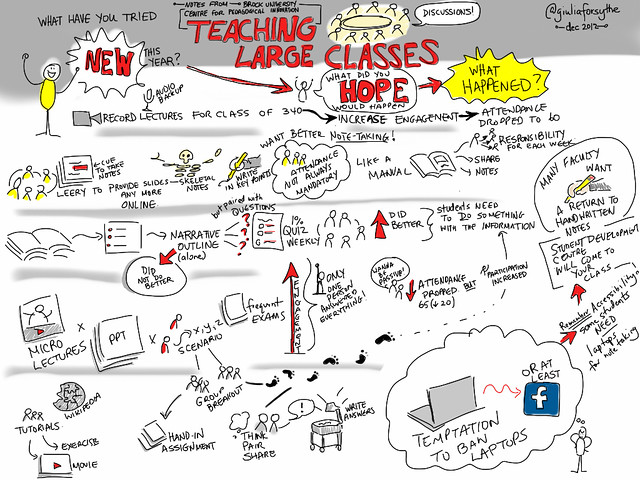
Teaching Large Classes: Discussion. Creative Commons BY-NC-SA image via Giulia Forsythe on Flickr @giuliaforsythe
(This post is part of a series about the New Academics Program (NAP), I’ll be using this blog to scribble notes about the NAP as I work my way through it.)
Ask ten different people what effective teaching is and you’ll get ten different answers. Here’s a handy definition (let’s call it the willing definition for now) from Grant Campbell, currently Professor of Chemical Engineering at the University of Huddersfield. The original source may possibly be from elsewhere. [1]
“Effective teaching is inclining people to learn willingly what they would otherwise be disinclined to learn.”
This is an unusual definition, but is teaching easy interesting stuff always easy to do? Probably not. It’s also not always obvious to teachers (or students) how hard or easy things are going to be to learn. Appearances can be deceptive.
Imagine trying to teach somebody something they didn’t want to know or poorly understood. Like the Physicist Akram Khan @ProfAkramKhan, who has been trying to teach the novelist Will Self about Particle Physics, that’s hard (especially with a deliberately difficult student like Self) but the results are entertaining. Most students in higher education are considerably more willing than Self, and more motivated to work their way through the inevitable dull hard stuff that comes with every subject, so IMHO, effective teaching is about both the dull and the exciting.
References
Diane Salter (2013) Cases on Quality Teaching Practices in Higher Education ISBN-13: 978-1466636613
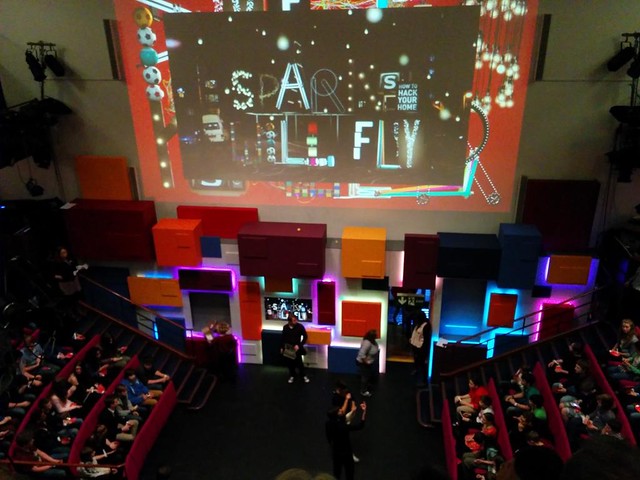
Our homes are full of technology that we typically take for granted and understand little. Your average smartphone or tablet, for example, is a “black box”, that deliberately discourages modification by tinkering and hacking. This Christmas, Danielle George takes three technologies we routinely take for granted – the light bulb, the telephone and the motor – and shows you how to hack your home as part of the Royal Institution Christmas Lectures broadcast on BBC Four.
Lecture 1/3 The Light Bulb Moment: First broadcast Monday 29th December
This year’s Royal Institution Christmas Lectures have been inspired by the great inventors and the thousands of people playing with technology at their kitchen tables or tinkering in their garden sheds. When Joseph Swan demonstrated the first working light bulb in 1878 he could never have dreamed that in 2014 we’d be surrounded by super-bright LED screens and lights that could be controlled using mobile phones.
In this lecture, Danielle explains how these technologies work and show how they can be adapted to help you realise your own light bulb moments. She shows how to send wireless messages using a barbecue, control a firework display with your laptop and use a torch to browse the internet. (via richannel.org/the-light-bulb-moment)
Lecture 2/3 Making Contact: First broadcast Tuesday 30th December
Inspired by Alexander Graham Bell, Danielle attempts to beam a special guest into the theatre via hologram using the technology found in a mobile phone. Along the way, Danielle shows the next generation how to hack, adapt and transform the electronics found in the home to have fun and make a difference to the world.
This year’s Royal Institution Christmas Lectures have been inspired by the great inventors and the thousands of people playing with technology at their kitchen tables or tinkering in their garden sheds. When Scottish inventor Alexander Graham Bell demonstrated the first telephone in 1876, he could never have dreamed that in 2014 we’d all be carrying wire-free phones in our pockets and be able to video chat in crystal clear HD across the world.
In this lecture, Danielle explains how these technologies work and shows how they can be adapted to help keep you connected to the people around you. She shows how to control paintball guns with a webcam and turn your smartphone into a microscope, whilst also investigating a device that allows you to feel invisible objects in mid-air. (via richannel.org/making-contact)
Lecture 3/3 A New Revolution: First broadcast Wednesday 31st December
Inspired by the Royal Institution’s very own Michael Faraday, Danielle attempts to use simple motors to construct the world’s greatest robot orchestra. Along the way, Danielle shows the next generation how to hack, adapt and transform the electronics found in the home to have fun and make a difference to the world.
This year’s Royal Institution Christmas Lectures have been inspired by the great inventors and the thousands of people playing with technology at their kitchen tables or tinkering in their garden sheds. When Michael Faraday demonstrated the first electric motor in 1822, he could never have dreamed that in 2014 we’d be surrounded by mechanical devices capable of performing nearly every human task.
In this lecture, Danielle explains how these robotic and motor-driven appliances work and shows how they can adapted to help you kick-start a technological revolution. She shows how to turn a washing machine into a wind turbine, how Lego can solve a Rubik’s Cube and how the next Mars rover will traverse an alien world. (via richannel.org/a-new-revolution)
This will (probably) be the last post of the year at O’Really, so if you’ve visited, thanks for reading during 2014. Wherever you are, whatever you’re up to, have a Very Makey Christmas and a Hacky New Year in 2015.
It’s that time of year when people look back at over the year that was 2014 (1-5). The place where I work, celebrated it’s 50th anniversary. Colleagues put together a little booklet of facts and figures with an some accompanying web pages to mark the occasion. My personal favourite factoid compares computing in 2014 with 1964. The Atlas Computer represented the state of the art in computing in 1964, and today that crown is held by SpiNNaker – a very different kind of computer.
50 years of computing (and pipe-smoking is lesson common around computers)
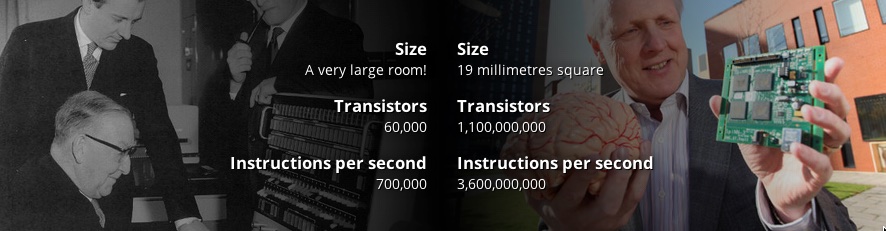
Sometimes, numbers speak louder than words, so here is a numerical comparison of Atlas (1964) with SpiNNaker (2014):
One way of looking at this data is to say, based on the the instructions per second, SpiNNaker is around ~5000 times faster than Atlas. But what is probably more interesting is that SpiNNaker (which is due for completion in 2015) is expected to be used by neuroscientists and psychologists, as a platform to study problems such as Alzheimer’s disease – something that would have been impossible (and unthinkable) only fifty years ago [6,7]. Wonder where the next 50 years will take us in 2064?
Morello, L., Abbott, A., Butler, D., Callaway, E., Cyranoski, D., Reardon, S., Schiermeier, Q., & Witze, A. (2014). 365 days: 2014 in science Nature, 516 (7531), 300-303 DOI: 10.1038/516300a
Anon (2014). 365 days: Nature’s 10, Ten people who mattered this year. Nature, 516 (7531), 311-319 DOI: 10.1038/516311a
Hand, E. (2014). Comet Breakthrough of the Year + People’s choice Science, 346 (6216), 1442-1443 DOI: 10.1126/science.346.6216.1442
Furber, S., Galluppi, F., Temple, S., & Plana, L. (2014). The SpiNNaker Project Proceedings of the IEEE, 102 (5), 652-665 DOI: 10.1109/JPROC.2014.2304638
Alan Turing Binary code, Shoreditch High Street, London by Chris Beckett on Flickr (CC-BY-NC-ND license)
Over at democracy corner, Manchester Digital is interviewing all of its elected council members. Somehow, I got volunteered to be first interviewee. Here’s my two pence on one of the questions asked: “What do you think is biggest challenge we face as an industry?” (with some extra links)
Firstly, coding and “computational thinking” [1], needs to be understood as something that isn’t just for developers, geeks, coders, techies, boffins or “whizz kids” – as the Manchester Evening News likes to call them. Computational thinking, the ability to understand problems and provide innovative solutions in software and hardware, is a fundamental skill that everyone can learn, starting in primary school. As well as being fun to learn and practice, it is a crucial skill in a wide range of organisations in digital and beyond. Thankfully, the new computing curriculum in UK schools has recognised and addressed this, but it remains to be seen what the long-term impact of the changes in primary & secondary education will be on employers.
Secondly, as an industry, both the digital and technology sectors are seriously hindered by gender imbalance. If only 10-20% of employees are female, then large numbers of talented people are being excluded from the sector – bad news for everyone.
Is that reasonable – or have I missed the point? Are there more pressing issues facing the technology sector? Either way, you can read the rest of the interview at manchesterdigital.com/democracy-corner which will be supplemented with more interviews of council members every week over the next few months.
References
Wing, J. (2008). Computational thinking and thinking about computing Philosophical Transactions of the Royal Society A: Mathematical, Physical and Engineering Sciences, 366 (1881), 3717-3725 DOI: 10.1098/rsta.2008.0118
 The year 2016 will go down as an interesting one, but was it magnificent, horrible or stupid? Or perhaps all three
 Along with 16 million other people on the 23rd June 2016 I voted to remain in the European Union (EU). I believe the benefits of EU membership exceed the costs. Free trade and free movement have been beneficial to me personally, many of
  2015 has been a busy year in the School of Computer Science at the University of Manchester (

 O'Really?