O'Really?

July 2, 2025

What’s the Story, Learning Glory? How we can start telling better stories about teaching in Higher Education

All your dreams are made, when you’re chained to the lecture and the teaching trade. Was that lecture, lab or lesson a dream or a nightmare? Exactly what did you learn from the experience? When you reflect on it, how will you tell yourself and others the stories of your study?

The stories students tell about what they have learned, the teaching they experience and research they are exposed to are a key part of the story of every University. These stories demonstrate the value that a University adds to society through the people that it educates, the knowledge, skills and abilities that students at that organisation acquire alongside the research that the institution does.

How are teaching and learning represented in stories online? We analysed the frequency of the keywords TEACH*, LEARN*, STUDENT*, RESEARCH* and SCHOLAR* in ten years of stories summarised in annual press releases. These stories were published by the University of Manchester every December from 2015 to 2024. The main results of the analysis were presented this week [1,2,3] at the Institute of Teaching and Learning (ITL) conference are shown below in Figure 1. There is bad news and good news:

Figure 1: Average frequency of keywords per article over ten years, 2015-2024. On average the words TEACH* and LEARN* occurred just 1.3 and 0.6 times per article in comparison to STUDENT* and RESEARCH* which occurred more than 9 and 15 times in each press release respectively. In theory, teaching has parity of esteem with research, but in practice, this is clearly not the case when counting words in press releases. See [1] for full data.


The BAD NEWS is, the words in our press releases are a long long way off from the words in our strategic vision. [4] This will be disappointing and demoralising for anyone who cares about teaching and learning because our press releases mis-represent a huge amount of important learning done by thousands of our students. They also under-represent massive amounts of teaching delivered by our colleagues across the University. As Duygu Candarli and Steven Jones have shown, this a common pattern repeated across the Higher Education sector. [5] This isn’t just a Mancunian problem, there is a lack of integrity in much of the UK HE sector, what Steven Jones calls “integrity deficits”. [6]

However, the GOOD NEWS is there’s plenty we can do to improve the narrative, by getting on what Sue Beckingham calls the Scholarship of Teaching and Learning (SoTL) staircase [7]. There are some simple and easy steps we can take to tell better stories that represent more accurately what our University (and wider HE sector) actually does. There is a good chance these steps could lead us upwards towards better teaching and scholarship, with students learning more skills and knowledge to prepare them for the world beyond University.

The presentation makes some suggestions for how academic staff can go about climbing the SoTL staircase to deliver even better teaching and an even better learning experience for students. For example, you could:

These are small steps that go in the right direction towards rebalancing the imbalance above. So whatever you are learning and whoever you are teaching, what’s your story, learning glory?

References

  1. Hull, D. (2025) What’s the Story, Learning Glory: Why we need to hear more stories about teaching and learning at the University of Manchester, White paper DOI:10.5281/zenodo.15684409
  2. Hull, D. (2025) What’s the Story, Learning Glory: How we can get better at telling teaching stories at the University of Manchester, Poster presentation #ITLConf25 DOI:10.48420/29360969.v4 (Low resolution screenshot below, for higher resolution use the DOI above)
  3. Blake, J (2025) University of Manchester Teaching and Learning Conference: Abstract Booklet, DOI:10.48420/29371811.v1
  4. Rothwell, N. (2024) Our future: vision and strategic plan. manchester.ac.uk/about/vision
  5. Candarli, D., & Jones, S. (2022). The representation of students in undergraduate prospectuses between 1998 and 2021: a diachronic corpus-assisted discourse study. Critical Discourse Studies. DOI:10.1080/17405904.2022.2130952
  6. Jones, S. (2022) Universities Under Fire: Hostile Discourses and Integrity Deficits in Higher Education. (Palgrave Critical University Studies). Palgrave Macmillan. DOI:10.1007/978-3-030-96107-7
  7. Beckingham, S (2025) SoTL Staircase, National Teaching Repository. Figure. DOI:10.25416/NTR.29438096.v1

You can cite this blog post using DOI:10.59350/oreilly.11284 and get Digital Object Identifiers (DOIs) for your blog posts at rogue-scholar.org


Thanks to Hannah Cobb and Jennie Blake for organising the conference. There is some extra commentary, acknowledgements and discussion of this post at linkedin.com/pulse/whats-story-learning-glory-how-we-can-start-telling-better-hull–dwyxe
April 15, 2021

I wish I’d read this book when I was doing my PhD!

Anyone for a game of PhD bingo?

Published this year by Oxford University Press, How to Get Your PhD: A Handbook for the Journey by Gavin Brown [1] is essential reading for anyone thinking of doing, or trying to get through, a PhD. I wish I’d had this book when I was doing mine, here’s why:

I thoroughly enjoyed my PhD and given the chance I’d do it all again. I was lucky to be able to do research guided by a great supervisor (Robert Stevens) and it was rewarding being part of a big and friendly lab. There were loads of opportunities to get involved in all sorts of other projects along the way. Thankfully, I also had some good mentors and met tonnes of interesting people from all over the world. I am very grateful to Robert, Carole Goble and everyone else who made it possible.

Despite all the good stuff, there’s plenty I could have done better. Hindsight is a great teacher. Gavin’s book would have helped me do a better PhD but hadn’t been written at that time – I wish it had been. I wish that I knew what I know now, when I was younger. [2]

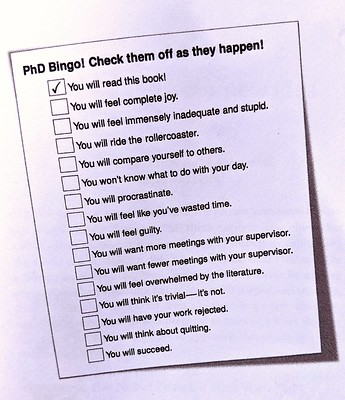
Alongside serious technical advice on the mechanics of doing a PhD, Gavin’s book provides a good overview of some the psychological and emotional hurdles every PhD will encounter. Unlike a lot of similar books (there’s already tonnes of self-help PhD guides out there), this one is written in first person singular which makes for a more engaging and shorter read. Serious advice is balanced by the books light hearted tone, with plenty of humour, such as the game of PhD Bingo, shown in the picture on the right. Like most students, I ticked all those boxes (BINGO!) apart from the “you will read this book” box. Don’t be that person, Read The Friendly Manual! RTFM. Read THIS Friendly Manual!

The handbook also includes personal stories which help get key messages across, not just from Gavin, but a distinguished bunch of scientists, engineers and mathematicians who have contributed to the second part of the book including Nancy RothwellVictoria BurnsSteve FurberLucy KissickHiranya PeirisMelanie LengJeremy WyattDavid HandCarolyn VircaShakir MohamedJonny Brooks-Bartlett and Jennifer Polk.

So if you’re wondering about doing a PhD, or you’re currently doing one, go and read Gavins book. I’m not just saying that because (disclaimer) Gavin is a colleague of mine. I’m saying that because I wish this book had existed back when I did my PhD. It’s packed full of sound advice and I heartily recommend you read it!

References

  1. Brown, Gavin (2021) How to Get Your PhD: A Handbook for the Journey, Oxford University Press, ISBN:9780198866923
  2. Lane, Ronnie and Wood, Ronnie (1973) “Ooh La La.” In Ooh La La. The Faces. “I wish that I knew what I know now, when I was younger…”

May 5, 2017

Venturing Further in 2017 with student entrepreneurs in Manchester #VentureFurther

venturefurtherVenture Further is a business startup competition that awards £50k of prize money to eight student entrepreneurs in Manchester. Running annually, #VentureFurther showcases the enterprising talent of students and graduates of the University of Manchester in four themed categories: Business, Research, Digital and Social. Here is a quick summary of results from the 2017 competition, now in its twelfth year.

This year there were were 16 finalists selected from a total of 73 entries. I was pleased to be invited to judge on the panel for the digital category, which saw some impressive and well polished business propositions. It was really was hard picking the winners!

The awards ceremony and dinner were held in the Whitworth Hall and attended by members of the North West business community. After a keynote from Dale Murray CBE on her distinguished career as an entrepreneur and angel investor, the awards were announced as follows:

Business category: Commercial potential for new products or services

First prize: Eleanor Trimble, Siddharth Kohli, Mohammed Abdulaal, Meera Dulabh, and Dr Alex Casson for Neurolytics, working on biometric data analysis

Second prize: Amir Khorasani and Mohammad Hajhashem for Russell Food Group’s Locally Sourced, a farming supply chain disruptor.

Runners-up: Bilal El Sayed and Benedict Vardey for UWispa a mobile phone case and Crystal Bromwell for Wardrobe in the City a clothing-rental subscription service

Research category: Businesses that focus on the application of university-based research

First prize: Salman Malik and Muftau Akanbi for Microspray Technologies enabling industrial and research scale particle manufacture using aerosols.

Second prize: Denis Bandurin and Alexander Obraztsov for GrapheX, developing portable x-ray sources with graphene-based cathodes.

Runners-up: Mohammad Nazmul Karim and Shaila Afroj for 2DTronics wearable e-textiles and Niall Coogan and Barry Johnston for Cable Coatings a novel low cost method to boost electricity grid capacity.

Digital category: Businesses that apply digital technologies

First prize: Rishabh Jindal for Otterly a food ordering service

Second prize: Michal Wisniewski and Edmund Moore for Simple terms crowdsourcing and gamifying recruitment.

Runner-up: Mubashshar Rahman, Jonathan Tang and Ali Ibrahim for HollaMe a student services exchange and Caleb Conner for SpareSpace Airbnb for luggage

Social cateogory: Businesses that improve the lives of people and communities

First prize: Duncan Swainsbury, Eve Chancellor, Jessica Stalmach, Ashton Coates and Neil Stewart for Bounceback Education a ‘buy one, donate one’ tutoring service giving disadvantaged students access to free tuition.

Second prize:Kathryn Pierce for Somewhere MCR CIC a social enterprise supporting the LGBT community.

Runner-up:Salman Malik and Jamshed Malik for Second Shave Barbers CIC a barbershop for homeless people and Hamza Arsbi and Farah Abu Hamdan for The Science League an educational platform

Congratulations to all the finalists, making it to the final 16 is an achievement in itself. Thanks goes to

If you would like to get involved in the next round of the Venture Further competition in 2018, as competitor, sponsor or supporter see the Venture Further website and details of the 2017 competition on LinkedIn.

Blog at WordPress.com.