O'Really?

July 16, 2025

…from my students I have learned most of all


I have learned much from my teachers and even more from my friends, but from my students I have learned most of all

From left to right, Minahil, Sambbhav and Muna, the latest graduand (now graduate) guests on the Hearing Your Future podcast. As of July 2025, there’s twenty one lessons (aka episodes) that students have taught me, maybe you’ll learn something from them too. 🎧

Graduation is one of the most enjoyable milestones in the academic calendar. It’s a chance for everyone to celebrate and reflect on what students have learned and how they have grown during the time they have spent at University. What makes it special (and possible) is the help of friends, families, speakers and supporters who come to mark the occasion with style and substance.

For the last three years, I’ve been hosting a fringe graduation event with graduands and graduates from a studio in the the Kilburn building, as part of an ongoing audio podcast. [1] The latest three episodes of the podcast are now available including:

Thanks to Minahil, Sambbhav and Muna for taking part, it’s always a pleasure to record these episodes, hear your stories and learn from the unique journeys you are taking. Listen or subscribe at:

Unless you count programming languages, I’m agnostic when it comes to religion, but the quote at the top of this page about learning most from your students comes from the Talmud. [2]

P.S. Sambbhav is looking for work in the UK, if you’re looking for engineers with experience, adaptability, good communication skills and intelligence, you should invite him to interview before somebody else snaps him up! linkedin.com/in/khare-sambbhav

References

  1. Hull, Duncan (2023). Amplifying student voices on employability with podcasts. figshare. Presentation. DOI:10.6084/m9.figshare.23726541.v1
  2. Chanina, Rabbi (Various dates) en.wikipedia.org/wiki/Talmud (Taanis 7a) 

Cite this blog post using DOI:10.59350/oreilly.11426 from rogue-scholar.org

July 28, 2022

What’s your story, coding glory?

Filed under: engineering — Duncan Hull @ 11:21 am
Tags: , , , , ,
Congratulations to all this years graduates!

Last week we celebrated graduation, its been the first proper graduation since before the pandemic. A lot proverbial water has passed very quickly under our proverbial bridge since this years graduates starting studying back in 2018/19. What obstacles have they faced during their study and placements and how have they overcome them? Where are they going next? What’s their story? I interviewed five of this years graduands and previous years graduates to find out. Hear from some of our students including:

  • Sneha Kandane, she’s returning Matillion where she did her industrial placement cdyf.me/sneha
  • Carmen who did an internship at McKinsey and a placement at The Walt Disney Company cdyf.me/carmen
  • Brian Yim Tam who did a placement at Disney Streaming here in Manchester cdyf.me/brian
  • Raluca Cruceru who did a placement at CERN where she now works as a software engineer cdyf.me/raluca
  • Jason Ozuzu who did a placement at Morgan Stanley, an internship at FitBit and is joining Google in London cdyf.me/jason

Listen online at Coding your Future or subscribe wherever you get your podcasts cdyf.me/hearing#subscribing

Congratulations to all this years graduates, it was lovely to celebrate your achievements despite the considerable challenges you’ve faced during the last three of four years. Thanks to Sneha, Carmen, Brian, Raluca and Jason for sharing your stories too.

December 13, 2013

I’m Sorry I Haven’t A Podcast, now on BBC Radio 4

ISIHAC

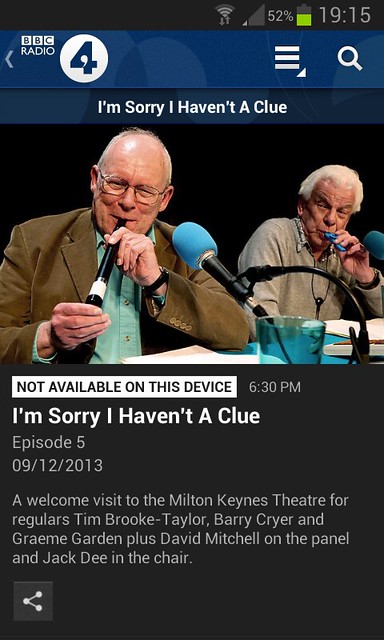
I’m Sorry I Haven’t A Clue, also unavailable on Samsung Android devices.

I’m Sorry I Haven’t A Clue (ISIHAC) is a superbly funny comedy show broadcast by the BBC since 1972 and currently airing it’s sixtieth (yes 60th!) series. Unlike many other BBC programmes, ISIHAC is mysteriously unavailable as a podcast, which makes it difficult to listen to offline. Why is this? Professor Google doesn’t give a definitive answer and the BBC aren’t saying much about it either. So in the spirit of public broadcasting, this post poses the question, where’s the podcast? Currently there are a two theories floating around on the interwebs:

  • The podcast was destroyed by the lovely Samantha when she exceeded her bandwidth after … [insert smutty innuendo here]
  • There is no podcast because Random Entertainment Ltd, the company behind ISIHAC, make a tidy profit from ISIHAC merchandise (mostly CDs, audiobooks, Uxbridge English Dictionary etc). This makes enough money for Graeme Garden and Jon Naismith to have a lifetime supply of Swanee whistles and Kazoos funded by tax-payers money. Consequently, the BBC don’t have the rights to podcast it or something, probably…

If all you want is an ISIHAC MP3 of the broadcast that can be listened to offline at your leisure, then the lack of a podcast is frustrating. Of course, there various workarounds and hacks to roll your own using using get_iplayer, a digital recorderXBMC or similar but this will be a lot of unnecessary hassle for most listeners. None of this seems to be in the spirit of public  broadcasting and there’s a bigger (unanswered?) question about how the BBC decides what to podcast (and what not to).

So Jon Naismith, Graeme Garden and anyone at the BBC, if you’re reading this, please can ISIHAC be made available as an MP3 via a podcast? Much obliged.

[Update July 2015: the BBC iPlayer Radio app now supports downloads – the next best thing in the absence of podcasts. Hooray!]

May 24, 2012

Physics or Stamp Collecting? Let’s hear it for the Stamp Collectors

An old stamp collection by DigitalTribes on Flickr

Are you a Physicist or a Stamp Collector? Creative commons licensed image via DigitalTribes on Flickr.

The Life Scientific is a series of interviews by Jim Al-Khalili of high profile scientists. It’s a bit like Desert Island Discs without the music and with more interesting guests. If you missed them on the radio, you can download the lot as a podcast. Here’s a good example of an interview with John Sulston on the Physics vs. Stamp Collecting debate [1].

Jim Al-Khalili:

“There’s this wonderful, I’m sure you’ve heard it, Lord Rutherford’s tongue in cheek quote that all science is either physics or stamp collecting. Very rude, very insulting of course and it was applying to the way 19th Century naturalists would classify the world around them. What you were doing was a similar sort of thing but down at the level of individual cells.”

John Sulston:

“Yes I mean I am a stamp collector by that definition and I freely admit that, that’s why…”

Jim Al-Khalili:

“I don’t want to be insulting.”

John Sulston:

“No, no, no it’s not insulting in the least, I am a stamp collector but stamp collecting with a purpose, I don’t want to collect all stamps, I like collecting stamps that people are going to use. So I collect patterns perhaps is what I do. And I make maps that other people can use for their own work and that’s true of the cell, and it’s true of the genome, and I think that’s my role, I don’t think I’m a very intellectual person but I certainly can through a sort of obsession and loving of sort of completeness make a map that other people find valuable. Whereas other people previously had only done little tiny bits of it, which weren’t joined up, so I had to do the joining up, that’s very appealing to me. But it works – it wouldn’t work at all if you were off on your own – that’s why the stamp collector thing is used in a pejorative sense because it means somebody all by themselves just obsessively collecting stamps but if you bring a map out and it becomes the basis for a lot of other people’s work, like my maps have, then it’s entirely different.”

So let’s hear it for the stamp collectors, aka the “other scientists”. They no longer have to live in the shadow of Ernest Rutherford‘s jokey insult about their physics envy.

References

  1. Birks, J.B. (1962) Rutherford at Manchester OCLC:490736835
  2. Ihde, A. (1964). Rutherford at Manchester (Birks, J. B., ed.) Journal of Chemical Education, 41 (11) DOI: 10.1021/ed041pA896
  3. Birks, J., & Segrè, E. (1963). Rutherford at Manchester Physics Today, 16 (12) DOI: 10.1063/1.3050668
  4. Goldhammer, P. (1963). Rutherford at Manchester. J. B. Birks, Ed. Heywood, London, 1962; Benjamon, New York, 1963. x + 364 pp. Illus. $ 12.50 Science, 142 (3594), 943-944 DOI: 10.1126/science.142.3594.943-a

Blog at WordPress.com.