
O'Really?

January 9, 2026

Improving practical software engineering teaching with industrial mentoring of open source team projects

Screenshot from stendhalgame.org, the software used in this project

Mentors can enrich and extend your teaching by supporting students learning during their study. Here’s a paper I presented yesterday describing some teaching we’ve done over the last decade (2015-2025) mentoring software engineers on a second year undergraduate course in Computer Science at the University of Manchester in the UK. Our mentors have come from around forty different organisations from startups to BigTech and everything in between, using a Massively Multiplayer Online Role-Playing Game (MMORPG) called stendhalgame.org for the project. Here’s the abstract of the paper below [1] published open access in the full conference proceedings from Computing Education Practice (CEP) at Durham University via the ACM Digital Library [2]:

Employers often remark that Computer Science graduates do not have the right skills to work on modern software engineering projects where agile practices, continuous integration, test-driven development, git workflows and regular code reviews are commonplace. To address this issue, we designed a course to introduce students to some of the realities of software engineering outside of academia. We describe the journey of building and running an industrial mentoring scheme for this course where students are assigned an experienced engineering mentor from industry who each guide a small team of six through an open source project.

This sets the course apart from the more traditional engineering projects, where students build small and simple system from scratch. Instead we ask students to fix bugs and add features in a large and unfamiliar open source codebase, a game called stendhalgame.org. The mentoring scheme is a key part of enabling that, both in terms of motivating the students but also in providing guidance and advice on how to tackle these kinds of software engineering task. We reflect on the program, which has been taken by more than 2000 second year students over a nine year period. The main contribution is the combination of human mentoring with software that facilitates more meaningful discussions between mentors and mentees that would otherwise have not taken place. As far as we can tell, this is novel in the UK in terms of scale and approach.

Thanks to the students, Graduate Teaching Assistants (GTAs), mentors and my co-authors (especially Suzanne Embury but also Ben Possible, Christopher Page and Tom Carroll) who made this work possible by designing, developing, delivering, improving and (in the case of students) actually doing the course. Thanks to Karl Southern and Steven Bradley for organising CEP, which celebrated its tenth birthday 🎂 this year. We wrote a paper about that too, but that’s another story for another post. [3]

If you teach some kind of Computing, you might enjoy attending CEP, even if you don’t want to publish anything. It’s a good place to learn about what others are doing, because the focus on Practice, rather than Research. [3] CEP is full of lots of good ideas, papers, workshops and interesting people teaching Computing at a wide range of institutions from primary school through secondary school, from FE Colleges, Apprenticeships and a range of different Universities. I’ll post the slides and recorded presentation talk here shortly. The full course material is at software-eng.netlify.app

References

  1. Duncan Hull, Suzanne Embury, Ben Possible, Christopher Page and Tom Carroll (2026) Improving practical software engineering teaching with industrial mentoring of open source team projects. CEP ’26: Proceedings of the 10th Computing Education Practice Pages 29–32, DOI:10.1145/3772338.3772350
  2. CEP ’26: Proceedings of the 10th Computing Education Practice, Durham University DOI:10.1145/3772338
  3. Steven Bradley, Rosanne English, Sally Fincher, Duncan Hull and Mark Zarb (2025) From Marco to Maria: Ten Years of the Computing Education Practice Conference, Koli Calling ’25: Proceedings of the 25th Koli Calling International Conference on Computing Education Research Article No.: 15, Pages 1 – 11 Article No.: 15, Pages 1–11 DOI:10.1145/3769994.3770003

Cite this blog post using the full DOI:10.59350/w8xkx-sa110 or the shorter doi.org/qmmf, both point the same thing. Get DOI’s for your blog posts at rogue-scholar.org
February 15, 2022

Where have all the women gone?

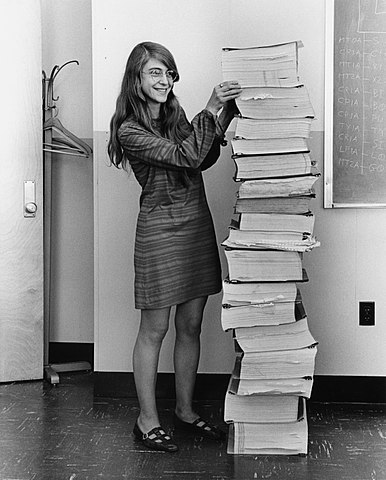
Public domain image of Margaret Hamilton standing next to a print out of software that she and her MIT team produced for the Apollo Guidance Computer in 1969 via Wikimedia Commons w.wiki/4mXY

Computing is too important to be left to men, but where have all the women gone? While women continue to play a key role in computing they are currently under-represented in Computer Science. How can we change this and what evidence is there for practices that get more women into computing? We discussed this paper by Briana Morrison et al [1] on Monday 7th February at journal club. Here is the abstract of the paper:

Computing has, for many years, been one of the least demographically diverse STEM fields, particularly in terms of women’s participation. The last decade has seen a proliferation of research exploring new teaching techniques and their effect on the retention of students who have historically been excluded from computing. This research suggests interventions and practices that can affect the inclusiveness of the computer science classroom and potentially improve learning outcomes for all students. But research needs to be translated into practice, and practices need to be taken up in real classrooms. The current paper reports on the results of a focused systematic “state-of-the-art” review of recent empirical studies of teaching practices that have some explicit test of the impact on women in computing. Using the NCWIT Engagement Practices Framework as a means of organisation, we summarise this research, outline the practices that have the most empirical support, and suggest where additional research is needed.

There is lot of stuff in this paper, and we barely scratched the surface. Personally, one of the things I found useful was the National Center for Women in Technology (NCWIT) Engaging Practices Framework which I’d not seen. These have advice on how to make computing a more inclusive subject for all students, not just women. Some of the guidelines include:

  1. Make it matter (e.g. by making interdisciplinary connections and addressing misconceptions)
  2. Build student confidence and professional identity (e.g. by encouraging a growth mindset)
  3. Grow an inclusive community (e.g. by using well-structured collaborative learning and avoiding stereotypes)

The evidence for which approaches work isn’t particularly strong, see Jane Waites lightning talk slides, but there is some evidence to suggest these practices can help to make small steps in the right direction. The evidence is outlined in the paper.

References

  1. Briana B. Morrison, Beth A. Quinn, Steven Bradley, Kevin Buffardi, Brian Harrington, Helen H. Hu, Maria Kallia, Fiona McNeill, Oluwakemi Ola, Miranda Parker, Jennifer Rosato and Jane Waite (2021) Evidence for Teaching Practices that Broaden Participation for Women in Computing in Proceedings of the 2021 Working Group Reports on Innovation and Technology in Computer Science Education DOI:10.1145/3502870.3506568

August 15, 2012

Fancy becoming a Software Fellow?

Filed under: engineering,Science — Duncan Hull @ 3:48 pm
Tags: , , , ,

Airplane by  By Kuster & Wildhaber Photography

Airplane by By Kuster & Wildhaber Photography

The Software Sustainability Institute www.software.ac.uk has launched a Fellowship programme that recognises outstanding UK-based researchers who use software. The Fellowships come with £3000 funding which can be used for travel, collaboration and running events.

Fellows advise the Institute on important software, evangelise software practices and champion the adoption of best-of-breed software. Fellows will contribute to the software blog, and are supported in advertising their own research.

You can apply to become a Fellow online. Keep an eye on the software.ac.uk blog and Twitter account @SoftwareSaved for further information.

Launch event

A Fellowship Launch event will be held at the Digital Research 2012 in Oxford on 10th September 2012. Attendees at the launch event will receive free entry to the conference on 10 September and, if they choose to stay on, a 50% reduced fee for the rest of the conference. Applicants to the Fellowship Programme put themselves in an advantageous position if they have attended the workshop.

Who should apply

The SSI is seeking fifteen outstanding researchers at different  stages in their career, from PhDs to Professors, and from a wide range of research disciplines in science, technology and engineering. Successful Fellows will have a demonstrable knowledge and visibility in their community and have excellent communication skills.

Funding

The ÂŁ3000 funding is flexible and can be used for travel to conferences, setting up and running workshops, starting new collaborations or hosting/teaching at Software Carpentry training events.

Application details

The Software Sustainability Institute is a national facility that helps researchers and developers to build and use better research software.

The closing date for applications is Thursday 20 September 2012 at 5pm.

Fellowships last eighteen months and are available from the 1st of January 2012 through the 30th of June 2014.

Successful recipients of the Software Sustainability Institute’s Fellowships will be announced in November 2012.

Questions?

If you have any questions, please contact the Institute: info@software.ac.uk.

Blog at WordPress.com.