It’s easy to be impressed by people’s titles. From the Chief of this, to the Director of that and from the President of this, to the Leader of that or the Head of whatever and Manager of so-and-so or Founder of an organisation: Titles tell you something about the person that holds them. In the UK we have more than our fair share of extraordinarily grandiose and pompous titles, some of which have been in the news recently, often for the wrong reasons:
The Duke (of Cambridge) William Mountbatten-Windsor #NotMyDuke
The Duchess (of Edinburgh) Sophie Mountbatten-Windsor #NotMyDuchess
The Princess (of Wales) Catherine Mountbatten-Windsor #NotMyPrincess
The Prince (of Entitlement) Andrew Mountbatten-Windsor, this is less of a fairy tale and more of a horror story for anyone who associated with the disgraced collaborator of convicted sex offender Jeffrey Epstein. Formerly the Prince of York, he’s now simply known as the Prince of Power, Corruption & Lies and definitely #NotMyPrince
Universities everywhere are stuffed full of people with fancy sounding titles too: Professors, Chancellors, Masters, Fellows, Doctors, Proctors, Bachelors, Presidents, Deans, Principals, Rectors, Wardens and so on. Churches love to lord it over us too with their Archbishops, Bishops, Deacons, Priests, Canons and Vicars etc. In many organisations you’ll find plenty of Associate do-da’s, Assistant so-and-so’s, Deputy what-nots, Senior thingamajigs and Vice bla-blas.
Titles, titles everywhere! Some hard earned, some inherited, some awarded, some bought. Some meritocratic, some theocratic, some democratic, some aristocratic. While there are many good and legitimate reasons for using titles, they aren’t always used with honourable intentions. I’m thinking of scenarios like:
“Don’t you know who I am?”
“We’re not on first name terms yet”
“You must use my titles when addressing me…”
Titles can be dehumanising for both addresser and addressee. When titles are stripped from their holder, it is a good reminder that we shouldn’t be too enamoured by them in the first place, especially when they carry lots of baggage. The weightier the titles, the more cumbersome they can be.
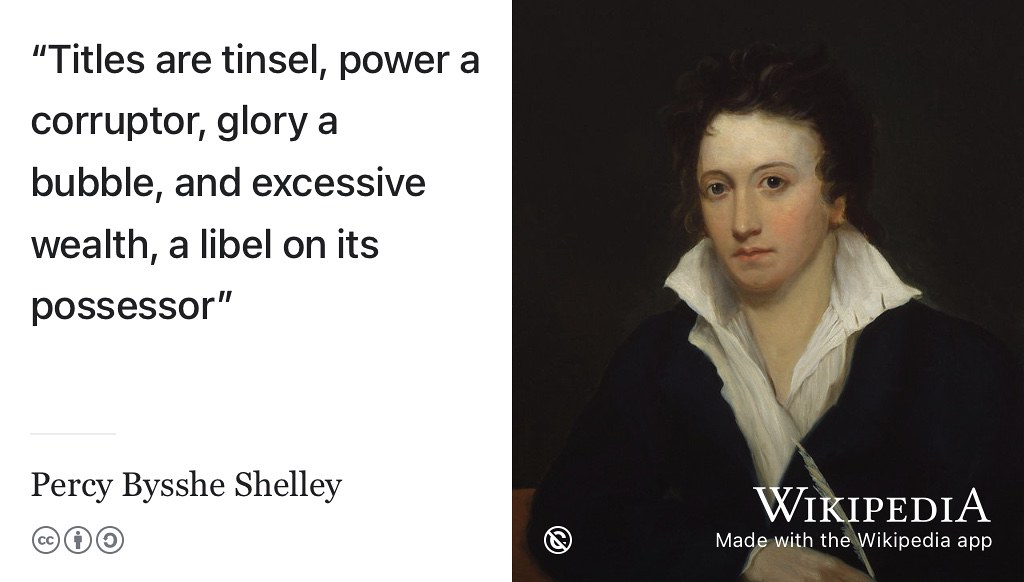
Titles have a tendency to put people on a pedestal, which they inevitably fall off at some point. Shelley puts it better:
According to Percy Bysshe Shelley “Titles are tinsel, power a corruptor, glory a bubble, and excessive wealth, a libel on its possessor” [1] Public domain image of a portrait of the romantic poet Percy Bysshe Shelley by Alfred Clint via the UK National Portrait Gallery in London on Wikimedia Commons w.wiki/p3h
So, titles are tinsel because we’re all human, decorated or otherwise. Maybe you like a bit of tinsel on your Christmas tree, who doesn’t, but a tree is still a tree – with or without the fancy decorations. So the next time you’re impressed by somebody’s title, remember that the titled, en-titled, un-titled, de-titled, re-titled and stripped of their titles, are all just people with very human flaws which might otherwise be obscured by the decorative titles we give them.
We should treat people with respect, not because of their titles, but because they are human.
References
Shelley, Percy Bysshe (1812) “Declaration of Rights.” In The Prose Works of Percy Bysshe Shelley, Volume 1, edited by E. B. Murray. Romantic Poetry; Oxford University Press. DOI:10.1093/actrade/9780198127482.book.1
You can cite this page using the Digital Object Identifier provided by rogue-scholar.org either the long DOI:10.59350/1fs12-2z824 or the shorter doi.org/qvd8, both of which point to the same thing.
Screenshot from stendhalgame.org, the software used in this project
Mentors can enrich and extend your teaching by supporting students learning during their study. Here’s a paper I presented yesterday describing some teaching we’ve done over the last decade (2015-2025) mentoring software engineers on a second year undergraduate course in Computer Science at the University of Manchester in the UK. Our mentors have come from around forty different organisations from startups to BigTech and everything in between, using a Massively Multiplayer Online Role-Playing Game (MMORPG) called stendhalgame.org for the project. Here’s the abstract of the paper below [1] published open access in the full conference proceedings from Computing Education Practice (CEP) at Durham University via the ACM Digital Library [2]:
Employers often remark that Computer Science graduates do not have the right skills to work on modern software engineering projects where agile practices, continuous integration, test-driven development, git workflows and regular code reviews are commonplace. To address this issue, we designed a course to introduce students to some of the realities of software engineering outside of academia. We describe the journey of building and running an industrial mentoring scheme for this course where students are assigned an experienced engineering mentor from industry who each guide a small team of six through an open source project.
This sets the course apart from the more traditional engineering projects, where students build small and simple system from scratch. Instead we ask students to fix bugs and add features in a large and unfamiliar open source codebase, a game called stendhalgame.org. The mentoring scheme is a key part of enabling that, both in terms of motivating the students but also in providing guidance and advice on how to tackle these kinds of software engineering task. We reflect on the program, which has been taken by more than 2000 second year students over a nine year period. The main contribution is the combination of human mentoring with software that facilitates more meaningful discussions between mentors and mentees that would otherwise have not taken place. As far as we can tell, this is novel in the UK in terms of scale and approach.
Thanks to the students, Graduate Teaching Assistants (GTAs), mentors and my co-authors (especially Suzanne Embury but also Ben Possible, Christopher Page and Tom Carroll) who made this work possible by designing, developing, delivering, improving and (in the case of students) actually doing the course. Thanks to Karl Southern and Steven Bradley for organising CEP, which celebrated its tenth birthday 🎂 this year. We wrote a paper about that too, but that’s another story for another post. [3]
If you teach some kind of Computing, you might enjoy attending CEP, even if you don’t want to publish anything. It’s a good place to learn about what others are doing, because the focus on Practice, rather than Research. [3] CEP is full of lots of good ideas, papers, workshops and interesting people teaching Computing at a wide range of institutions from primary school through secondary school, from FE Colleges, Apprenticeships and a range of different Universities. I’ll post the slides and recorded presentation talk here shortly. The full course material is at software-eng.netlify.app
References
Duncan Hull, Suzanne Embury, Ben Possible, Christopher Page and Tom Carroll (2026) Improving practical software engineering teaching with industrial mentoring of open source team projects. CEP ’26: Proceedings of the 10th Computing Education Practice Pages 29–32, DOI:10.1145/3772338.3772350
CEP ’26: Proceedings of the 10th Computing Education Practice, Durham University DOI:10.1145/3772338
Steven Bradley, Rosanne English, Sally Fincher, Duncan Hull and Mark Zarb (2025) From Marco to Maria: Ten Years of the Computing Education Practice Conference, Koli Calling ’25: Proceedings of the 25th Koli Calling International Conference on Computing Education Research Article No.: 15, Pages 1 – 11 Article No.: 15, Pages 1–11 DOI:10.1145/3769994.3770003
“I have learned much from my teachers and even more from my friends, but from my students I have learned most of all”
From left to right, Minahil, Sambbhav and Muna, the latest graduand (now graduate) guests on the Hearing Your Future podcast. As of July 2025, there’s twenty one lessons (aka episodes) that students have taught me, maybe you’ll learn something from them too. 🎧
Graduation is one of the most enjoyable milestones in the academic calendar. It’s a chance for everyone to celebrate and reflect on what students have learned and how they have grown during the time they have spent at University. What makes it special (and possible) is the help of friends, families, speakers and supporters who come to mark the occasion with style and substance.
For the last three years, I’ve been hosting a fringe graduation event with graduands and graduates from a studio in the the Kilburn building, as part of an ongoing audio podcast. [1] The latest three episodes of the podcast are now available including:
Thanks to Minahil, Sambbhav and Muna for taking part, it’s always a pleasure to record these episodes, hear your stories and learn from the unique journeys you are taking. Listen or subscribe at:
Unless you count programming languages, I’m agnostic when it comes to religion, but the quote at the top of this page about learning most from your students comes from the Talmud. [2]
P.S. Sambbhav is looking for work in the UK, if you’re looking for engineers with experience, adaptability, good communication skills and intelligence, you should invite him to interview before somebody else snaps him up! linkedin.com/in/khare-sambbhav
References
Hull, Duncan (2023). Amplifying student voices on employability with podcasts. figshare. Presentation. DOI:10.6084/m9.figshare.23726541.v1
All your dreams are made, when you’re chained to the lecture and the teaching trade. Was that lecture, lab or lesson a dream or a nightmare? Exactly what did you learn from the experience? When you reflect on it, how will you tell yourself and others the stories of your study?
The stories students tell about what they have learned, the teaching they experience and research they are exposed to are a key part of the story of every University. These stories demonstrate the value that a University adds to society through the people that it educates, the knowledge, skills and abilities that students at that organisation acquire alongside the research that the institution does.
How are teaching and learning represented in stories online? We analysed the frequency of the keywords TEACH*, LEARN*, STUDENT*, RESEARCH* and SCHOLAR* in ten years of stories summarised in annual press releases. These stories were published by the University of Manchester every December from 2015 to 2024. The main results of the analysis were presented this week [1,2,3] at the Institute of Teaching and Learning (ITL) conference are shown below in Figure 1. There is bad news and good news:
Figure 1: Average frequency of keywords per article over ten years, 2015-2024. On average the words TEACH* and LEARN* occurred just 1.3 and 0.6 times per article in comparison to STUDENT* and RESEARCH* which occurred more than 9 and 15 times in each press release respectively. In theory, teaching has parity of esteem with research, but in practice, this is clearly not the case when counting words in press releases. See [1] for full data.
The BAD NEWS is, the words in our press releases are a long long way off from the words in our strategic vision. [4] This will be disappointing and demoralising for anyone who cares about teaching and learning because our press releases mis-represent a huge amount of important learning done by thousands of our students. They also under-represent massive amounts of teaching delivered by our colleagues across the University. As Duygu Candarli and Steven Jones have shown, this a common pattern repeated across the Higher Education sector. [5] This isn’t just a Mancunian problem, there is a lack of integrity in much of the UK HE sector, what Steven Jones calls “integrity deficits”. [6]
However, the GOOD NEWS is there’s plenty we can do to improve the narrative, by getting on what Sue Beckingham calls the Scholarship of Teaching and Learning (SoTL) staircase [7]. There are some simple and easy steps we can take to tell better stories that represent more accurately what our University (and wider HE sector) actually does. There is a good chance these steps could lead us upwards towards better teaching and scholarship, with students learning more skills and knowledge to prepare them for the world beyond University.
The presentation makes some suggestions for how academic staff can go about climbing the SoTL staircase to deliver even better teaching and an even better learning experience for students. For example, you could:
Listen to and be a guest on pedagogical podcasts at the University such as Good Practice in Teaching
These are small steps that go in the right direction towards rebalancing the imbalance above. So whatever you are learning and whoever you are teaching, what’s your story, learning glory?
References
Hull, D. (2025) What’s the Story, Learning Glory: Why we need to hear more stories about teaching and learning at the University of Manchester, White paper DOI:10.5281/zenodo.15684409
Hull, D. (2025) What’s the Story, Learning Glory: How we can get better at telling teaching stories at the University of Manchester, Poster presentation #ITLConf25 DOI:10.48420/29360969.v4 (Low resolution screenshot below, for higher resolution use the DOI above)
Blake, J (2025) University of Manchester Teaching and Learning Conference: Abstract Booklet, DOI:10.48420/29371811.v1
Candarli, D., & Jones, S. (2022). The representation of students in undergraduate prospectuses between 1998 and 2021: a diachronic corpus-assisted discourse study. Critical Discourse Studies. DOI:10.1080/17405904.2022.2130952
Jones, S. (2022) Universities Under Fire: Hostile Discourses and Integrity Deficits in Higher Education. (Palgrave Critical University Studies). Palgrave Macmillan. DOI:10.1007/978-3-030-96107-7
Beckingham, S (2025) SoTL Staircase, National Teaching Repository. Figure. DOI:10.25416/NTR.29438096.v1
Have you ever been asked WHAT SCHOOL DID YOU GO TO? I was once asked this in a high-stakes job interview and my answer was that of a startled rabbit caught in the headlights before becoming squashed roadkill on the highway to hell. Nobody has asked me that question before or since. How can such a simple question be so difficult to answer?
Figure 1: Check out my awesome founding members badge! 📛
WHAT SCHOOL DID YOU GO TO? is a Big Friendly Question (BFQ) that triggered lots more questions in my head rather than a composed answer from my mouth. My brain started work on Questioning The Friendly Question (QTFQ):
Why was the interviewer asking, when I could see him reading it off the top of my CV from across the table?
How the hell was the school I attended relevant to my suitability for the role?
Was this a friendly warm-up question, an innocent icebreaker or a inappropriately tricky tiebreaker to sort the men from the boys and the women from the girls?
Was the purpose of the interview to enable someone in the Human Resources department to cynically tick some state school box for Equality, Diversity & Inclusion (EDI) before abandoning me by the roadside as unfortunate (but deliberate) interview roadkill?
If I’m just here to make up the numbers, maybe the interviewer would like to know where they could shove their stupid question and the interview with it?
Years later, I still can’t decide what to make of the WHAT SCHOOL DID YOU GO TO interview question. If you were asked this question in a high-stakes job interview what would your answer be?
This is my answer.
Beware of the heavily loaded juggernaut
The heavily loaded question of WHAT SCHOOL DID YOU GO TO is a very personal one. The personal is political and the political is often provocative. It proved to be a fatally political question in a Great Gatsby Scholarship interview I had for a DPhil at the University of Oxford. I wasn’t expecting the question or the abusive reply to my bewildered (but factually correct) answer. As with many job interviews, there was a big power imbalance between the interviewer and the interviewee. The Professor interviewing me was a member of some exclusively professional gentlemen’s clubs in London. One of these clubs serves as UK’s National Academy of Sciences (the royalsociety.org) whose members, or Fellows (as they like to be called), use the letters FRS after their names. Alan Turing, Charles Darwin, Isaac Newton, Christopher Wren and Stephen Hawking were all FRS alongside 8,000 other fellows in total. Around 80% of Royal Society fellows are no longer with us, which is why they are sometimes called the Dead Scientists Society. To keep themselves relevant in the land of the living, they invite around 60 new fellows to join their esteemed club every year. Although the society started as the oldest of old boy networks for scientists back in 1660, women started joining relatively recently in 1945. Newer members include Nobel laureates like Jennifer Doudna and Demis Hassabis (of Google DeepMind) alongside business leaders like Elon Musk, although his fellowship (like most things he does) is controversial. There is still lots more work to be done improving diversity at the Royal Society, because only 12% of their ~1,800 living fellows are female. (1)
The other professional club my interviewer sported membership of was another exclusive invitation-only outfit, let’s call it the Imperial Club. As a Commander of the British EmpireCBE, this Professor was awarded a premium Imperial Club membership by the royal family alongside 99 other newly appointed commanders each year. Diversity in the Imperial Club is actually a bit better than that of the Royal Society (and certainly the royal family), but still not generally particularly representative of society as a whole. (2)
Figure 2: Just before becoming interview roadkill, I froze like a breathless rabbit caught in the headlights of the question many state schoolers dread: WHAT SCHOOL DID YOU GO TO? (3) This interview wasn’t looking like the Stairway to Heaven I’d hoped for, (4) but more of a Highway to Hell. (5) Rabbit sketch by Visual Thinkery is licensed under CC-BY-ND🐰
The odds are about 5:1 that my interviewer was also a member of the 7% club (6), that’s the elite minority group of the UK population who are privately educated by one of our formidable Engines of Privilege. (7) But who knows? This Professor was justifiably proud to be a Fellow the Royal Society (FRS) and a commanding member of the Imperial Club (CBE), because they are both significant awards in their own right. Only about 0.002% of the UK population are deemed worthy of the award of club membership. (8) Membership of these London clubs does not come easy because the bouncers working the doors are notoriously powerful, opinionated and they love a good fight. They don’t fight with their fists, they wage war in words. If your name isn’t down on their closely guarded list, you’re not coming in. The Professor interviewing me was down on the list and up there in career clubbers heaven with other Gods because he was appointed CBE by Queen Elizabeth II. That same Queen (and her son King Charles III) were appointed to their posts as head of state by God using a special hat – so I’m literally only three steps from God:
✞ God
step one takes you from God to:
👑 The Queen (or The King)
step two takes you from the reigning monarch to:
🎓 The Professor
step three takes you from the Professor to:
😀 Me
Fall on your knees! O hear the angel voices! Alternatively, if you’re an agnostic republican like me who can’t tolerate watching any more nonsense on the premium subscription channel Monarchy+, at least show some R.E.S.P.E.C.T. in this High Temple of Science. Despite my republican agnosticism combined with a healthy dose of scepticism, I dress appropriately, take my metaphorical shoes off and respectfully leave them by the door of the interview room. I am grateful, incredibly lucky and immensely privileged to have this unique once-in-a-lifetime opportunity of an interview and I really wanted to make the most of it. Bring it on!
Stairway to Heaven or Highway to Hell?
In stark contrast to my interviewer, the only letters I had after my name were the humble BSc (Hons). That’s a Bachelor of Science degree in Plant Sciences with Industrial Experience, also known as a year in industry. On being asked WHAT SCHOOL DID YOU GO TO, the letters BSc (Hons) were rapidly followed by a collection of other post-nominals including:
WTF?
OMG
FFS!
The only clubs I was a member of at the time were the climbing club and the all inclusive 93% club, a group for the overwhelming majority of the UK population educated in state schools. The 93% club didn’t actually exist back then but I’m really glad it exists now.
While I ended up as yet more roadkill on the interview highway to hell, just another casualty of the Oxford juggernaut, I learned a painful, humiliating but important lesson about pride, or what 93% clubbers call State School Pride. (9) That’s a badge I’d been wary of because my mum, a very wise and stoic woman that I love and listen to, warned me about pride. “Pride comes before a fall, Duncan” – she said. She’s right, especially when you see how the proud have fallen, all those privately educated cocksure Oxford graduates. The likes of Blair, Cameron, Johnson and Sunak haven’t exactly showered themselves in glory since graduating have they? When it comes to school badges, some of the alternatives to the pride badge are:
📛 State School Taboo: It’s a bit awkward, so let’s change the subject shall we?
I’ve worn all those school badges and even been employed as a Science teacher in secondary schools that are accused of minting them such as the (supposed) Scumbag College. If you’re not familiar with the infamous College, it’s a bog standard comprehensive state school in AnyTown, AnyWhere which feeds into another (supposed) Scumbag College, part of the University of AnyCity. These school badges are uncomfortable to wear, they don’t look good and they don’t help you, the school or the University you attended make a useful contribution to society. If you’re a state schooler like me, I don’t recommend wearing any of them unless you want to become squashed roadkill too.
If you haven’t already, you should burn these badges immediately and replace them with your State School Pride badge! 🏳️🌈
Whatever school badge you decide to wear, the education your school(s) gave you is a paradox. It’s both incredibly relevant and completely irrelevant on your CV and in job interviews. My state schooling, funded by the taxpayer, was relevant because I’d been invited to interview thanks to years of hard work by my teachers. If it wasn’t for the teachers who patiently taught me (and my friends and my siblings) during thirteen years of primary and secondary school education I wouldn’t have been able to express myself to create a CV accompanied by a persuasive covering letter that convinced decision makers to interview me. If it wasn’t for my maths and science teachers, I would never have been able to study Science at University in the first place. My Mancunian teachers at the University of Manchester extended this education, building on the foundations of my compulsory state school education.
But at the same time, that very same education was completely irrelevant, it should not affect how I was treated. Should it have even been an interview question at all?
In its defence, WHAT SCHOOL DID YOU GO TO is an open-ended question that invites the interviewee to challenge the authority of the interviewer. There are many possible answers to choose from including: Why the hell are you asking me that? I didn’t have either the guts or the gift of the gab to think of that under pressure. Rabbit. Headlights. Roadkill. On the other hand the irrelevance of the question will probably make the admissions and HR department blush because it doesn’t comply with their new EDI policy. 😳
SO, WHAT SCHOOL DID YOU GO TO? It’s not really any of my business and certainly won’t affect how I treat you. Wider society may differ so there’s an argument for making whatever kind of education you’ve had another protected characteristic. (10) Just as your age, your race, your religion or beliefs, your sexual orientation, your gender, your disabilities, your marriage or civil partnership, your pregnancy and maternity, your education should not determine how you are treated either. These characteristics are covered by the Equality Act of 2010. Your education (private or state) is your own business, and you probably didn’t have that much say in which school you went to anyway.
Figure 3: Anyone can become an owner of an awesome 93% club enamel pin badge by joining us at 93percent.club/join📛
What I definitely care about 100%, is the school I went to, especially when asked in a high-stakes job interview where my reply is mocked by the abusive and memorable comment:
“I’VE NEVER HEARD OF IT”!
At this point, my dæmon (that rabbit I was talking about) died a quick but horrible bloody death and although the interview continued, I was barely able to function, let alone be my very best. The education we receive is an integral part of who we are and what makes us, so when someone demeans it, its like they’ve had a head-on collision with your soul. Juggernauts and rabbits don’t work well together. 🐰
I’m lucky and privileged to have attended the kind of state schools that never held me back and got me, my friends and my siblings to wherever we wanted to go. Thank you Fitzmaurice Primary School and St. Laurence School. Thanks to my amazing state school teachers and thousands more professionals just like them working incredibly hard in an increasingly challenging state sector to educate EVERYONE inclusively across the UK:
regardless of their socio-economic background
regardless of their ability to pass an extrance exam
regardless of their families ability to pay the school fees, with or without VAT (11)
regardless of their families ability to live in the catchment area of the “right” school
regardless of their ability to win competitive scholarships, assisted places or other bursaries
That’s an extraordinarily diverse group of millions of students in state schools across the UK. I’m proud be one of them. I’m proud to be a card-carrying, badge-wearing, box-ticking, word-spreading and founding member of the UK’s least exclusive members club: the 93percent.club. 💪
Join us in tackling inequality across the UK
Not everyone educated in the state sector gets the headstart in life that I did. (10) As the former Education secretary Justine Greening once put it, talent is spread evenly but opportunity is not. (12) There is a class ceiling to accompany the glass ceiling which prevents many students educated in the state sector from getting the opportunities they deserve. (13) That’s just plain wrong. It’s indefensible. It’s immoral and it’s an injustice. Unfortunately, the UK is still a country where the school you went to definitely counts, and the higher you want to go in pretty much any profession, the more it will tend to matter. Your education has a huge influence on how society treats you but unfortunately our educational system in the UK is riddled with inequality from the bottom up to the very top. The Elitist Britain report by Martina Milburn and Peter Lampl at the Social Mobility Commission and Sutton Trust provides an unappetising taster of the scale of the problem we face. (14)
Would you like to help us tackle inequality through the power of our community? Would you like to empower state-educated students by giving them access to more social capital, better opportunities, improved careers advice and more mentoring? By bringing together thousands of like-minded individuals across the country, we are breaking down the structural barriers to social mobility and building a future that’s fairer for the next generation. Find out how to join at 93percent.club/join
If you’re a student studying at a University in the UK, see if your Students’ Union has a 93% club, for example you could join:
If your Students’ Union doesn’t have a 93% club yet, why don’t you start one?
P.S. Sophie, speaking of word-spreading, when is the next episode of the WHAT SCHOOL DID YOU GO TO podcast due? It’s been a while… (15)
Epilogue
POST PUBLICATION UPDATE № 1: Several readers of this article have pointed out that the abuse I received is mild compared to the daily torrent of invective and unfair treatment they are subjected to as a non-male, non-white, non-heterosexual, non-middle class, non-binary, non-Southern English, non-privileged, non-RP, non-whatever person. I agree with you. I’m definitely not claiming to be an excluded member of any under-represented, marginalised or minority group. Thanks to all those readers for correcting what I’d initially overlooked from my self-confessed position of middle-class middle-England mediocre male white privilege. I’m doubly, triply or quadruply lucky that I don’t have to deal with anything like the same level of abuse and unfairness that many of you routinely do every single day. I can’t even begin to imagine what that must be like, I am definitely not claiming to “feel your pain”. Maybe (just maybe) I got the faintest whiff of it for a few minutes in a high-stakes job interview that didn’t go my way. So, yes abuse and unfairness might be an all too familar stench to you, but it was a new and unexpected odour for me at the time in the circumstances. Just sayin’
POST PUBLICATION UPDATE № 2: A lot of abusive and unfair behaviour is not reported and goes on behind closed doors. The incident described above took place behind a closed door because it was a one-to-one interview, part two in a series of three. The other two interviews were much smoother, they must have been using the classic good cop, bad cop interrogation technique to give me a good grilling. I dealt with the fallout of this bad cop interview as many people do using the Chris McCauseland method of: “I take every emotion, I dig a big hole, bury it in the ground and then I build a car park on top of it.” I didn’t report or reflect on the experience very much, because it was too painful to do so and I blamed myself for my stoopid stoopid naive rookie interview technique. Other than briefly discussing it with close family and friends, it has been buried deep in my subconscious for 27 years. A bit like 28 Years Later, it re-emerged uninvited after a period of dormancy. So if you think I’m woefully ignorant of all the horrendous abuse and unfairness going on in the big bad world, I disagree. A big part of the problem is that people don’t talk about it, myself included. If you’re able to talk about it, don’t be yet another one of those people who buries bad behaviour . 🤦♀️
Page J, Plant R. (1971). Stairway to heaven. In: Page J, editor. Led Zeppelin IV [Internet]. Led Zeppelin; Atlantic Records; Available from: https://www.wikidata.org/wiki/Q192023
5.
Scott B, Young A, Young M. (1979). Highway to hell. In: Lange M, editor. Highway to hell [Internet]. AC/DC; Atlantic Records; Available from: https://www.wikidata.org/wiki/Q1508213
Young A, Young M, Scott B. (1975). It’s a long way to the top (if you wanna rock ’n’ roll). In: Vanda H, Young G, editors. TNT [Internet]. AC/DC; Albert Productions; Available from: https://www.wikidata.org/wiki/Q2550514
Forty two years ago I wrote my first bit of software on a BBC Micro in the Code Club at Fitzmaurice Primary School. My bestie Branwen Munn and I were encouraged by our teacher, Mr. Jackson, as we typed our first instructions which looked something like this:
10 PRINT "HAPPY CHRISTMAS"
20 GOTO 10
RUN
Variations of this BASIC loop introduced millions of school children like us to computing, especially those lucky enough to have access to a strange new machine called a COMPUTER which had just arrived in our school.
So it was great to sit down with one of the two main designers of the BBC Micro (Steve Furber) earlier this year and talk about his career in Computing over the last 50 years, as he retired from 33 years of service at the University of Manchester.
Some things we discussed when we spoke:
What he and many of his 36 PhD students struggled with most in their research. From his first (Nigel Paver) to his last: what advice would he offer his former self and fellow students?
Computing by post, with punched cards from the Manchester Grammar School in the sixties
How joining Cambridge University Gliding Club helped his interest in Computing take off
What he would do if he were appointed the new Vice Chancellor of the University of Manchester instead of Duncan Ivison?
Why 2001: A Space Odyssey is his favourite film, The Moody Blues are his favourite band and music is important to him
If you’ve any long journeys by planes, train & automobiles over the holidays, you can download and enjoy this extended episode telling some of Steve’s remarkable story. You can listen to the interview by searching for Coding Your Future on Apple podcasts, Spotify, Amazon Music or wherever you get your podcasts and at www.cdyf.me/steve
Wishing you a happy holiday and a prosperous new year.
Figure 1: Twelve student voices from the last twelve months, interviewed and broadcast in twelve podcast episodes. From top left, Raluca, Jason, Brian, Carmen, Sneha, Alice, Jason, Ivo, Ingy, Nadine, Pedro and Amish. Portraits re-used from LinkedIn and Github with students permission.
According to Stephen Fry, “education is the sum of what students teach each other between lectures and seminars”. A more teacher-centric view of education would claim the opposite to be true, that education is primarily about what teachers teach their students, not what students teach other. Here’s how this old-school, chalk-and-talk view of education works: In lectures, seminars, labs and tutorials, teachers share their knowledge and expertise with students. While the Professors profess their monologues, the lecturers lecture, the educators educate, the teachers teach and the students study. Learners learn by watching, listening, reading and acting on the voices of their educators. Students are then examined, grades are given and that, in a nutshell, should be what the sum of education is. No?
The reality of course, is that education should be much more of a dialogue, a two-way conversation between students and teachers, rather than an expert-driven monologue to a passive audience. Both sides of this conversation need to be heard and in some cases, the student voices in these conversations can make valuable contributions, by co-creating curricula.
All too often the student voice gets drowned out in the busy noise of pedagogy. The demands of teaching in higher education mean that staff don’t always sufficient time and resources to listen, especially when teaching classes of hundreds of students with many ongoing conversations. In this blog post, I’ll explain how you can amplify some important student voices in these conversations using audio podcasting. I’ll describe some of the costs and benefits of recording and publishing these conversations so that more people can hear and learn from these voices, not just students but their employers and their educators too.
Student voices on employability
Student voices are particularly important when it comes to employability: enabling undergraduates to develop the professional skills that are essential to the workplace. I’ve been teaching professional skills and employability to Computer Science students for the last ten years at the University of Manchester. During this time, I’ve learned that there are many different voices and opinions that need to be heard. Which of these voices, written or spoken, do students pay attention to most? Is it:
❌ The voices of their employability tutors?
❌ The voices of their Professors and lecturers?
❌ The voices of their careers service consultants and advisors?
❌ The voices of employers and alumni?
❌ The voices of their friends and family?
These voices all have their own influence, but in my experience, there’s one voice that is listened to above all others when it comes to employability and that is:
✅ The voices of their fellow students
So, one way to improve teaching and learning, is to maximise opportunities for students to learn from each other through peer learning and peer instruction. To do this, educators need to create more and better spaces for students to talk about their learning with each other and then amplify their voices.
There are lots of different ways to do this, but one of the most important is through Peer Assisted Study Sessions (PASS) at peersupport.manchester.ac.uk. These sessions allow more experienced students to pass on their knowledge to their less experienced, usually younger, peers. For example, the PASS scheme in Computer Science shown in figure 2, is run by my colleague Thomas Carroll. There is a focus on passing exams, but PASS is about much more than just improving students grades. It’s about students learning from and teaching each other as part of a student-led community.
Figure 2: Peer Assisted Study Sessions (PASS) allow more experienced students pass on their knowledge to their less experienced peers. First years have PASS1 (in yellow), run by second and third year students. Second years have PASS2 (in green), where students returning from internships and placements share their knowledge about job hunting and interviews. PASS3+ (in pink) is where our alumni can get involved. CC-BY-SA picture by yours truly
As well as helping students to pass academic exams, our PASS scheme also helps students to pass employers “exams”. This includes written exams such as job applications and oral exams such as interviews. This is a significant part of PASS2, where students returning from placements and internships share what they have learned with first and second year students.
Students are encouraged to take part in PASS, either as leaders, facilitators or participants, but the kinds of conversations that take place during these sessions often need to be amplified for those that aren’t in the room where it happens.
Over the last 12 months, I’ve been experimenting with using audio podcasts to record and publish some of these conversations as stories so they can heard by a wider audience. I’m calling them audio podcasts here to distinguish them from the video podcasts (lecture capture and catchup) you will find at mypodcasts.manchester.ac.uk. You can subscribe and listen to audio podcasts wherever you get your podcasts, details at the end of this post.
Figure 3: The Hearing your Future podcast is a cross between Desert Island Discs hosted by Lauren Laverne and The Life Scientific hosted by Jim Al-Khalili. Subscribe and listen wherever you get your podcasts. CC-BY-SA Portrait of Lauren Laverne by Jwslubbock on Wikimedia Commons w.wiki/6z4z, CC-BY-SA portrait of Jim Al-Khalili by Debbie Rowe at the Royal Society on Wikimedia Commons w.wiki/_w2fh, CC-BY-NDHearing your Future artwork by Visual Thinkery.
The essential ingredients of this podcast are:
Students: both graduands ready to graduate and recent graduates at the start of their career. Twelve students have been interviewed so far, with more episodes planned for the future.
An audio podcast host, I’m using one called liberated syndication at libsyn.com
Some open ended questions for students to answer
Figure 4: Any investment you make in recording technology will pay you back with higher-fidelity audio. This particular microphone, a Zoom H5, is handy because it can be used in a portable battery-powered mode or connected to a computer via USB. CC-BY-SA picture by yours truly.
The open-ended questions are key because I need to let students do most of the talking, acting as much more of a listener than a speaker. Think less Professor Monologue, the egocentric “sage-on-the-stage” who loves the sound of their own voice and more Professor Dialogue, the “guide-on-the-side” who facilitates discussion. [1] It sometimes takes effort for academics to suppress their public speaking instincts by talking less and listening more to what students have to say. Students are given five questions before the interview, with questions designed to encourage difficult conversations being optional. The five basic questions are:
🎸 What’s your story, (coding glory)?
✊🏽 Minority report (optional)
👑 You are the next vice chancellor (optional)
🍿 One tune, one book, one podast, one film
⏱ Time traveller, advice to your former self
Question one asks students to tell their story from why they studied computer science in the first place to where they are now. What obstacles have they faced in finding work and how did they overcome them? What has been their journey from student in year one to professional in year three or four? Every student has a different story to tell.
Question two asks students to reflect on their experience if they identify as a member of a minority group. What can employers and universities do to make campuses and workplaces more welcoming to members of their minority group? What has been their experience of being female, black, disabled or otherwise marginalised in computing? What can we do to make campuses more equal, diverse and inclusive spaces?
Question three asks students to imagine they are the next vice chancellor of the University of Manchester. Now that they are responsible for over 10,000 staff, 40,000 students and half a million alumni, what would they do to improve teaching and learning?
Question four is a personal one: students recommend a tune, a book, a podcast and a film and outline why these are important to them. Why do they recommend other students should watch, listen to or read them? This is the Desert Island Discs part, except we don’t cast students away to a remote island afterwards. It adds a personal touch to the stories students tell.
Finally, question five is another hypothetical one: given a time machine, if they could travel back to meet themselves in first year, what advice would they offer their former selves and fellow students about getting the most out of all the time and money they’ve invested in their University education?
I ask these simple, open-ended questions, sit back and enjoy listening to students answer them.
Everything I had to know, I heard it on my radio
As with radio broadcasting, there are costs and benefits of podcasting. The main cost is the time it takes to record, transcribe and edit each episode. Each interview takes an hour to record, more than an hour to transcribe and less than an hour to edit. These costs are relatively small, when you compare them to the cost of preparing a lecture (video lecture or live lecture), delivering a seminar, running a lab or facilitating a tutorial.
There are many benefits that this investment in podcasting buys. From a teaching point of view, I’ve learnt more about the harsh realities of job hunting faced by Generation Z. It also gives me seriously useful content in the form of case studies. So when I’m talking to students about the need for resilience in their job search I can tell Brian’s story, about finding a placement very late in the year (August) on LinkedIn. Don’t give up, it worked for Brian, maybe it will work for you too.
When discussing the importance of starting early, in first year, I can tell Alice’s story about how spring insights in her first year gave her some valuable experience to help her subsequent job applications stand out in second year and beyond. Start early, it worked for Alice, maybe it will work for you.
When discussing the inevitable rejection that comes with job applications, I can tell Amish’s story about being rejected by all five big tech companies (Microsoft, Google, Apple, Facebook and Amazon) before landing a role he enjoyed with Bloomberg. Learn to live with rejection, it’s a normal part of job hunting but it will most likely work out for you in the end.
When talking about not overlooking smaller employers, I can tell Raluca’s story about how she worked for a local company called Koder.ly in Oldham at the end of her first year, then moved onto CERN for her placement year and subsequent graduate role. You can start small, think big and remember that experience matters.
When discussing the importance of networking, I can tell Jonathan’s story about how he grew his professional network and found hidden vacancies by attending local tech meetups in Manchester. It’s not just what you know, it’s who you know.
These are just five short stories, from the twelve longer stories that students have shared with me. Recording them as podcasts has enabled me to amplify the student voice for more people to hear.
Another benefit of the podcast is, it has strengthened our community of students, alumni and employers. With permission, students have shared their LinkedIn profiles to facilitate digital networking. This means that students can find out about and connect with peers they might never otherwise have spoken to. It has also helped staff and employers understand better what challenges students face in an increasingly competitive job market.
So, what started as an experimental side project, has now become a key part of my teaching toolkit. It’s also has been rewarding to listen to and record students stories in an audio podcast format.
Conclusions: a good face for radio?
Podcasting is a low cost tool with many benefits for teachers and learners alike. Audio is fantastic medium for recording conversations and stories, especially if (like me), you have a “good face for radio”. [2] Most students are much more comfortable talking to a microphone than a video camera, because having a natter over a brew is a very natural format. Podcasting forces me to spend more time thinking about dialogue and less time making flashy animations and graphically-driven PowerPoint monologues. In this case, it’s enabled me to focus on what students are teaching other, rather than what I think they need to learn, so I can improve the Intended Learning Outcomes (ILOs) for my courses.
The student voices I’ve chosen to amplify have been deliberately “cherry picked” so I can’t pretend that their voices are representative of the entire study body. However, recording a few key voices documents how students learn professional skills for the workplace in a way that other students can learn from. A lot of higher education focuses on a narrow set of academic and technical skills, alongside fundamental knowledge. These are important, but a rounded education should develop a much broader set of softer personal and social skills that are just as important to talk about and recognise as the hard technical skills. Education is the sum of all these skills and knowledge, students play as important a role in teaching each other as their teachers do, shown in figure 5.
In the future, I plan to keep recording and broadcasting student voices to broaden the set of interviewees to include alumni who graduated further back in time. I welcome any comments on how these interviews can be improved in the future. Subscribe and listen wherever you get your podcasts:
As Stephen Fry points out, students play a crucial and often overlooked role in the education of their peers. Their voices need to be heard by a wider audience, not just their fellow students but their employers and educators too. Audio podcasting is a good way to amplify their voices. If you are a former student of Computer Science at the University of Manchester and would like to amplify your story about your personal journey from student to professional (and beyond), get in touch.
Figure 5: What is education the sum of? What students teach each other! Fry describes his student-centred view of education in The Fry Chronicles. [3] Public domain portrait of Stephen Fry by the US Embassy in London w.wiki/4wrn adapted using the Wikipedia App
References
King, Alison (1993) From Sage on the Stage to Guide on the Side, College Teaching, Vol. 41, No. 1 , pp. 30-35, DOI: 10.1080/87567555.1993.9926781
A video of the presentation given at the #ITLConf23 conference in Manchester at the Pendulum Hotel, 6th July 2023, see doi.org/kk47 (Please excuse the audio errors and background noise in this recording, artefacts created by the software and microphone which I’m still learning to configure properly)
Thanks Judy Williams, Jennie Blake, Hannah Cobb, Holly Dewsnip-Lloyd, Lisa McDonagh, Freya Corrywright, Beth Rotherham, Emma Sanders, Patricia Clift Martin and everyone at the Institute for Teaching and Learning (ITL) for organising the conference where this talk was first presented.
As far as I know, this is the first time a conference of this size has been run at the University of Manchester, a beta release, version 1.0 if you like. There’s some significant ways it could be improved when it returns next year. Here’s three improvements that I’d like to see in the next release, version 2.0:
A more findable web presence and citable conference proceedings: The conference which provided a good venue for practitioners to publish their work on teaching, get feedback on it and credit for it. The proceedings are available on documents.manchester.ac.uk but they are difficult to find and cite properly. To give authors due credit for their work, the conference needs to have a proper proceedings that can be cited. I’ve been involved in organising two similar teaching conferences in the UK: CEP and UKICER. Both of these events have citable proceedings, each paper has its own URL and a Digital Object Identifier (DOI) so their authors can be cited and credited properly, see doi.org/kjdn and doi.org/jbgm for examples. Having a proceedings means appointing a program committee who get academic credit for peer reviewing the submissions. Yes, doing all this takes time and money, but also incentivises high quality submissions which their authors (and reviewers) can get due credit for. Proceedings will show up in search engine results and get citations. At the time of writing, the only relevant result that appears when you Google for “teaching and learning conference manchester” is the call for papers from April (the month not the dean), everything else about the conference is currently invisible. As far as the internet is concerned, the conference never happened.
Better publicity: When I mentioned the conference to my colleagues, lots of them hadn’t heard about it, including many teaching focussed staff. Opportunities for teachers to get together and talk about the art (and science) of pedagogy are few and far between, so we need to let more people know that these kinds of events are happening. The announcement should go out far and wide, repeatedly but it wasn’t included in (for example) the weekly teaching academy update from Andy Weightman, see here for example.
A bigger venue: The lack of publicity meant that some of my colleagues found out about the event late. When they tried to register they were told it was full and were turned away. Since its takes such a lot of effort to organise a conference of this size (with six parallel tracks!), it doesn’t make sense to turn late registrants away so, next year, we’re going to need a bigger boat venue to match the better publicity.
So thanks again to all the organisers, I look forward to attending an even bigger and better Teaching & Learning conference in 2024.
Computing is widely taught in schools in the UK and Ireland, but how does the subject vary across primary and secondary education in Scotland, England, Wales and Ireland? Join us to discuss via a paper published at UKICER.com by Sue Sentance, Diana Kirby, Keith Quille, Elizabeth Cole, Tom Crick and Nicola Looker. [1] From the abstract:
Many countries have increased their focus on computing in primary and secondary education in recent years and the UK and Ireland are no exception. The four nations of the UK have distinct and separate education systems, with England, Scotland, Wales, and Northern Ireland offering different national curricula, qualifications, and teacher education opportunities; this is the same for the Republic of Ireland. This paper describes computing education in these five jurisdictions and reports on the results of a survey conducted with computing teachers. A validated instrument was localised and used for this study, with 512 completed responses received from teachers across all five countries The results demonstrate distinct differences in the experiences of the computing teachers surveyed that align with the policy and provision for computing education in the UK and Ireland. This paper increases our understanding of the differences in computing education provision in schools across the UK and Ireland, and will be relevant to all those working to understand policy around computing education in school.
(we’ll be joined by the co-authors of the paper: Sue Sentance and Diana Kirby from the University of Cambridge and the Raspberry Pi Foundation with a lightning talk summary to start our discussion)
Sue Sentance, Diana Kirby, Keith Quille, Elizabeth Cole, Tom Crick and Nicola Looker (2022) Computing in School in the UK & Ireland: A Comparative Study UKICER ’22: Proceedings of the 2022 Conference on United Kingdom & Ireland Computing Education Research 5 pp 1–7 DOI: 10.1145/3555009.3555015
Public domain portrait of Stephen Fry by the US Embassy in London on Wikimedia Commons w.wiki/4wrn
It’s easy to undervalue the importance of natural languages like English because we use them everyday. Scientists and engineers can be particularly bad at this, often overlooking the importance of written and spoken language. It probably doesn’t help that in the UK, and many other countries, many students choose either an exclusively scientific-mathematical path OR an arty-humanities path through their education, especially in the latter stages. This means that the two cultures of humanities and science are thriving, but still living in separate houses like an estranged and bickering couple. In the worst case scenario, two cultures in society produces graduate scientists and engineers with weaker communication and literacy, and articulate humanities graduates with weaker technical & numeracy skills.
Over on BBC4, Alan Yentob is having conversations with prominent artistes. [1] The first episode in the series is with writer, presenter, comedian and actor Stephen Fry. As a self-confessed Fry-fanboi, I enjoyed his description of the joy of using language:
YENTOB: Why do you need all that stuff?
FRY: I think what underlies 90%, if not more, is language, is a real profound love and excitement at the process of putting one word after another and what happens when you do it.
Not just the meanings that are conveyed and the moods you can create with language, but even the text of it, the tip of the tongue hitting the back of the teeth, the rhythm, the swing, the swoop, the flow, the joy, the sound and sex of language. People have that with music. We all have it with music. Music is often described as being beyond language, and indeed it is and I’m the first to say how profound I think music is.
But everybody has language, and yet almost nobody has such a realisation of what a beautiful thing it can be. I mean one of the thrills that’s happened in music in the last 20 or so years, I suppose, is rap and hip-hop and poetry slamming and things like that because then it’s taken away from the normal people who are people like me, who, as it were, have an educated sense of language and its returned to where language belongs.
And so the wildness and freedom of using language with joy and pleasure and realising we’re all the equivalent of grade eight musicians, or painters, only with language.




 O'Really?