O'Really?

May 1, 2011

Myopia, Hubris and Amnesia: Three Reactions to Innovation

Arthur C. Clarke (1917-2008)According to Arthur C. Clarke [1]:

“New ideas pass through three periods:

  1. It can’t be done;
  2. It probably can be done, but it’s not worth doing;
  3. I knew it was a good idea all along.”

These three stages can be summed up as Myopia, Hubris and Amnesia. Which sounds a bit like the famous misquote (?) by Mahatma Gandhi:

“First they ignore you,
then they laugh at you,
then they fight you,
then you win.”

We are all surrounded by innovations of various kinds. If Clarke and Gandhi are right, we are either:

  • myopically ignoring them…
  • laughing and fighting them hubristically or
  • amnesiacally approving of the winners

Which one are you?

References

    1. Benford, G. (2008). Obituary: Arthur C. Clarke (1917–2008) Nature, 452 (7187), 546-546 DOI: 10.1038/452546a

April 28, 2011

Are machines taking over the planet?

TastyTalk of machines taking over the planet is the stuff of science fiction but if world domination was just a simple numbers game, some machines have already “taken over” from their human masters.

One machine, the particular brand of computer processor found inside all iPhones and lots of other electronic devices, has been quietly spreading around the globe at a phenomenal rate. There are some interesting statistics on just how many of these processors are out there published in an interview with engineer Steve Furber [1]. Here is an excerpt from the interview:

“Around the end of 2007, the ten-thousand-millionth ARM [Advanced RISC Machine] had been shipped, so there are more ARMs than people on the planet. I believe production is currently running at about 10 million a day. It is projected to rise to about one per person on the planet per year within two or three years”.

Those numbers highlighted in bold (emphasis mine) are completely mind-boggling. As humans, we are outnumbered by just one brand of machine! Of course, they are just lots of “dumb” computer chips with no intelligence. But Furber suspects that:

“there’s more ARM computing power on the planet than everything else ever made put together” [1]

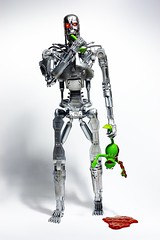
So if you could find a way of using all these processors at once, maybe they’d become magically self-aware in a neural network [2,3,4,5]? Cue ominous Terminator theme tune

References

  1. Jason Fitzpatrick (2011). An interview with Steve Furber Communications of the ACM, 54 (5) DOI: 10.1145/1941487.1941501 (since 2007, numbers have risen to 10 billion in 2008 an another one billion in the first quarter of 2011 alone!)
  2. Steve Furber (2011). Biologically-Inspired Massively-Parallel Architectures: A Reconfigurable Neural Modelling Platform Lecture Notes in Computer Science, 6578 (2) DOI: 10.1007/978-3-642-19475-7_2
  3. Steve Furber, & Steve Temple (2008). Studies in Computational Intelligence Computational Intelligence: A Compendium, 115, 763-796 DOI: 10.1007/978-3-540-78293-3_18
  4. An estimated one million ARM processors give you about 1% of the capacity of the human brain see the details of the Spiking Neural Network Architecture (SpiNNaker) project
  5. James Cameron, et al (1991) Terminator 2: Judgment Day (T2)

[Creative commons licensed picture of Terminator terror by Tasty by cszar]

April 1, 2011

Circular logic is the best type of logic, because it’s circular

Me Fish!One of the great things about logic is there are so many different flavours to choose from. If you thought that logic came in just one flavour (vanilla), then think again. Now, I Am Not A Logician, but I can’t help marvelling at the bewildering array of  logical flavours on offer including, but not limited to:

So if you’ve ever wondered which logic was the “best” kind of logic, then maybe Antonio Cangiano can provide an answer. Antonio recently stated that:

Easy, you see? Circular logic, is logically the best…

References

  1. Lucas Laursen (2009). Computational biology: Biological logic Nature, 462 (7272), 408-410 DOI: 10.1038/462408a
  2. Critical Reasoning for Beginners, Oxford University iTunesU

[Creative Commons licensed circular shot by Hamed Saber]

March 11, 2011

Drop the Digital Dummy!

Pacifier anyone?Here is an experiment to investigate dependence on your “digital dummy”. A digital dummy is any computer, smartphone or other digital device on which you suckle data like a baby. What you need to do is:

  1. Delete all your so-called “social networks” on LinkedIn, Facebook etc. Being sat in front of a computer is distinctly unsociable.
  2. Delete your twitter account.
  3. Don’t bother reading your email (90% of email is useless noise).
  4. Blast your blog into oblivion.
  5. Ignore your feed reader, or “mark all items as read” because if Internet Addiction Disorder (IAD) actually exists and you are a sufferer [1], the currently best known cure is to go cold turkey.

After completing all these steps, wait for at least one week and observe results. Hasn’t it gone quiet?  Is your life any better? Repeat as necessary until sanity returns…

References

  1. Flisher, C. (2010). Getting plugged in: An overview of Internet addiction Journal of Paediatrics and Child Health, 46 (10), 557-559 DOI: 10.1111/j.1440-1754.2010.01879.x

February 10, 2011

Podcast profiles of peculiar and provocative personalities

QuestionsWhat do the following people have in common?

  1. Lady Gaga
  2. Michael Gove
  3. Dilma Rousseff
  4. Prince William
  5. Mark Zuckerberg
  6. Colin Firth
  7. Sayeeda Warsi

If you think you know, leave a comment below. If nobody guesses correctly, the answer will be revealed next week…[update: answer below in the comments]

[Creative commons licensed picture of question mark cufflinks from Tim O’Brien]

January 19, 2011

Animated speeches at the RSA

Filed under: education — Duncan Hull @ 7:51 am
Tags: , , ,

The Royal Society for the encouragement of Arts, Manufactures & Commerce (RSA) has an interesting series of video lectures from “the world’s most inspiring thinkers”. If you haven’t seen them already, they’re worth watching not just for their stimulating content but for the beautifully produced hand-drawn animations. The one below is from Ken Robinson on the purpose of education:

There are a whole series of these along the same lines on the RSA’s YouTube channel. The illustrations are really good (but it doesn’t seem to say anywhere who the artist behind the work is?)

December 22, 2010

Happy Christmas Lectures 2010

Mark Miodownik by Joe Dunckley, on FlickrAs Tom Lehrer once sang on his christmas carol:

“Christmas time is here, by golly,
Disapproval would be folly,
Deck the halls with hunks of holly,
Fill the cup and don’t say ‘when.’
Kill the turkeys, ducks and chickens,
Mix the punch, drag out the Dickens,
Even though the prospect sickens,
Brother, here we go again…”

Which must mean it’s also time for another seasonal tradition: the Royal Institution Christmas lectures. This year they are being given by the materials scientist and engineer Mark Miodownik with the title “Size Matters“. After nearly a decade in the wilderness of More4 and Channel 5 and elsewhere, this year the lectures will be back with the BBC broadcast on the 28th, 29th and 30th December at 8.00pm (also subsequently on iPlayer). Topics this year include:

  1. Why elephants can’t dance (but hamsters can skydive) see “crash test pets” video below.
  2. Why chocolate melts and jet planes don’t – chocolate is “one of the most sophisticated and highly engineered materials on the planet”!
  3. Why mountains are so small (Yes, small) – how rocks behave like liquid.

Mark has a reputation for being an entertaining and passionate [1] speaker, who unlike some previous lecturers – likes to improvise without a script which will probably make for lively and educational viewing.

Where ever you are this winterval, have a happy holiday.

References

  1. Mark Miodownik (2005). Facts not opinions? Developing both the physical and aesthetic properties of materials Nature Materials, 4 (7), 506-508 DOI: 10.1038/nmat1416

[Creative commons licensed picture of Mark Miodownik at the Science is Vital rally earlier this year in London by Joe Dunckley]

December 17, 2010

Planet Facebook

Whatever your views on Facebook [1], you can’t deny that from space, “Planet Facebook” looks rather intriguing. The wonderful diagram below of Facebook connections has been made by Paul Butler. Even miserable Facebook refuseniks (like me) can’t help but go “ooh that’s pretty” while marvelling at the masterful use of the R language to construct this beautiful map…

Planet Facebook / Planet Earth by Paul Butler

References

  1. John H. Tucker (2010). Status update: “I’m so glamorous”. A study of facebook users shows how narcissism and low self-esteem can be interrelated. Scientific American, 303 (5) PMID: 21033279, see also original research by Soraya Mehdizadeh at DOI:10.1089/cyber.2009.0257

December 8, 2010

Science Careers: The Good, the Bad and the Starry

Filed under: education,web of science — Duncan Hull @ 6:03 pm
Tags: , , , , , ,

Mauna Kea SunsetOf all the things you can do with a Science degree, being paid money to stargaze from the top of a volcano in Hawaiʻi has to be one of the more interesting.

Tom Kerr is one such lucky astronomer who has been managing operations at UKIRT (UK infrared telescope) – currently the world’s largest telescope dedicated solely to infrared astronomy [1]. So what is it like working more than 4000 metres* above sea level, near the summit of Mauna Kea on the big Island of Hawaiʻi? Can you imagine filling your days and nights  observing the glorious majesty of the night sky, amazing sunsets and sunrises interspersed with surfing sessions on the beach?

Tom’s blog A Pacific View documents what Hawaiian life can be like. A recent post things I’ll miss (and others I won’t) describes the good, bad and starry parts of astronomy in an exotic location. There is also an accompanying set of rather stunning pictures on Flickr. So if you’ve ever wondered what it’s like to be involved in stargazing for a living, Tom’s blog and photostream tells you more.

References

  1. Song, I., McCombie, J., Kerr, T., & Sarre, P. (2007). The 3.3-μm PAH emission band of the Red Rectangle Monthly Notices of the Royal Astronomical Society, 380 (3), 979-985 DOI: 10.1111/j.1365-2966.2007.12197.x and arXiv:0707.0541
  2. The interwebs is full of blogging astronomers

[Creative Commons image of Mauna Kea Sunset by therefromhere, on Flickr]
*4000 metres is about 14,000 feet in real money…

November 12, 2010

The Infinite Professor Theorem

Filed under: funny — Duncan Hull @ 10:15 pm
Tags: , , , , , , ,

Prof Brian Cox by greyhawk68 on FlickrIf you took an infinite number of Professors, added some comedians, recording studios (instead of typewriters) and got them to record random radio shows you might just end up with a program like the Infinite Monkey Cage.

After a brief break, Physicist Brian Cox (pictured on the right with the sun shining out of his behind) and Robin Ince return for a third series of their phunny physics show which takes a “witty, irreverent look at the world according to science”. The next program will be broadcast Monday 15th November on BBC Radio 4 at 4.30pm and is available as a podcast too. Worth tuning into if you like your science comical, physical and audial.

[Creative Commons licensed picture of Brian Cox by John Roling (greyhawk68)]

« Previous PageNext Page »

Blog at WordPress.com.