O'Really?

February 21, 2008

Biological Complexity

Filed under: sysbio — Duncan Hull @ 11:00 pm
Tags: , , ,

From Molecules to Systems @ UCLDetails of two-day conference titled “Biological Complexity: From Molecules to Systems” at University College London (UCL) in June 2008 have recently been announced. Speakers and topics are described in the link above and also by Martyn Amos on his blog.

Speakers from the UK include: Martyn Amos, Cyrus Chothia, Jasmin Fisher, Mike Hoffman / Ewan Birney, Jaroslav Stark, Michael Sternberg and Perdita Stevens.

Speakers from the Weizmann UK include Nir Friedman, David Harel, Shmuel Pietrokovski, Gideon Schreiber, Eran Segal, Ehud Shapiro and Yoav Soen

February 8, 2008

Video Killed The Webbio Star

Filed under: video — Duncan Hull @ 6:18 pm
Tags: , , ,

We can’t rewind we’ve gone too far.

Video Killed The Webbio Star…

January 18, 2008

One Thousand Databases High (and rising)

StampsWell it’s that time of year again. The 15th annual stamp collecting edition of the journal Nucleic Acids Research (NAR), also known as the 2008 Database issue [1], was published earlier this week. This year there are 1078 databases listed in the collection, 110 more than the previous one (see Figure 1). As we pass the one thousand databases mark (1kDB) I wonder, what proportion of the data in these databases will never be used?

R.I.P. Biological Data?

It seems highly likely that lots of this data is stored in what Usama Fayyad at Yahoo! Research! Laboratories! calls data tombs [2], because as he puts it:

“Our ability to capture and store data has far outpaced our ability to process and utilise it. This growing challenge has produced a phenomenon we call the data tombs, or data stores that are effectively write-only; data is deposited to merely rest in peace, since in all likelihood it will never be accessed again.”

Like last year, lets illustrate the growth with an obligatory graph, see Figure 1.

Figure 1: Data growth: the ability to capture and store biological data has far outpaced our ability to understand it. Vertical axis is number of databases listed in Nucleic Acids Research [1], Horizontal axis is the year. (Picture drawn with Google Charts API which is OK but as Alf points out, doesn’t do error bars yet).

Another day, another dollar database

Does it matter that large quantities of this data will probably never be used? How could you find out, how much and which data was “write-only”? Will Biologists ever catch up with the physicists when it comes to Very Large stamp collections Databases? Biological databases are pretty big, but can you imagine handling up to 1,500 megabytes of data per second for ten years as the Physicists will soon be doing? You can already hear the (arrogant?) Physicists taunting the Biologists, “my database is bigger than yours”. So there.

Whichever of these databases you are using, happy data mining in 2008. If you are lucky, the data tombs you are working will contain hidden treasure that will make you famous and/or rich. Maybe. Any stamp collector will tell you, some stamps can become very valuable. There’s Gold in them there hills databases you know…

  1. Galperin, M. Y. (2007). The molecular biology database collection: 2008 update. Nucleic Acids Research, Vol. 36, Database issue, pages D2-D4. DOI:10.1093/nar/gkm1037
  2. Fayyad, U. and Uthurusamy, R. (2002). Evolving data into mining solutions for insights. Communications of the ACM, 45(8):28-31. DOI:10.1145/545151.545174
  3. This post originally published on nodalpoint (with comments)
  4. Stamp collectors picture, top right, thanks to daxiang stef / stef yau

January 15, 2008

Who’s the Daddy? PCR…

Filed under: biotech,omics — Duncan Hull @ 1:04 pm
Tags: , , , , ,

PCR, When you need to know who the Daddy is ♫ …

♫ There was a time when to amplify DNA,

You had to grow tons and tons of tiny cells.

Then along came a guy named Dr. Kary Mullis,

Said you can amplify in vitro just as well.

Just mix your template with a buffer and some primers,

Nucleotides and polymerases, too.

Denaturing, annealing, and extending.

Well it’s amazing what heating and cooling and heating will do.

PCR, when you need to detect mutations.

PCR, when you need to recombine.

PCR, when you need to find out who the daddy is.

PCR, when you need to solve a crime. ♫

(repeat chorus)

When you’ve finished chuckling at that ridiculous viral marketing video, go and Dance Naked in the Mind Field with Kary Mullis. Found via Respectful Insolence: Scientists for better PCR.

December 21, 2007

Blogging: Speakers’ Corner of the Internet

There is a famous place in London town, inside Hyde Park, known as Speakers’ Corner. It is a space where free speech and self-expression prevail. At Speakers’ Corner, anyone can say anything they like about anything they want to anyone who cares to listen. There are some obvious parallels between blogging and Speakers’ Corner as well as one rather striking difference.

If you’ve ever been there, you’ll know Speakers’ Corner is full of circus acts. A quick wander around and you are almost guaranteed to encounter: conspiracy theorists, anarchists, bible salesmen, drunks, religious fundamentalists, pimps, tramps, radicals, punks, politicians, self-promoting exhibitionists, drug addicts, prophets and philosophers. Curiously you don’t often see professional scientists there. Some speakers will talk sense, others will talk nonsense. Either way, a stroll around Speakers’ Corner never fails to entertain, Sunday morning is usually best. Your personal beliefs will probably be challenged and you will almost certainly find someone to strongly dis/agree with. The digital equivalent of Speakers’ Corner is the blogosphere, the bloggers’ corner of the Internet.

Bloggers’ Corner?

There are some obvious similarities between Speakers’ Corner and Bloggers’ Corner. They both involve free speech, entertainment and cheap technology:

Zero cost free speech

At Speakers’ Corner you need is something to stand on, a soapbox or stepladder, anything will do. Speakers also need time, an opinion and plenty of air in their lungs. This is “free” speech in two ways. Firstly, it doesn’t cost anything, so you don’t need money or powerful friends to be a speaker. Secondly, speakers are free to discuss anything they want. The same is true of blogging, all you need is some kind of blogging software and off you go. The hecklers will post their comments if they choose.

Shout, shout, let it all out!
At Speakers’ Corner anyone is free to shout. Speakers, like bloggers, have to entertain, and shout loud, to build an audience and get their voice heard, whichever corner they find themselves in. No sh*t Sherlock!

Not about technology

Speakers’ Corner is not about technology, and neither is blogging. The digital technology that makes blogging possible (news feeds, software, servers etc) is no more interesting than their analogue counterparts: soapboxes and stepladders. Yes, digital soapbox technology is cheap and readily available but to my mind, blogging is not about technology. Well, duh!

One striking difference

As well as all these similarities, there is one striking difference between Speakers’ Corner and the Blogosphere. When you have had enough of the speakers ranting and raving, you can walk away, returning to the relative peace of Hyde Park.

However, on the Internet, bloggers are everywhere not just in the corner of the Internet park. This is partly due to the fact that there are lots more of them, more than 70 million bloggers on the internet by some counts. Consequently, the collective noise bloggers make can be deafening, but it is the unmistakable sound of free speech all over the Internet.

=====================

Since this is my last post for 2007, happy holidays to all readers at nodalpoint. If you’ve read any of my posts here thanks for reading, you’ve been a wonderful audience and thanks again Greg for running the nodalpoint server. While I’m packing up my digital soapbox for the year, may I wish your speech in 2008, wether digital or verbal, to be of the free variety wherever possible. And, if you’ve ever seen a professional scientist talk at Speakers’ Corner, I’d love to hear about it.

[Speakers’ Corner Pictures above by Jim Callender and Cory Doctorow, part of the excellent pictures of Speakrs’ Cornr on Flickr].

December 12, 2007

Mapping the Internet

Internet mapAs of 2007, the Internet is mostly still a wild untamed jungle. Many people have tried to chart the territory, but what should a map of the internet look like?

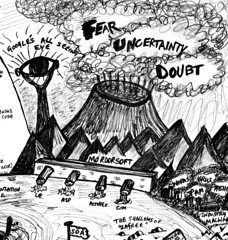
One of my favourite maps is “The Web Is Agreement” by Paul Downey. Paul’s map has a Tolkien-like Lord of the Rings feel to it, so instead of Microsoft we have Mordorsoft. The all seeing eye of Sauron is Google of course, helping search, but raising privacy concerns.

Paul is not the only cartographer busy drawing maps, Randall Munroe has drawn a nifty map based on Internet Protocol (IP) addresses (available as a poster, for hard-core geeks) and an online communities map, shown at the bottom of this post.

If the atoms of the Internet had numbers, you could organise them into a map like the Periodic Table, just as Mendeleev did. Hence we have The Periodic Table of the Internet by Wellington Grey, which uses PageRank (instead of atomic numbers) as a means of charting the Internet.

Periodic Table of the Internet

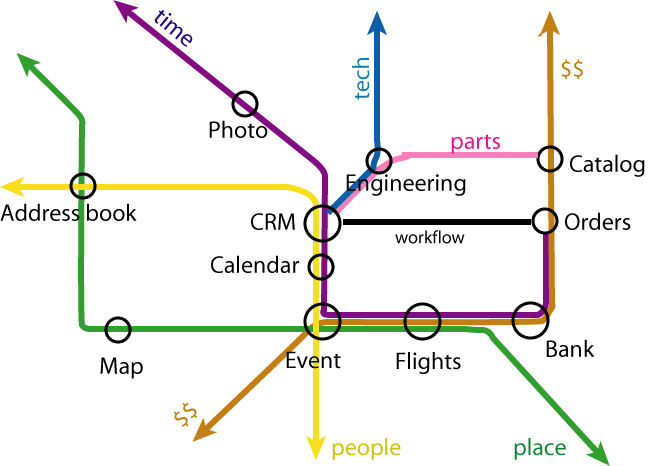
And of course there’s some bloke called Tim who, showing his British roots, often draws more abstract maps that look like the London Underground, shown below.

The map is not the territory but you can learn a hell of a lot by looking at the map before you head into the jungle. Using the map below, you’ll find nodalpoint, down South in the warm “blogipelago“, past the “Gulf of YouTube” below. Bon voyage!

November 30, 2007

Burn semantic Web, Burn!

Taking down A.I. town?

Danger! Religious Wars!The Semantic Web is (quote) “a new form of Web content that is meaningful to computers”. It will “unleash a revolution of new possibilities” using a magical “new” artificially intelligent technology called ontology. So says a much-cited article in Scientific American published back in May 2001. Most people who have read this article, fall into two camps: “believers” and “non-believers”. Let me tell you a short story about a religious war between these two groups…

An Old War Story: Chapter 1

This is a work of fiction, though as they say in Hollywood it is “based on a true story”. Characters names are real.

A crusade of semantic web believers, is started by three people called Jim Hendler, Ora Lassila and Tim Berners-Lee. At the heart of their faith is a holy scripture and a suite of sacred technology called the semantic web stack. If people use this technology, the crusaders believe, the Web would be a better place. Search engines like Google, for example, would be even smarter than they already are, because they would intelligently “know what you mean“, when you type your keywords. All this new magic comes from using good old fashioned logic, metadata and reasoning. Better Search Engines is one of the mantras of the semantic web troops as they pour onto the battlefield towards the promised land. Viva la Webolution! Charge!

A counter-attack is launched by the non-believers of this vision of the future. They rally behind a man called Clay Shirky who roars “the semantic web is doomed” at the top of his voice. Many others echo Shirky’s sentiment, including Peter Norvig, Rob McCool, Cory Doctorow and Tim O’Reilly. General Shirky makes powerful allies in battle, and he has a two-pronged attack. “Ontology is over-rated” he jeers. Led by Shirky, the non-believers capture the sacred technology, add their own firewood and put the torch to it in a very public place. The flames leap into the sky, visible for miles around.

“Burn semantic web, burn!” the non-believers cry as they gleefully dance around the fire.

The battle rages, the believers will not take this heresy lying down. They regroup and surge forward again. Death to the blasphemers! With the help of some biologists, they seek revenge using the Gene Ontology as deadly ammunition. The non-believers are confused by this tactic, they don’t know what genes are and neither do the biologists. Unfortunately, the biologists unwittingly find themselves in the middle of an epic battle they didn’t start. There are ugly skirmishes involving logic and graph theory. Dormant and hideous A.I. monsters are resurrected from their caves, where they spent the A.I. winter. These gruesome monsters make the Balrog beast from Lord of the Rings look like a childrens cuddly toy.

From the relative safety of their command centres, the leaders orchestrating the war look on. Many foot soldiers and PhD students have been slayed on the field of battle, tragic young victims of the holy war. Understandably the crusaders are unhappy. Jim Hendler isn’t pleased as he surveys the carnage and devasation. Ora Lassila is also disappointed.

“We never said that, you completely minsunderstood. You are all burning the wrong thing, using fuel we never gave you. You lied, you cheated, you faked, you changed the stakes!”

There is a lull in battle. But confusion reigns, especially among the innocent civilians and bewildered biologists.

(End of chapter 1)

Epilogue

As of the winter of 2007, the semantic web fire is still burning. While I warm myself next to it, using all the juicy metadata as material for my PhD, it is still too early to predict just how useful the technology is going to be. It doesn’t really matter if you’re a “believer”, a “non-believer” or completely agnostic about the semantic web. The religious war beween the two sides tells you more about human behaviour, than it does about the utility of the technology. Optimists profit from making bold claims to get noticed on the battlefield. Critics are more cynical, furthering their own careers by countering the optimists claims. Other people interpret the interpretations of the cynics second-hand. Thanks to cumulative error, or the Chinese whispers effect, everyone gets really upset. The original optimists vision has been changed in ways they didn’t expect.

It’s a very natural and human story amidst all the “artificial” machine intelligence.

Ora, Jim and Tim have done quite well out of the fighting. Google Scholar reckons their original article has been cited nearly 5000 times. That is a lot of attention, in scientific circles, a veritable blockbuster hit. At the time of writing, not even Albert Einstein can match that, and his ideas are much more important than the semantic web probably ever will be. Many good scientists with important ideas can only dream of publishing a paper that is as heavily cited as that infamous Scientific American article. So which do you think would most scientists prefer:

  • Being internationally known and talked about, but misunderstood by large groups of people?
  • Being relatively unknown, ignored but well understood by a small and obscure group of people?

Neither is ideal but I think in most cases, there is only one thing in the world worse than being talked about, and that is not being talked about.

We have reached the end of chapter 1 of this little story. Wouldn’t it be nice if Chapter 2 was less bloody? Perhaps the two sides could focus more on facts and evidence, rather than the beliefs, opinions, marketing, hype and “visions” that have dominated the battle so far. As the winter solstice approaches and the new year beckons, can we give peace, diplomacy and above all SCIENCE a chance?

The Moral of the Story (so far)

The moral of this old war story is simple. Religions of various kinds have been known to make people commit horrendous and completely unreasonable war crimes. Nobody is innocent. So if you don’t like a fight, steer well clear of religious wars.

Acknowledgements

  1. The “burn” idea comes from Leftfield with John Lydon (1995) Open Up “Burn Hollywood, Burn! Taking down Tinseltown
  2. Thanks to Carole for the idea of using fiction to illustrate science see Carole Goble and Chris Wroe (2005) The Montagues and the Capulets: In fair Genomics, where we lay our scene… Comparative and Functional Genomics 5(8):623-632 DOI:10.1002/cfg.442 seeAlso Shakespearean Genomics: a plague on both your houses)
  3. This post, originally published on nodalpoint

November 6, 2007

What’s The Point of Blogging?

I am a hard bloggin' scientist. Read the Manifesto.
Sometimes I wonder what what the point of blogging is and just how much time people (myself included) waste reading and writing them. Let’s face it, most leading scientists are too damn busy to pay much attention to the blogosphere, especially when it descends (as it frequently does) into “uncontrollable verbal discharge”. This unfortunate medical condition is also known as Blogorrhoea. A free-flowing blog is unlikely to directly increase a scientists productivity (as approximated by the infamous h-index), and might even decrease it. Now, we all know that powerpoint can be PowerPointless, so is blogging also a pointless activity? Or to put it another way: Nodalpoint or Nodalpointless?

If you’ve ever wondered what the point of scientific blogging is, you should read the following, (if you haven’t already):

So what the heck, if blogging is fun and helps you communicate ideas with people, why get all uptight about questionable metrics for measuring scientific productivity? Wherever you blog, blog hard, blog fast and enjoy it. At the very least, it will fill the gaping void left on the Web by traditional scientific publishing. Who knows what the other benefits might be?

References

  1. Jorge Hirsch An index to quantify an individual’s scientific research output Proceedings of the National Academy of Sciences. 2005 November;102(46):16569-16572 DOI:10.1073/pnas.0507655102
  2. this post originally on nodalpoint with comments

October 19, 2007

The Webolution Will Be Televised

The American poet and songwriter Gil Scott-Heron once famously remarked that The Revolution Will Not Be Televised [1]. Science has undergone its own quiet revolution since the invention of the Web back in 1990. This has slowly but surely changed scientific communication, not just a Revolution but a “Webolution” [2] if you like. The recent addition of television to the Web means that, to paraphrase Gil, the Webolution will be televised. You can now watch some of the webolution in science, thanks the likes of JOVE (The Journal Of Visualised Experiments), SciVee.TV, Google Video and YouTube. What are these sites like and is their scientific and technical content any good?

(more…)

October 17, 2007

The Luxuriant Flowing Hair Club for Scientists (LFHCfS)

Filed under: Uncategorized — Duncan Hull @ 9:18 pm
Tags: , , , , , ,


Falk Schuch, Andreas Linsner and Kai Jung
Calling all Scientists, is your hair luxuriant and flowing? Perhaps you’re a bouffant bioinformatician, a hairy hacker or share a lab with somebody who is? If this is you, its high-time you joined the Luxuriant Flowing Hair Club for Scientists.

To propose somebody for membership, send email to Marc Abrahams at Harvard University marca /ate/ chem2.harvard.edu. Your email needs to include evidence of your luxuriant, flowing hair (a photo) and your credentials as a scientist. Some current members have impressive hair, see Simon Gregory, Carlisle Landel and Sterling Paramore for examples. Honorary and historical members include Dr. Brian May (Queen guitarist / astrophysicist), Dimitry Mendleyev and Albert Einstein, “Physicist. Bon vivant. A bold experimentalist with hair”.

So, if you are a scientist with a copius coiffure, ask yourself, will you ever get another chance to be in such distinguished company?

« Previous PageNext Page »

Blog at WordPress.com.