O'Really?

July 11, 2023

Amplifying student voices on employability with audio podcast interviews

How can we get better at listening to student voices to improve teaching and learning in our Universities?

This post summarises a talk I gave at the inaugural ITL Teaching & Learning conference at the Pendulum Hotel in Manchester on July 6th 2023 tackling this question. It describes recording and publishing twelve interviews with undergraduate Computer Science students shown in figure 1 on their personal journey from student to professional. The interviews are available as an audio podcast called Hearing your Future.

Figure 1: Twelve student voices from the last twelve months, interviewed and broadcast in twelve podcast episodes. From top left, Raluca, Jason, Brian, Carmen, Sneha, Alice, Jason, Ivo, Ingy, Nadine, Pedro and Amish. Portraits re-used from LinkedIn and Github with students permission.

According to Stephen Fry, “education is the sum of what students teach each other between lectures and seminars”. A more teacher-centric view of education would claim the opposite to be true, that education is primarily about what teachers teach their students, not what students teach other. Here’s how this old-school, chalk-and-talk view of education works: In lectures, seminars, labs and tutorials, teachers share their knowledge and expertise with students. While the Professors profess their monologues, the lecturers lecture, the educators educate, the teachers teach and the students study. Learners learn by watching, listening, reading and acting on the voices of their educators. Students are then examined, grades are given and that, in a nutshell, should be what the sum of education is. No?

The reality of course, is that education should be much more of a dialogue, a two-way conversation between students and teachers, rather than an expert-driven monologue to a passive audience. Both sides of this conversation need to be heard and in some cases, the student voices in these conversations can make valuable contributions, by co-creating curricula.

All too often the student voice gets drowned out in the busy noise of pedagogy. The demands of teaching in higher education mean that staff don’t always sufficient time and resources to listen, especially when teaching classes of hundreds of students with many ongoing conversations. In this blog post, I’ll explain how you can amplify some important student voices in these conversations using audio podcasting. I’ll describe some of the costs and benefits of recording and publishing these conversations so that more people can hear and learn from these voices, not just students but their employers and their educators too.

Student voices on employability

Student voices are particularly important when it comes to employability: enabling undergraduates to develop the professional skills that are essential to the workplace. I’ve been teaching professional skills and employability to Computer Science students for the last ten years at the University of Manchester. During this time, I’ve learned that there are many different voices and opinions that need to be heard. Which of these voices, written or spoken, do students pay attention to most? Is it:

  • ❌ The voices of their employability tutors?
  • ❌ The voices of their Professors and lecturers?
  • ❌ The voices of their careers service consultants and advisors?
  • ❌ The voices of employers and alumni?
  • ❌ The voices of their friends and family?

These voices all have their own influence, but in my experience, there’s one voice that is listened to above all others when it comes to employability and that is:

  • ✅ The voices of their fellow students

So, one way to improve teaching and learning, is to maximise opportunities for students to learn from each other through peer learning and peer instruction. To do this, educators need to create more and better spaces for students to talk about their learning with each other and then amplify their voices.

There are lots of different ways to do this, but one of the most important is through Peer Assisted Study Sessions (PASS) at peersupport.manchester.ac.uk. These sessions allow more experienced students to pass on their knowledge to their less experienced, usually younger, peers. For example, the PASS scheme in Computer Science shown in figure 2, is run by my colleague Thomas Carroll. There is a focus on passing exams, but PASS is about much more than just improving students grades. It’s about students learning from and teaching each other as part of a student-led community.

Figure 2: Peer Assisted Study Sessions (PASS) allow more experienced students pass on their knowledge to their less experienced peers. First years have PASS1 (in yellow), run by second and third year students. Second years have PASS2 (in green), where students returning from internships and placements share their knowledge about job hunting and interviews. PASS3+ (in pink) is where our alumni can get involved. CC-BY-SA picture by yours truly

As well as helping students to pass academic exams, our PASS scheme also helps students to pass employers “exams”. This includes written exams such as job applications and oral exams such as interviews. This is a significant part of PASS2, where students returning from placements and internships share what they have learned with first and second year students.

Students are encouraged to take part in PASS, either as leaders, facilitators or participants, but the kinds of conversations that take place during these sessions often need to be amplified for those that aren’t in the room where it happens.

Over the last 12 months, I’ve been experimenting with using audio podcasts to record and publish some of these conversations as stories so they can heard by a wider audience. I’m calling them audio podcasts here to distinguish them from the video podcasts (lecture capture and catchup) you will find at mypodcasts.manchester.ac.uk. You can subscribe and listen to audio podcasts wherever you get your podcasts, details at the end of this post.

Essential podcast ingredients

Channelling my inner Lauren Laverne and Jim Al-Khalili, the podcast is a cross between the BBC shows Desert Island Discs and The Life Scientific. The resulting show is called Hearing your Future, shown in figure 3, because it is part of an undergraduate course and guidebook called Coding your Future aimed at all students of computing.

Figure 3: The Hearing your Future podcast is a cross between Desert Island Discs hosted by Lauren Laverne and The Life Scientific hosted by Jim Al-Khalili. Subscribe and listen wherever you get your podcasts. CC-BY-SA Portrait of Lauren Laverne by Jwslubbock on Wikimedia Commons w.wiki/6z4z, CC-BY-SA portrait of Jim Al-Khalili by Debbie Rowe at the Royal Society on Wikimedia Commons w.wiki/_w2fh, CC-BY-ND Hearing your Future artwork by Visual Thinkery.

The essential ingredients of this podcast are:

  1. Students: both graduands ready to graduate and recent graduates at the start of their career. Twelve students have been interviewed so far, with more episodes planned for the future.
  2. A decent microphone, see figure 4.
  3. Audio editing software, I’m using a free application called GarageBand apple.com/mac/garageband
  4. An audio podcast host, I’m using one called liberated syndication at libsyn.com
  5. Some open ended questions for students to answer
Figure 4: Any investment you make in recording technology will pay you back with higher-fidelity audio. This particular microphone, a Zoom H5, is handy because it can be used in a portable battery-powered mode or connected to a computer via USB. CC-BY-SA picture by yours truly.

The open-ended questions are key because I need to let students do most of the talking, acting as much more of a listener than a speaker. Think less Professor Monologue, the egocentric “sage-on-the-stage” who loves the sound of their own voice and more Professor Dialogue, the “guide-on-the-side” who facilitates discussion. [1] It sometimes takes effort for academics to suppress their public speaking instincts by talking less and listening more to what students have to say. Students are given five questions before the interview, with questions designed to encourage difficult conversations being optional. The five basic questions are:

  1. 🎸 What’s your story, (coding glory)?
  2. ✊🏽 Minority report (optional)
  3. 👑 You are the next vice chancellor (optional)
  4. 🍿 One tune, one book, one podast, one film
  5. ⏱ Time traveller, advice to your former self

Question one asks students to tell their story from why they studied computer science in the first place to where they are now. What obstacles have they faced in finding work and how did they overcome them? What has been their journey from student in year one to professional in year three or four? Every student has a different story to tell.

Question two asks students to reflect on their experience if they identify as a member of a minority group. What can employers and universities do to make campuses and workplaces more welcoming to members of their minority group? What has been their experience of being female, black, disabled or otherwise marginalised in computing? What can we do to make campuses more equal, diverse and inclusive spaces?

Question three asks students to imagine they are the next vice chancellor of the University of Manchester. Now that they are responsible for over 10,000 staff, 40,000 students and half a million alumni, what would they do to improve teaching and learning?

Question four is a personal one: students recommend a tune, a book, a podcast and a film and outline why these are important to them. Why do they recommend other students should watch, listen to or read them? This is the Desert Island Discs part, except we don’t cast students away to a remote island afterwards. It adds a personal touch to the stories students tell.

Finally, question five is another hypothetical one: given a time machine, if they could travel back to meet themselves in first year, what advice would they offer their former selves and fellow students about getting the most out of all the time and money they’ve invested in their University education?

I ask these simple, open-ended questions, sit back and enjoy listening to students answer them.

Everything I had to know, I heard it on my radio

As with radio broadcasting, there are costs and benefits of podcasting. The main cost is the time it takes to record, transcribe and edit each episode. Each interview takes an hour to record, more than an hour to transcribe and less than an hour to edit. These costs are relatively small, when you compare them to the cost of preparing a lecture (video lecture or live lecture), delivering a seminar, running a lab or facilitating a tutorial.

There are many benefits that this investment in podcasting buys. From a teaching point of view, I’ve learnt more about the harsh realities of job hunting faced by Generation Z. It also gives me seriously useful content in the form of case studies. So when I’m talking to students about the need for resilience in their job search I can tell Brian’s story, about finding a placement very late in the year (August) on LinkedIn. Don’t give up, it worked for Brian, maybe it will work for you too.

When discussing the importance of starting early, in first year, I can tell Alice’s story about how spring insights in her first year gave her some valuable experience to help her subsequent job applications stand out in second year and beyond. Start early, it worked for Alice, maybe it will work for you.

When discussing the inevitable rejection that comes with job applications, I can tell Amish’s story about being rejected by all five big tech companies (Microsoft, Google, Apple, Facebook and Amazon) before landing a role he enjoyed with Bloomberg. Learn to live with rejection, it’s a normal part of job hunting but it will most likely work out for you in the end.

When talking about not overlooking smaller employers, I can tell Raluca’s story about how she worked for a local company called Koder.ly in Oldham at the end of her first year, then moved onto CERN for her placement year and subsequent graduate role. You can start small, think big and remember that experience matters.

When discussing the importance of networking, I can tell Jonathan’s story about how he grew his professional network and found hidden vacancies by attending local tech meetups in Manchester. It’s not just what you know, it’s who you know.

These are just five short stories, from the twelve longer stories that students have shared with me. Recording them as podcasts has enabled me to amplify the student voice for more people to hear.

Another benefit of the podcast is, it has strengthened our community of students, alumni and employers. With permission, students have shared their LinkedIn profiles to facilitate digital networking. This means that students can find out about and connect with peers they might never otherwise have spoken to. It has also helped staff and employers understand better what challenges students face in an increasingly competitive job market.

So, what started as an experimental side project, has now become a key part of my teaching toolkit. It’s also has been rewarding to listen to and record students stories in an audio podcast format.

Conclusions: a good face for radio?

Podcasting is a low cost tool with many benefits for teachers and learners alike. Audio is fantastic medium for recording conversations and stories, especially if (like me), you have a “good face for radio”. [2] Most students are much more comfortable talking to a microphone than a video camera, because having a natter over a brew is a very natural format. Podcasting forces me to spend more time thinking about dialogue and less time making flashy animations and graphically-driven PowerPoint monologues. In this case, it’s enabled me to focus on what students are teaching other, rather than what I think they need to learn, so I can improve the Intended Learning Outcomes (ILOs) for my courses.

The student voices I’ve chosen to amplify have been deliberately “cherry picked” so I can’t pretend that their voices are representative of the entire study body. However, recording a few key voices documents how students learn professional skills for the workplace in a way that other students can learn from. A lot of higher education focuses on a narrow set of academic and technical skills, alongside fundamental knowledge. These are important, but a rounded education should develop a much broader set of softer personal and social skills that are just as important to talk about and recognise as the hard technical skills. Education is the sum of all these skills and knowledge, students play as important a role in teaching each other as their teachers do, shown in figure 5.

In the future, I plan to keep recording and broadcasting student voices to broaden the set of interviewees to include alumni who graduated further back in time. I welcome any comments on how these interviews can be improved in the future. Subscribe and listen wherever you get your podcasts:

As Stephen Fry points out, students play a crucial and often overlooked role in the education of their peers. Their voices need to be heard by a wider audience, not just their fellow students but their employers and educators too. Audio podcasting is a good way to amplify their voices. If you are a former student of Computer Science at the University of Manchester and would like to amplify your story about your personal journey from student to professional (and beyond), get in touch.

Figure 5: What is education the sum of? What students teach each other! Fry describes his student-centred view of education in The Fry Chronicles. [3] Public domain portrait of Stephen Fry by the US Embassy in London w.wiki/4wrn adapted using the Wikipedia App

References

  1. King, Alison (1993) From Sage on the Stage to Guide on the Side, College Teaching, Vol. 41, No. 1 , pp. 30-35, DOI: 10.1080/87567555.1993.9926781
  2. Mair, Eddie (2017) A Good Face for Radio: Confessions of a Radio Head Little Brown publishing , ISBN:9781408710678
  3. Fry, Stephen (2010) The Fry Chronicles Penguin books, ISBN:0718157915
A video of the presentation given at the #ITLConf23 conference in Manchester at the Pendulum Hotel, 6th July 2023, see doi.org/kk47 (Please excuse the audio errors and background noise in this recording, artefacts created by the software and microphone which I’m still learning to configure properly)

Acknowledgements

Thanks to all the students shown in figure 1 who took the time to tell me their stories: Raluca Cruceru, Jason Ozuzu, Brian Yim Tam, Carmen Faura Práxedes, Sneha Kandane, Alice Păcuraru, Jonathan Cowling, Ivo Iliev, Ingy Abdelhalim, Nadine Abdelhalim, Amish Shah & Pedro Sousa.

Thanks also to all the employers who’ve hosted these students as interns, placement students and graduates where they’ve learned professional skills that would be impossible to develop in a purely academic environment. These include Amazon Web Services aws.com, arm.com, home.barclays, home.cern, disney.com, disneyplus.com, equalexperts.com, Google, imago.cs.manchester.ac.uk (our student software company led by Suzanne Embury), infinityworks.com (part of Accenture), koder.ly, matillion.com, moneysupermarket.com, morganstanley.com, nomura.com, palantir.com, publicissapient.com, recursiveai.co.jp, thg.com and wise.com.

Thanks Jez Lloyd for getting me into podcasting with the CS@Manchester podcast.

Thanks to Thomas Carroll and Andrea Schalk who are responsible for current and previous incarnations of our PASS scheme in Computer Science. studentnet.cs.manchester.ac.uk/ugt/pass

Thanks Judy Williams, Jennie Blake, Hannah Cobb, Holly Dewsnip-Lloyd, Lisa McDonagh, Freya Corrywright, Beth Rotherham, Emma Sanders, Patricia Clift Martin and everyone at the Institute for Teaching and Learning (ITL) for organising the conference where this talk was first presented.

I look forward to an even bigger and better ITL conference in 2024!
September 19, 2022

Mind the gap at the end of the Elizabethan line

Elizabeth Line roundel by Transport for London via Wikimedia Commons w.wiki/5iib

So we’ve finally reached the end of the Elizabethan line. Not the the CrossRail route that straddles London but the seventy year reign of Elizabeth II from 1952 to 2022. Like many, I have mixed feelings about our monarch and monarchy but the history of the last seventy years should fascinate republicans, royalists and anarchists alike. So here are some historical facts about the start of the Elizabethan line for your amusement:

  • 🇬🇧 In 1952 Princess Elizabeth Alexandra Mary of York became Queen Elizabeth II en.wikipedia.org/wiki/Elizabeth_II
  • 🇪🇺 In 1952 The European Economic Community (EEC), precursor to the European Union (EU), did not exist. That came five years later in 1957, see en.wikipedia.org/wiki/European_Economic_Community
  • 🏳️‍🌈 In 1952 Alan Turing was working on two new areas of research he’d recently pioneered called “Computer Science” and “Artificial Intelligence” (AI). The very same year Turing was prosecuted for being homosexual which was shamefully labelled “gross indecency” and illegal at that time. He tragically committed suicide two years later in 1954 after being chemically castrated by the government of the UK. Her Majesty’s Government was led at the time by some bloke called Winston Churchill, see en.wikipedia.org/wiki/Gross_indecency
  • 🇺🇸 In 1952 The England National Football Team were recovering from their debut appearance in a FIFA World Cup two years previously. In a pattern that is now familiar, England failed to make it through to the final stages of the 1950 tournament in Brazil after beating Chile but losing to both Spain and the United States, see en.wikipedia.org/wiki/United_States_v_England_(1950_FIFA_World_Cup)
  • 🎼 In 1952 Alan Turing and Christopher Strachey had recently finished experimenting with creating the worlds first computer generated music, to accompany the worlds first computer game (draughts aka checkers), you can listen to the music they made (a tune you may have heard of called God Save The King) on a Ferranti Mark I computer in Manchester at blogs.bl.uk/sound-and-vision/2016/09/restoring-the-first-recording-of-computer-music.html
  • ⚛ In 1952, Geneva was selected as the site for the Organisation Européenne pour la Recherche Nucléaire (CERN), the vast network of underground tunnels and machines that can be found there now were just an idea seventy years ago see home.cern/about/who-we-are/our-history

It’s easy to view the events of the 1950s as ancient history and evidence of how far we have travelled down the Elizabethan line. However in 1952, when Elizabeth was 26 years old, her son Charles was 4 years old, Alan Turing was 40 and Winston Churchill was 78. So the history is not that ancient, especially if you’re an octogenarian or a nonagenarian.

Yes it is a long time ago, but it is almost within living memory. Almost.

Mind the Gaps

What a remarkable seventy years of history, so much has happened in a relatively short period of time. At the end of the journey, it feels like there’s a big gap at the end of the Elizabethan line as we search for our connection and onward destination. Not just one gap but lots of gaps:

  • The gaps between wealthy elites and everybody else
  • The gaps between those educated privately (including the royal family) and the other 93%
  • The gaps between London at the rest of the United Kingdom
  • The gaps between the UK and the rest of the world
  • The gaps between expectations and reality
  • The gaps between historical memories and the present day
  • The gaps between the Elizabethan line and the Carolean line

I wonder where we will be after another gap of seventy years, if the human race is here at all in the year 2092?

As the station announcers often warn as you disembark on the London Underground, mind the gap.

February 15, 2022

Where have all the women gone?

Public domain image of Margaret Hamilton standing next to a print out of software that she and her MIT team produced for the Apollo Guidance Computer in 1969 via Wikimedia Commons w.wiki/4mXY

Computing is too important to be left to men, but where have all the women gone? While women continue to play a key role in computing they are currently under-represented in Computer Science. How can we change this and what evidence is there for practices that get more women into computing? We discussed this paper by Briana Morrison et al [1] on Monday 7th February at journal club. Here is the abstract of the paper:

Computing has, for many years, been one of the least demographically diverse STEM fields, particularly in terms of women’s participation. The last decade has seen a proliferation of research exploring new teaching techniques and their effect on the retention of students who have historically been excluded from computing. This research suggests interventions and practices that can affect the inclusiveness of the computer science classroom and potentially improve learning outcomes for all students. But research needs to be translated into practice, and practices need to be taken up in real classrooms. The current paper reports on the results of a focused systematic “state-of-the-art” review of recent empirical studies of teaching practices that have some explicit test of the impact on women in computing. Using the NCWIT Engagement Practices Framework as a means of organisation, we summarise this research, outline the practices that have the most empirical support, and suggest where additional research is needed.

There is lot of stuff in this paper, and we barely scratched the surface. Personally, one of the things I found useful was the National Center for Women in Technology (NCWIT) Engaging Practices Framework which I’d not seen. These have advice on how to make computing a more inclusive subject for all students, not just women. Some of the guidelines include:

  1. Make it matter (e.g. by making interdisciplinary connections and addressing misconceptions)
  2. Build student confidence and professional identity (e.g. by encouraging a growth mindset)
  3. Grow an inclusive community (e.g. by using well-structured collaborative learning and avoiding stereotypes)

The evidence for which approaches work isn’t particularly strong, see Jane Waites lightning talk slides, but there is some evidence to suggest these practices can help to make small steps in the right direction. The evidence is outlined in the paper.

References

  1. Briana B. Morrison, Beth A. Quinn, Steven Bradley, Kevin Buffardi, Brian Harrington, Helen H. Hu, Maria Kallia, Fiona McNeill, Oluwakemi Ola, Miranda Parker, Jennifer Rosato and Jane Waite (2021) Evidence for Teaching Practices that Broaden Participation for Women in Computing in Proceedings of the 2021 Working Group Reports on Innovation and Technology in Computer Science Education DOI:10.1145/3502870.3506568

September 10, 2021

On this day, twenty years ago, 10th September 2001

The World Trade Center, New York in 2001, public domain image via Wikimedia Commons w.wiki/_z323

On this day twenty years ago, September 10th 2001, the following things did not exist:

  • Euro coins and banknotes; real physical €uro currency was released the following year in January 2002 [1]
  • The iPhone, iPad, iPod, iOS, smartphones and tablets. A new device called the “iPod” was released the following month in October 2001, swiftly followed by a tsunami of mobile devices and iThings. [2]
  • YouTube, Facebook, Twitter, Instagram, LinkedIn, WhatsApp, TikTok and indeed any form of social media. Do you sometimes wish we could go back to a world without social media? Oh Happy days!
  • Deadly viruses such as SARSMERS and SARS‑CoV‑2, the cause of the COVID-19 pandemic
  • Any kind of usable videotelephony service for the masses: Skype, Zoom, FaceTime, Teams, Whatever…

On this day twenty years ago, September 10th 2001, the following events were yet to take place:

On this day twenty years ago, September 10th 2001, the global average temperature was about ~0.5°C lower and the following things did exist in a significantly cooler global climate:

(As predicted, software has eaten the world, or at least it has taken a very big bite of our communication and commerce)

On this day twenty years ago, September 10th 2001, trillions of dollars were about to be spent fighting wars in which:

  • Thousands of civilians on all sides were killed
  • Thousands of combatants on all sides were killed

(May they rest in peace)

My ticket to the observation deck 09/01/93

On this day twenty years ago, September 10th 2001, the western world was a very different place. Did a lot more happen in the last twenty years (2001—2021), than in the preceding twenty years (1981—2001)? In retrospect, do the eighties and nineties look relatively uneventful when compared to the noughties and the teenies? As the globe warms and our climate changes, is politics getting hotter too?

  • Perhaps humanity is accelerating like never before? OR
  • Perhaps it’s just that life seems to speed up as you get older? OR
  • Perhaps we were just too young and not paying enough attention back then?

References

  1. Anon (2002) New Euro banknotes and coins introduced in 12 countriesEuropean Central Bank, Brussels
  2. Alicia Awbrey and Natalie Sequeira (2001) Apple Presents iPod: Ultra-Portable MP3 Music Player Puts 1,000 Songs in Your PocketApple Inc, Cupertino, California
  3. Simon Bowers (2001) Google hits on profit formulaThe Guardian, London

September 6, 2021

Join us to discuss why computing students should contribute to open source software projects on Mon 6th September at 2pm BST

unlocked padlock by flaticon.com

Why should students bother with open source software? Join us to discuss why via a viewpoint piece published by Diomidis Spinellis of Athens University and Delft University of Technology published in the July issue of Communications of the Association for Computing Machinery. [1] Here’s the introduction 

Learning to program is—for many practical, historical, as well as some vacuous reasons—a rite of passage in probably all computer science, informatics, software engineering, and computer engineering courses. For many decades, this skill would reliably set computing graduates apart from their peers in other disciplines. In this Viewpoint, I argue that in the 21st century programming proficiency on its own is neither representative of the skills that the marketplace requires from computing graduates, nor does it offer the strong vocational qualifications it once did. Accordingly, I propose that computing students should be encouraged to contribute code to open source software projects through their curricular activities. I have been practicing and honing this approach for more than 15 years in a software engineering course where open source contributions are an assessed compulsory requirement. Based on this experience, I explain why the ability to make such contributions is the modern generalization of coding skills acquisition, outline what students can learn from such activities, describe how an open source contribution exercise is embedded in the course, and conclude with practices that have underpinned the assignment’s success

All welcome, as usual, we’ll be meeting on Zoom see sigcse.cs.manchester.ac.uk/join-us for details.

References

  1. Spinellis, Diomidis (2021). “Why computing students should contribute to open source software projects”. Communications of the ACM64 (7): 36–38. DOI:10.1145/3437254

July 7, 2021

Would YOU want to live in Alan Turing’s house?

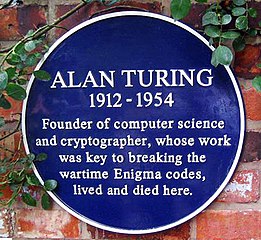
The blue plaque on Alan Turing’s house, commemorating his work in cryptography which founded both Computer Science and Artificial Intelligence as new disciplines. Picture by Joseph Birr-Pixton on Wikimedia Commons w.wiki/3aYW

The house where Computer Scientist Alan Turing spent his final years is currently up for sale. The estate agent describes the property on 43 Adlington Road, Wilmslow as a Victorian family residence of significant historical importance. Wilmslow and the surrounding Cheshire countryside is popular with Manchester commuters, including many Man United, Man City & England football stars. Even if you could afford its premier league price tag, would YOU want to live in the house where Turing’s life ended so tragically? 

Turing was found dead at this house, on the 8th June 1954 by his cleaner. The cause of his death the previous day was established as cyanide poisoning. He was just 41 years old. When his body was discovered, an apple lay half-eaten by his bedside. 

The coroner recorded a verdict of suicide.

At the end of his life Turing was suffering mentally and physically. The homophobic British authorities were using a form of legalised torture, known as forced chemical castration, to punish him for being homosexual. At the time, homosexuality was a crime. Turing put on a brave face and joked about his castration (“I’m growing breasts!), but it must have been horrible to endure.

If you’re feeling suicidal or tortured, you don’t have to struggle with difficult feelings alone. If you’re suffering from emotional distress or struggling to cope a Samaritan can face your problems with you. Whatever you’re going through, samaritans.org are available 24 hours a day, 365 days a year. They respond to around 10,000 calls for help every day. No judgement. No pressure. Call them free any time, from any phone on 116 123.

While everyone can have a good old nosey at Turing’s house through the estate agents window, no-one needs to suffer like its famous former resident did. Personally I think I’d find this property an enigmatically haunted house to live in, knowing that this was the place where a great man’s life ended in such tragedy. How about you?

Turing’s House: Copper Folly, 43 Adlington Road, Wilmslow, Cheshire, SK9 2BJ

  1. Rightmove details www.rightmove.co.uk/properties/109329428
  2. Savills.com details in a single pdf file bit.ly/alan-turings-house
  3. Turing’s house in Google maps goo.gl/maps/krMM3A2JfgTUVFfm8
  4. GCSE computing: Alan Turing: Creator of modern computing bbc.co.uk/teach/alan-turing-creator-of-modern-computing/zhwp7nb
  5. Alan Turing’s Manchester by Jonathan Swinton describes what it was like to make new friends and lovers in the smog-bound, bombed-out city of Manchester from 1948 to 1954 manturing.net
  6. Leslie Ann Goldberg, Simon Schaffer and Andrew Hodges discuss Turing’s ideas and life with Melvyn Bragg https://www.bbc.co.uk/programmes/m000ncmw
  7. Breast enlargement in men undergoing chemical castration https://en.wikipedia.org/wiki/Gynecomastia

Acknowledgements

Thanks to Alan O’Donohoe for spotting Turing’s house on the market and to Joseph Birr-Pixton for publishing his picture of Turing’s blue plaque on Wikimedia Commons.

February 24, 2021

Join us to discuss teaching social responsibility and justice in Computer Science on Monday 1st March at 2pm GMT

Scales of justice icon made by monkik from flaticon.com

With great power comes great responsibility. [1] Given their growing power in the twenty-first century, computer scientists have a duty to society to use that power responsibly and justly. How can we teach this kind of social responsibility and ethics to engineering students? Join us to discuss teaching social justice in computer science via a paper by Rodrigo Ferreira and Moshe Vardi at Rice University in Houston, Texas published in the sigcse2021.sigcse.org conference [2]. From the abstract of the preprint:

As ethical questions around the development of contemporary computer technologies have become an increasing point of public and political concern, computer science departments in universities around the world have placed renewed emphasis on tech ethics undergraduate classes as a means to educate students on the large scale social implications of their actions. Committed to the idea that tech ethics is an essential part of the undergraduate computer science educational curriculum, at Rice University this year we piloted a redesigned version of our Ethics and Accountability in Computer Science class. This effort represents our first attempt at implementing a “deep” tech ethics approach to the course.

Incorporating elements from philosophy of technology, critical media theory, and science and technology studies, we encouraged students to learn not only ethics in a “shallow” sense, examining abstract principles or values to determine right and wrong, but rather looking at a series of “deeper” questions more closely related to present issues of social justice and relying on a structural understanding of these problems to develop potential socio-technical solutions. In this article, we report on our implementation of this redesigned approach. We describe in detail the rationale and strategy for implementing this approach, present key elements of the redesigned syllabus, and discuss final student reflections and course evaluations. To conclude, we examine course achievements, limitations, and lessons learned toward the future, particularly in regard to the number escalating social protests and issues involving Covid-19.

This paper got me thinking:

Houston, we’ve had your problem!

After paging the authors in Houston with the message above there was initial radio silence.

Beep - beep - beep [white noise] Beep - beep - beep...

Hello Manchester, this is Houston, Can we join you?

So we’re delighted to be joined LIVE by the authors of the paper Rodrigo Ferreira and Moshe Vardi from Houston, Texas. They’ll give a lightning talk outlining the paper before we discuss it together in smaller break out groups.

Their paper describes a problem everyone in the world has had in teaching ethics in Computer Science recently. How can we make computing more ethical?

All welcome. As usual, we’ll be meeting on zoom, see sigcse.cs.manchester.ac.uk/join-us for details.

References

  1. Spider-Man (1962) https://en.wikipedia.org/wiki/With_great_power_comes_great_responsibility
  2. Rodrigo Ferreira and Moshe Vardi (2021) Deep Tech Ethics An Approach to Teaching Social Justice in Computer Science in Proceedings of the 52nd ACM Technical Symposium on Computer Science Education (SIGCSE ’21), March 13–20, 2021, Virtual Event, USA. ACM, New York, NY, USA. DOI:10.1145/3408877.3432449
  3. Jack Swigert (1970) https://en.wikipedia.org/wiki/Houston,_we_have_a_problem

September 17, 2020

Join us to discuss learning git on Monday 5th October at 2pm

The use of git is widespread in software engineering, however many novices struggle to get to grips with its complex distributed information model, challenging command line syntax and leaky abstractions. To investigate these pitfalls, we’ll be talking about a paper published by Santiago Perez De Rosso and Daniel Jackson on Purposes, Concepts, Misfits, and a Redesign of Git at OOPSLA. [1] From the abstract:

Git is a widely used version control system that is powerful but complicated. Its complexity may not be an inevitable consequence of its power but rather evidence of flaws in its design. To explore this hypothesis, we analysed the design of Git using a theory that identifies concepts, purposes, and misfits. Some well-known difficulties with Git are described, and explained as misfits in which underlying concepts fail to meet their intended purpose. Based on this analysis, we designed a reworking of Git (called Gitless) that attempts to remedy these flaws.

To correlate misfits with issues reported by users, we conducted a study of Stack Overflow questions. And to determine whether users experienced fewer complications using Gitless in place of Git, we conducted a small user study. Results suggest our approach can be profitable in identifying, analysing, and fixing design problems.

Details of the zoom meeting have been posted on our slack workspace, see sigcse.cs.manchester.ac.uk/join-us for further information. Thanks to Juha Sorva at Aalto University for recommending this paper. The Git logo by Jason Long at git-scm.com/downloads/logos is licensed under a Creative Commons Attribution 3.0 Unported License.

Journal club dates for your diary

We’ll be meeting on the first Monday of every month throughout autumn, so if you’d like to join us next month or a subsequent month, add these journal club dates to your diary:

  • Monday 5th October at 2pm
  • Monday 2nd November at 2pm
  • Monday 7th December at 2pm

References

  1. Santiago Perez De Rosso and Daniel Jackson (2016) Purposes, Concepts, Misfits, and a Redesign of Git in Proceedings of the 2016 ACM SIGPLAN International Conference on Object-Oriented Programming, Systems, Languages, and Applications, (OOPSLA), pages 292–310 DOI: 10.1145/2983990.2984018

July 27, 2020

Join us to discuss how video production affects student engagement Monday 3rd August at 11am

The MOOC! the movie image by Giulia Forsythe image published CC-BY-NC-SA

As Universities transition to online teaching during the global coronavirus pandemic, there’s increasing interest in the use of pre-recorded videos to replace traditional lectures in higher education. Join us to discuss how video production affects student engagement, based on a paper published by Philip Guo at the University of California, San Deigo (UCSD) from the Learning at Scale conference on How video production affects student engagement: an empirical study of MOOC videos. (MOOC stands for Massive Open Online Course). [1] Here is the abstract:

Videos are a widely-used kind of resource for online learning. This paper presents an empirical study of how video production decisions affect student engagement in online educational videos. To our knowledge, ours is the largest-scale study of video engagement to date, using data from 6.9 million video watching sessions across four courses on the edX MOOC platform. We measure engagement by how long students are watching each video, and whether they attempt to answer post-video assessment problems.

Our main findings are that shorter videos are much more engaging, that informal talking-head videos are more engaging, that Khan-style tablet drawings are more engaging, that even high-quality pre-recorded classroom lectures might not make for engaging online videos, and that students engage differently with lecture and tutorial videos.

Based upon these quantitative findings and qualitative insights from interviews with edX staff, we developed a set of recommendations to help instructors and video producers take better advantage of the online video format. Finally, to enable researchers to reproduce and build upon our findings, we have made our anonymized video watching data set and analysis scripts public. To our knowledge, ours is one of the first public data sets on MOOC resource usage.

Details of the zoom meeting will be posted on our slack workspace at uk-acm-sigsce.slack.com. If you don’t have access to the workspace, send me (Duncan Hull) an email to request an invite to join the workspace. The paper refers to several styles of video production, some examples below.

Khan style tablet drawings

The paper refers to Khan style videos, this is an example, taken from Khan Academy course on algorithms, khanacademy.org/computing/computer-science/algorithms

What is an algorithm? Video introduction to Khan Academy algorithms course by Thomas Cormen and Devin Balkcom

Talking Heads

Some examples of “talking head” videos:

How to frame a talking head with Tomás De Matteis

There’s more than one way to do talking head videos, see Moving to Blended Learning, Part 3: Types of Video at www.elearning.fse.manchester.ac.uk/fseta/moving-to-blended-learning-part-3-types-of-video/

Making video-friendly slides

My colleague Steve Pettifer explains how to make video-friendly slides

Lose the words! Your PowerPoint / Keynote presentation should not be a script or a handout

References

  1. Guo, Philip J.; Kim, Juho; Rubin, Rob (2014). “How video production affects student engagement“. Proceedings of the first ACM conference on Learning @ scale conference: 41–50. doi:10.1145/2556325.2566239.

March 4, 2020

Join us to discuss student misconceptions in programming, March 23rd from 1pm to 2pm

smallerscream

The Scream by Edvard Munch 😱, reproduced in LEGO by Nathan Sawaya, the BrickArtist.com

In Canterbury, Glasgow and Manchester, we’re starting a journal club, as part of uki-sigcse.acm.org, the Association for Computing Machinery (ACM) Special Interest Group (SIG) on Computer Science Education (CSE). Journal clubs are like a book clubs, but instead of chatting about books we discuss journal papers instead. Who should come? What’s on the agenda? How can you join and what are our club rules? Read on…

Who should come?

Our journal club will be of interest to:

  • Educators who teach some flavour of computing or you run a coding boot camp.
  • Employers who employ and train software engineers, data scientists, developers, coders, programmers, etc
  • Employees your boss has sent you on a training program or bootcamp to learn or improve your programming
  • Students what misconceptions about programming have you encountered?
  • Everyone and anyone who is curious. Our doors are open, this is not an ivory tower. Everyone has something to learn, everyone has something to teach.

Agenda: The paper we’ll be discussing

If you’d like to join us, read the paper: Identifying Student Misconceptions of Programming by Lisa Kaczmarczyk et al [1] which was voted a top paper from the last 50 years by SIGCSE members in 2019. Here is a summary:

Computing educators are often baffled by the misconceptions that their CS1 students hold. We need to understand these misconceptions more clearly in order to help students form correct conceptions. This paper describes one stage in the development of a concept inventory for Computing Fundamentals: investigation of student misconceptions in a series of core CS1 topics previously identified as both important and difficult. Formal interviews with students revealed four distinct themes, each containing many interesting misconceptions. Three of those misconceptions are detailed in this paper: two misconceptions about memory models, and data assignment when primitives are declared. Individual misconceptions are related, but vary widely, thus providing excellent material to use in the development of the CI. In addition, CS1 instructors are provided immediate usable material for helping their students understand some difficult introductory concepts.

In case you’re wondering, CS1 refers to the first course in the introductory sequence of a computer science major (in American parlance), roughly equivalent to first year undergraduate in the UK. CI refers to a Concept Inventory, a test designed to tell teachers exactly what students know and don’t know. According to Reinventing Nerds, the paper has been influential because it was the “first to apply rigorous research methods to investigating misconceptions”. After a brief introduction to the paper and its authors we will discuss the following:

  • What is good about the paper?
  • What could be improved?
  • What is the most surprising or interesting thing you got from the paper?
  • How convincing is the evidence, arguments and conclusions presented?
  • How could you use the results and insights in your own teaching or training program?
  • What are the next steps that follow on from this research? What has already been done to follow on from this work?
  • Has consensus and opinion moved since the publication of this paper ten years ago? If so, how and why?
  • Why was this paper voted top 10 of all time by SIGCSE.org members?
  • Are there any elephants in the room? Does the paper omit anything relevant or gloss over important details?
  • What do we know that we know (Rumsfeld’s known knowns)
  • What do we know that we don’t know (Rumsfeld’s known unknowns)
  • A.O.B.: Any other questions or comments?
  • Why was this paper chosen for journal club?
  • What paper should we discuss at our next meeting?

How can you join?

We’ll be meeting in the Atlas rooms, Kilburn building, Department of Computer Science, University of Manchester, M13 9PL, see bit.ly/directions-to-kilburn-building and www.cs.manchester.ac.uk/about/maps-and-travel online using Zoom, find login details and register at sigman1.eventbrite.co.uk.

Can’t make it this time? Groups will be running in parallel in Glasgow (23rd March at 1pm with Quintin Cutts) and Canterbury (Friday 27th March, 14.00, Room S132 in the Cornwallis building, School of Computing with Sally Fincher) to discuss the same paper. You can also join us online using the hashtag #SIGCSEJClub. If you’d like to know about future journal clubs in Manchester send an email to with the text…

subscribe sigcse-journal-club yourfirstname yoursecondname

…in the body of your email.

Start your own local journal club

If Manchester, Glasgow or Canterbury aren’t easy for you to get to, start your own journal club by joining SIGCSE at uki-sigcse.acm.org/membership and posting the details to their mailing list. We plan to have regular journal clubs every three months or so where we’ll discuss the same paper nationally during journal club week: this one is Monday 23rd to Friday 27th March.


Journal club rules

We will loosely be following the guidelines at Ten Simple Rules for Running a Journal Club including:

  • It will be casual  not formal. There will be coffee and refreshments available. We won’t be providing lunch but feel free to bring your own. Some companies call them brown bag meetings, because many of us may will only have an hour so we need to get straight down to business.
  • It’s about more than just the articles. We are building (and strengthening) communities of practice amongst peers in Computer Science education, not just inside academia but in industry as well. Don’t be shy, all are welcome!
  • Multidisciplinary is not a dirty word: we aim to foster equality, diversity and inclusion of different people, disciplines, practices and viewpoints. That means we’re open to anyone teaching computer science. That could be in a school, FE college, University, bootcamp, onboarding scheme, company induction or employers staff training program etc. Students are welcome too. The more diverse our journal club is, the stronger it will be.
  • Topics will reflect the diversity of our membership. We’ve started with student misconceptions, but we invite proposals for which paper we should discuss at our next meeting so we can vote on them.
  • We’ll pick interesting papers, but they don’t have to be award winning. Papers don’t need to be heavily cited either, but they do have to be thought provoking and provide something meaty to discuss alongside practical tips that can be put into practice straight away.

Any questions? Let me know in the comments section below, via email or twitter.

You might also like…

If you care about the training & education of software engineers and computer scientists, you might also be interested in #CSEdResearchBookClub which will take place on Thursday 5th March at 8pm. They’ll be discussing a paper by Sue Sentance et al. on using Predict, Run, Investigate, Modify & Make (PRIMM) called Teaching computer programming with PRIMM: a sociocultural perspective. CS education book club is co-ordinated by Jane Waite at Queen Mary University of London (QMUL) see below:

References

  1. Kaczmarczyk, Lisa C.; Petrick, Elizabeth R.; East, J. Philip; Herman, Geoffrey L. (2010). Identifying student misconceptions of programming, SIGCSE ’10: Proceedings of the 41st ACM technical symposium on Computer science educationages 107–111doi:10.1145/1734263.1734299
Next Page »

Blog at WordPress.com.