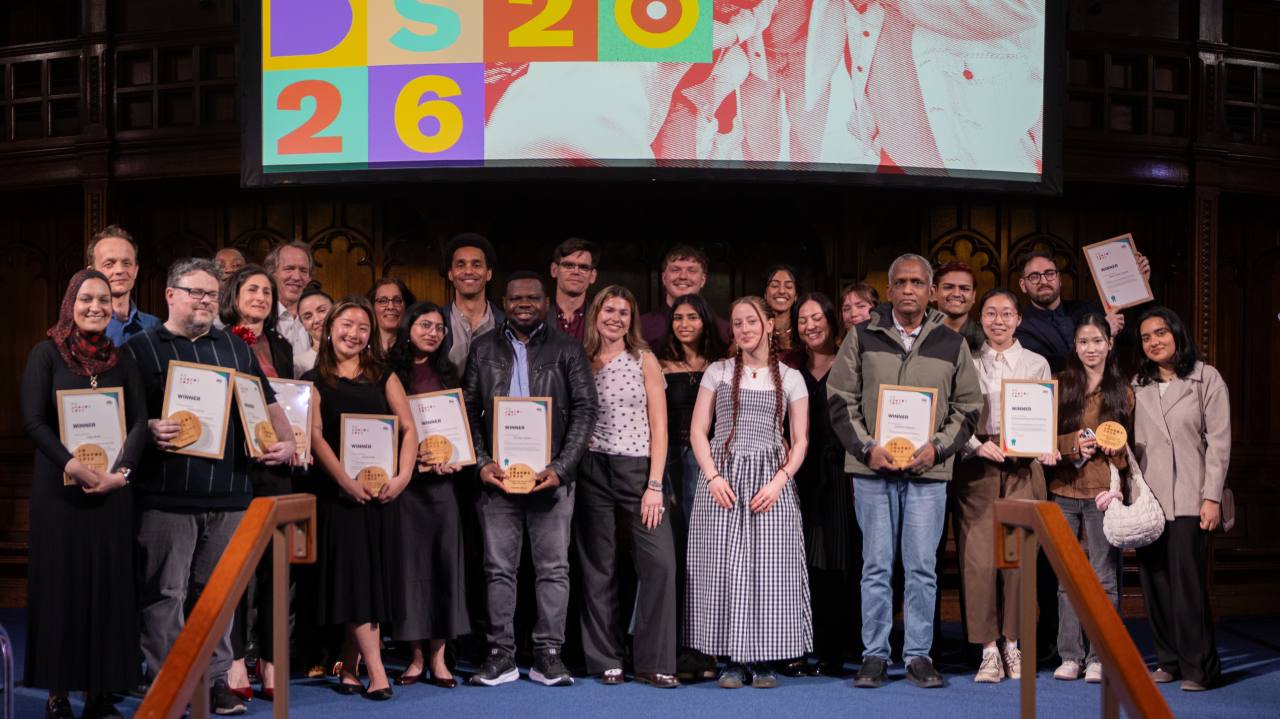
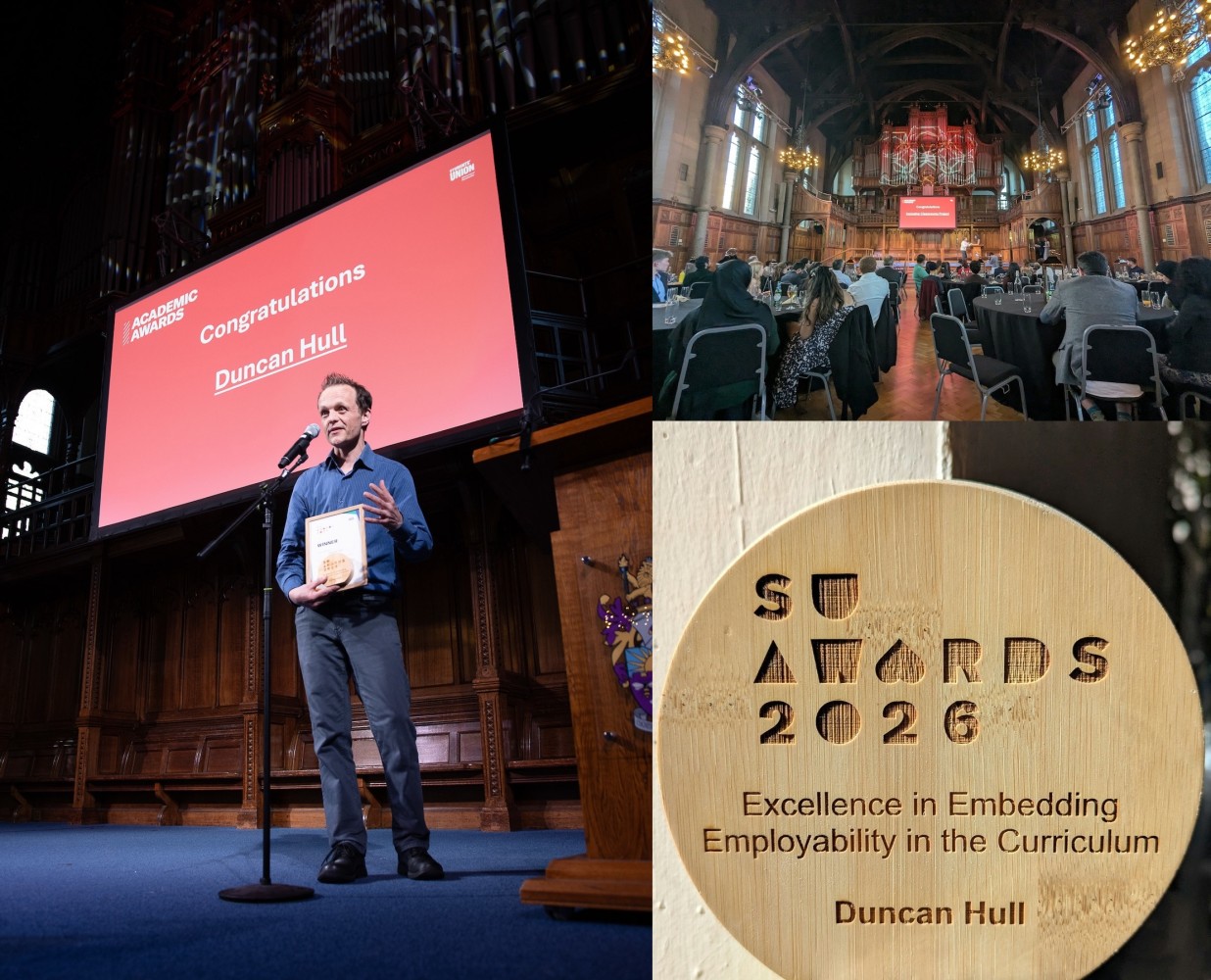
Every year hundreds of my colleagues gather at a conference in Manchester to talk about teaching & learning at the Glastonbury Festival of Scholarship. It’s not actually called that but since there’s no actual Glastonbury Festival of Contemporary Performing Arts in this fallow year of 2026, I’m looking for alternatives to the midsummer Somerset vibes from my neck of the woods down in the West Country. Festivals and conferences have some similarities, so let’s see where this musical analogy works, and where it breaks, while reviewing some of this years conference highlights.
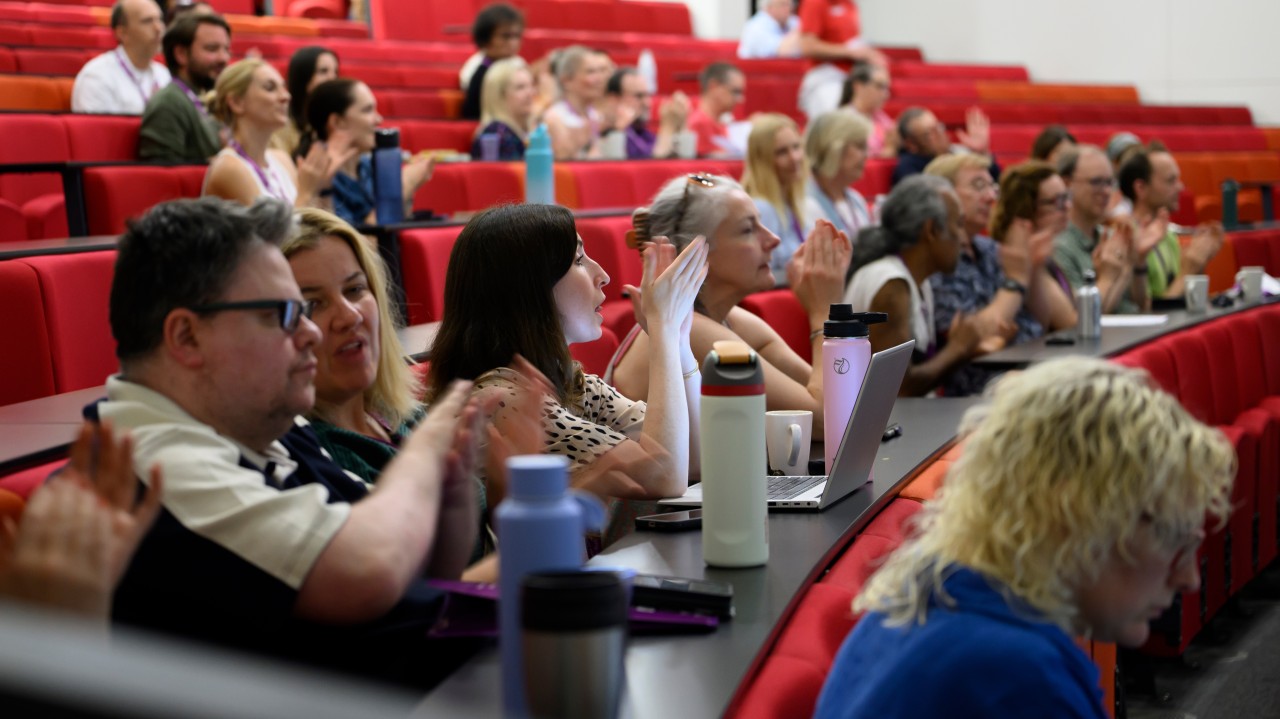
This particular annual festival and conference showcases some of the scholarship at The University of Manchester that makes teaching and learning better for everyone: students, teachers, staff, collaborators and employers. It’s called the Institute of Teaching & Learning (ITL) Conference. While Glastonbury passed its 40th iteration and 50th anniversary in 2025, the ITL conference is just getting going, with the 2026 conference being the 4th event in as many years. With more than 45,000 students on 1,000 different degree programmes at the University, there’s a lot of ground to cover during the two days. There are seven parallel tracks (or stages if you prefer) spread across several floors in University Place. This means you can only realistically expect to see about a seventh (~15%) of what’s going on while missing the other ~85% of the conference. I went to more than twenty presentations, including keynotes and plenaries. What’s ITL conference like and is it worth attending? How can you join in? Can you see any decent performances? How could it be better when it returns in 2027? Here’s some highlights from the 15% of the conference I managed to sample.
Partner-Enabled Learning
A central focus for this years’ conference was partner enabled learning where students work with employers, public bodies and community organisations in cross-disciplinary projects as an assessed part of their course. A good example of this is the partnership between the Manchester United Foundation, Oxfam, Age UK and the Department of Materials where Lindsay Pressdee, Dr Jo Conlon and Dr Amy Benstead have been teaching students about the circular economy with community embedded learning on the BSc Fashion courses. [1]
It has been estimated by This Is FC88 that 20 million shirts like the one in Figure 2 have been discarded since the FIFA World Cup 2026™ – Canada, Mexico and the United States finished last week, see for example this post from Joanna Czutkowna FRSA. In 2026, around 30 final year students will complete a course called Sustainability in Action where they will upcycle unwanted football shirts following on from earlier pilot feasability projects. Recycling all this “waste” is challenging not just because of the volume of it, but because there are strict rules about what can be done with logos and the synthetic material can be much more difficult to work with than natural fibres like cotton.

Another example of partner enabled learning was provided by Sarah Knighton, Harsha Parmar, Sadia Ibraham and Eisha M. with the Greater Manchester Cancer Alliance who have been teaching students on the Master of Pharmacy (MPharm) course. Trainee pharmacists act as a front door for patients talking about cancer, before they speak to a doctor. Pharmacists are the front line for NHS England, because they are often the first person a patient will talk to. See co-created learning through lived experience and partner engagement. [1]
From a pharmacy we moved to aphasia, an impairment in a person’s ability to comprehend or formulate language. Molly Smithies, Caroline Sutton and Steph Greenwood-Davies described The Connections Café: A service learning model for inclusive communication and community. [1] The cafe trains future language therapists on the BSc Speech and Language Therapy course who support people in the local community with language difficulties.
In her plenary Helen Walkington talked about partner enabled learning in the context of undergraduate research projects such as those found in the Get Published! initiative at Oxford Brookes University. GetPublished! supports students in developing research literacy and communication skills. Another example is GeoVerse, an undergraduate journal for Geographers. Undergraduate research has highlighted ten salient practices for providing robust and high-quality learning published by Centre for Engaged Learning at Elon University. Around 5% of undergraduate students at Oxford Brookes publish their research in GetPublished! For an example, see creating a prototype of a smartphone application to track the progress of individuals recovering from traumatic brain injury (TBI) in partnership with Oxford Head Injury Services.
Jennifer O’Brien described her work with the University Living Lab where research projects are framed within the United Nations Sustainable Development Goals. The project returns quality research to partner organisations who provide problems for students to work on including from Manchester City Council, The Old Abbey Taphouse and many others, see University Living Lab: Addressing social and environmental challenges through existing assessment. [1]
Representing the Department of Computer Science at The University of Manchester, I gave a presentation on partner enabled learning describing our experience with building and running a mentoring scheme for students learning software engineering. We started this ten years ago by partnering with local employers starting in Manchester (Graphene Valley) including Booking.com, Arm, JLR, IBM, Siemens, the BBC and as the program got bigger we’ve had mentors from further afield including Apple, Meta, Google, Microsoft and Amazon Web Services (Silicon Valley). Thanks to all our mentors which you can find out more about at industry-club.manchester.ac.uk/mentoring.html and in the paper. [2]
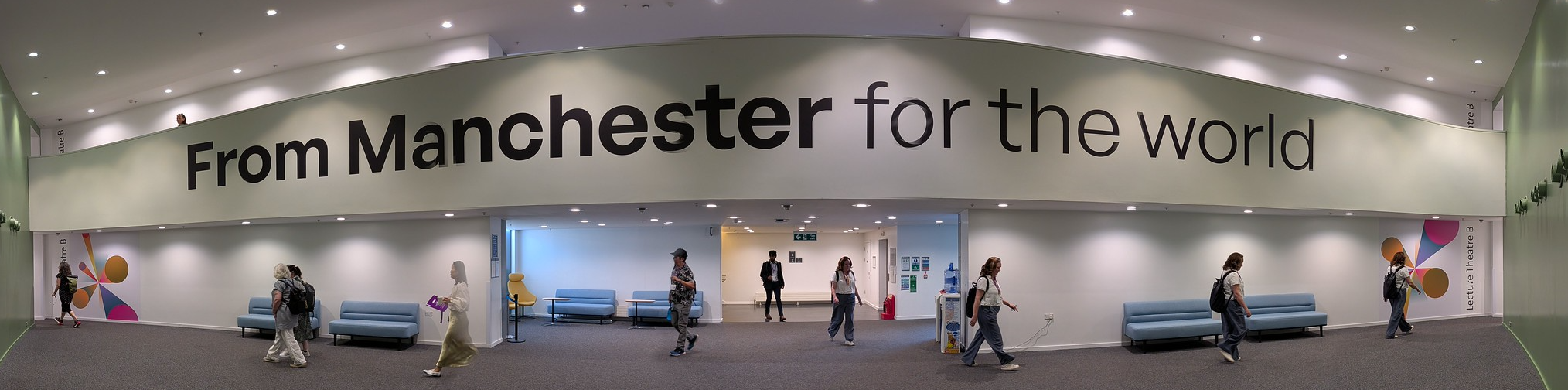
The AI in Higher Education Permathread
Predictably Artificial Intelligence (AI) dominated many of the talks and not just those where it was the theme of the session, it’s the permathread that’s here to stay whether we like it or not. Many delegates reported grappling with thorny and wicked problems that generative AI presents in Higher Education, particularly around academic integrity. What changes need to be made to teaching to help students use AI in a professional, responsible way that enriches rather than detracts from their learning? What skills should teachers focus on empowering their students with? Which are the most important and why? There are lots of difficult existential questions that have no easy answers.
Rather than using Microsoft CoPilot now available across the University, several groups reported making their own custom Large Language Models (LLMs) tailored to specific teaching tasks. An example was presented by Paul Baguley, Ian Stewart, Louise Edmondson, Auzair Khan, Ziru Tao and Linxi Xu. They’ve created tools based on Retrieval-Augmented Generation (RAG) for use in teaching the management of projects in collaboration with Sodexo, Bentley and Rolls-Royce, see a research informed generative AI framework to provide context in project management. [1]
Dr Homa Molavi and Dr. Kamal Qazi MAPM, SFHEA presented a Cross institutional AI-Driven Framework [1] while Salman Shahid talked about Evaluating Generative AI potential and integrating it in Chemical Engineering Education [1]. Lightning talks are a good way to see lots of stuff in a short period of time, here’s some I managed to see on AI:
- The use of AI tutors in science and engineering with Daniel Engstrøm, Christina Picken and Patricia Munoz-Escalona. Good teaching often involves asking diagnostic questions of students using the socratic method. Daniel and co have created custom AI’s created with “personalities” to do some of this questioning. [1]
- Writing an L-AI (lay article for the layperson) with Dirk Engelberg, Alison Harvey and Katie Moore gave an opportunity for students to have a discussion about boundaries and professional AI use by peer-reviewing an AI generated article. One problem is that with model capabilities rapidly changing, course materials need rewriting every year because what can’t be done by AI one year, is trivially done by AI the next. [1]
- Teaching programming in the AI era with Lijing Lin. Lijing is teaching diverse students without a technical background to write code. The foundations still matter, even though a calculator can crunch numbers for you, students still need to understand what the calculator is doing on their behalf. There are big risks with AI in programming which include students trying to skip code comprehension. [1]
- Designing AI-resistant Assessment and Perry’s scheme of Dualism, Multiplicity, Relativism, and Commitment within Relativism with Professor Jenni Rose. Jenni encourages her students to realise that sometimes there isn’t a “right answer” using a framework provided Perry’s scheme. [1]
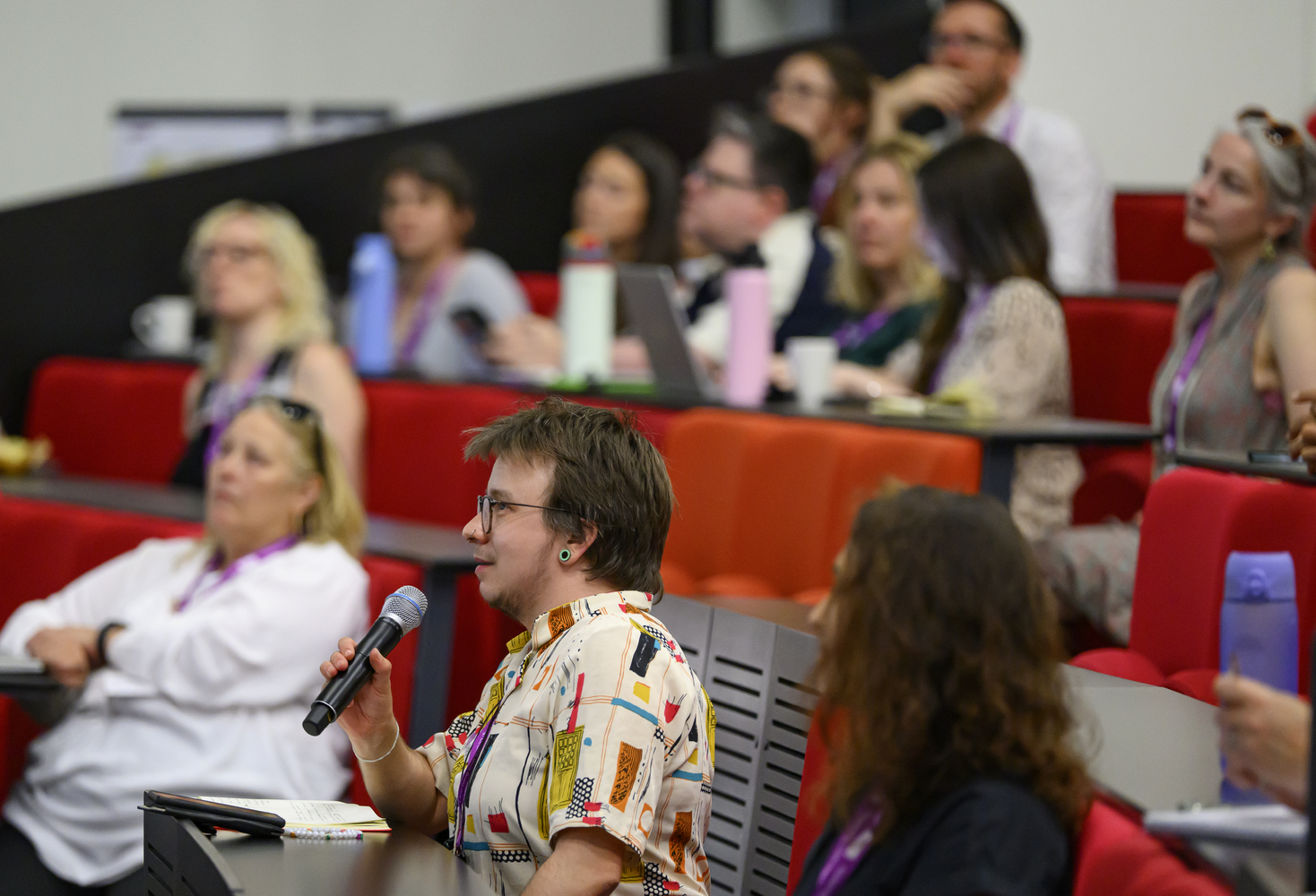
Sense of belonging and social justice
Sense of belonging and social justice were recurrent themes, two presentations I enjoyed on this were
- Belonging, Voice and Agency: Co-designing mentoring with international students with Lei Zeng, Wennie Subramonian and Lalrinzuali Fanai described creating materials to train 20 mentors working with 60 mentees for students outside the UK. Subjects include “speaking Manc”, travelling in Manchester, understanding the NHS – all things that UK students take for granted, but might seem incomprehensibly quirky and British to international students. I look forward to seeing this material when it is publicly available in the autumn. [1]
- In fashion again, Lisa Taylor talked about the KÁYÒMI Digital Sustainability Platform this looks like it would make a good student project for the Imago Software team. The project partners with African industry stakeholders, KÁYÒMI – ‘Cherish Our Garments’, a circular fashion initiative developed in collaboration with BITTANY. [1]
Which brings us full circle back to partners again …
Returning to partnerships and authentic assessment
Partnerships can make assessment more authentic, and authentic assessment is a subject in its own right. Two presentations caught my eye:
- Elika Aminian, Louise Walker and Rose Wagstaffe presented work on developing an authentic coursework assessment for actuarial science. [1] I didn’t realise the maths degree had so many flavours, it’s available with Physics, Computer Science, Philosophy, Finance and Actuarial Science.
- Stewart Blakeway and Uli Sattler presented work on scaling authentic learning: evaluating a large-cohort poster showcase in undergraduate Computer Science. [1]There was an interesting discussion on if this exercise should be formative or summative and if some kind of publication was possible.
The conference finished where we started with a final plenary with John Holden, Samira Kaissi from Unit M, George Moulton and Lee Pugalis, chaired by Jenn Hallam shown in figure 5.
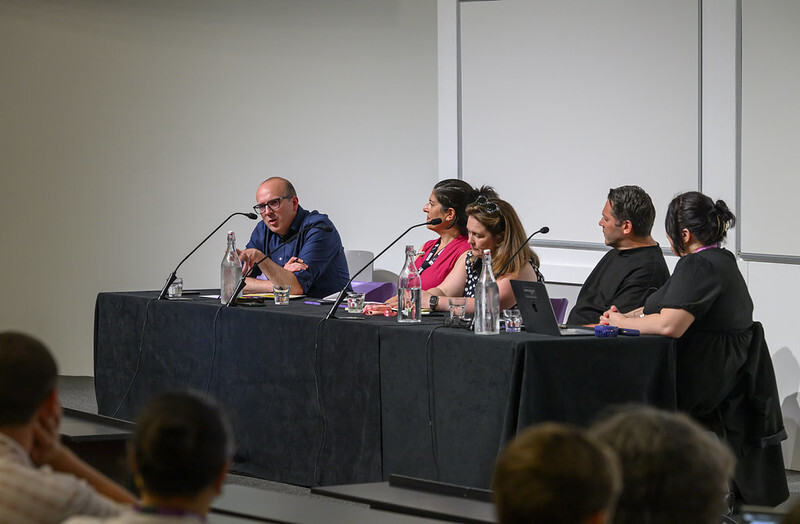
The panel explored how teaching and innovation can together become a defining feature of the student experience at the University of Manchester. The session examined how partner-enabled learning, entrepreneurship education, interdisciplinary collaboration and real-world challenge-led teaching can help prepare students to thrive in a rapidly changing economy and society. The panellists discussed how the University can create the culture, partnerships, and environments needed to turn learning, research and ideas into real-world impact within the context of the Manchester 2035 strategy.
One question I raised was, how do we mitigate the inherent risks to employers, students and staff associated with partnerships? What are the resources needed to make partnerships work at scale and who is going to provide and manage them? Part of the answer is, to manage expectations about what is required of partnerships and what they can deliver in practice.
How much is ITL actually like Glastonbury festival?
So, back to our festival analogy. How similar is the ITL conference to a musical event like Glastonbury Festival of Contemporary Performing Arts?

Figure 6: How much are conferences like festivals? They have some similarities but many differences. CC BY-SA picture of crowd gathered at Glastonbury Festival by Czampal via Wikimedia Commons w.wiki/SgyH
There are some similarities between Glastonbury festival (figure 6) and the ITL conference:
- They both involve performers trying to connect with their audience on multiple stages of various sizes. Some performances were better than others, some of the artists you’ve probably heard of, many of them will be new to you
- There is too much at both events to see in the short time available, seven parallel tracks at ITL and hundreds of stages at Glastonbury. This is a feature not a bug!
- It’s better to attend the live event if you can, festivals and conferences are about the experience of being there and joining in the conversation, rather than catching up later, but see the Zoom note below.
- Just like it’s easy too find some new music you like at Glastonbury, you’ll make lots of new connections with your colleagues at ITL, be exposed to some inspiring pedagogy that you can take away and use in your practice afterwards
But there are significant differences between them, because a conference isn’t like festival in lots of ways:
- The ITL conference is free to attend for UoM employees whereas Glastonbury requires you to take out a bank loan or remortgage your house in order to buy a ticket, provided you can even get hold of one.
- While there was lots fun to be had at the ITL conference, festivals are mostly about recreation whereas conferences are mostly about work. There is no music, there was no stage diving, crowd surfing, moshing, piggy-backing, camping and home-made flag-waving commonly found at music festivals, at least not in the sessions I attended! Maybe we should change this next year?
- If you want to get up on stage and tell everyone about your work, that’s probably easier to do at the ITL conference than Glastonbury festival, unless you’re already an established superstar with a record deal, back catalogue and huge fanbase
- If you’d like to get involved in ITL in 2027, there are lots of positions available on the organising committee and peer review panels, contact the organisers for details
- The food is much better at ITL than Glastonbury. I thought the food was good, much better than over-priced junk fast food you find at music festivals from mobile vendors.
- The toilets are much better at ITL than Glastonbury! Thankfully there are no long drops or portaloos, just well managed and clean facilities provided by the University. When you go home after the event you can have a proper shower and sleep in a decent bed. Phew!
So ITL is like a musical festival in some ways but not in lots of others.
How can ITL be better in 2027?
I thoroughly enjoyed the ITL conference, I’ve been every year for the last four years and I always meet interesting new people doing great projects, as well as catching up with old friends and getting the chance to share and reflect on my own practice. It was really refreshing to see members of the University executive team at the conference taking part this year. They didn’t just make a token appearance and then leave shortly after. The executive team took the time to listen to what people are talking about and contributed to the dialogue. Thanks to Duncan Ivison, Patrick Hackett, John Holden, Eleanor Morrissey FCIPD MA and Jenn Hallam for properly joining in.
I’d like ITL to carry on growing and improving year on year, a bit like Glastonbury has done since starting in 1970. In order to continue growing, the ITL conference needs to:
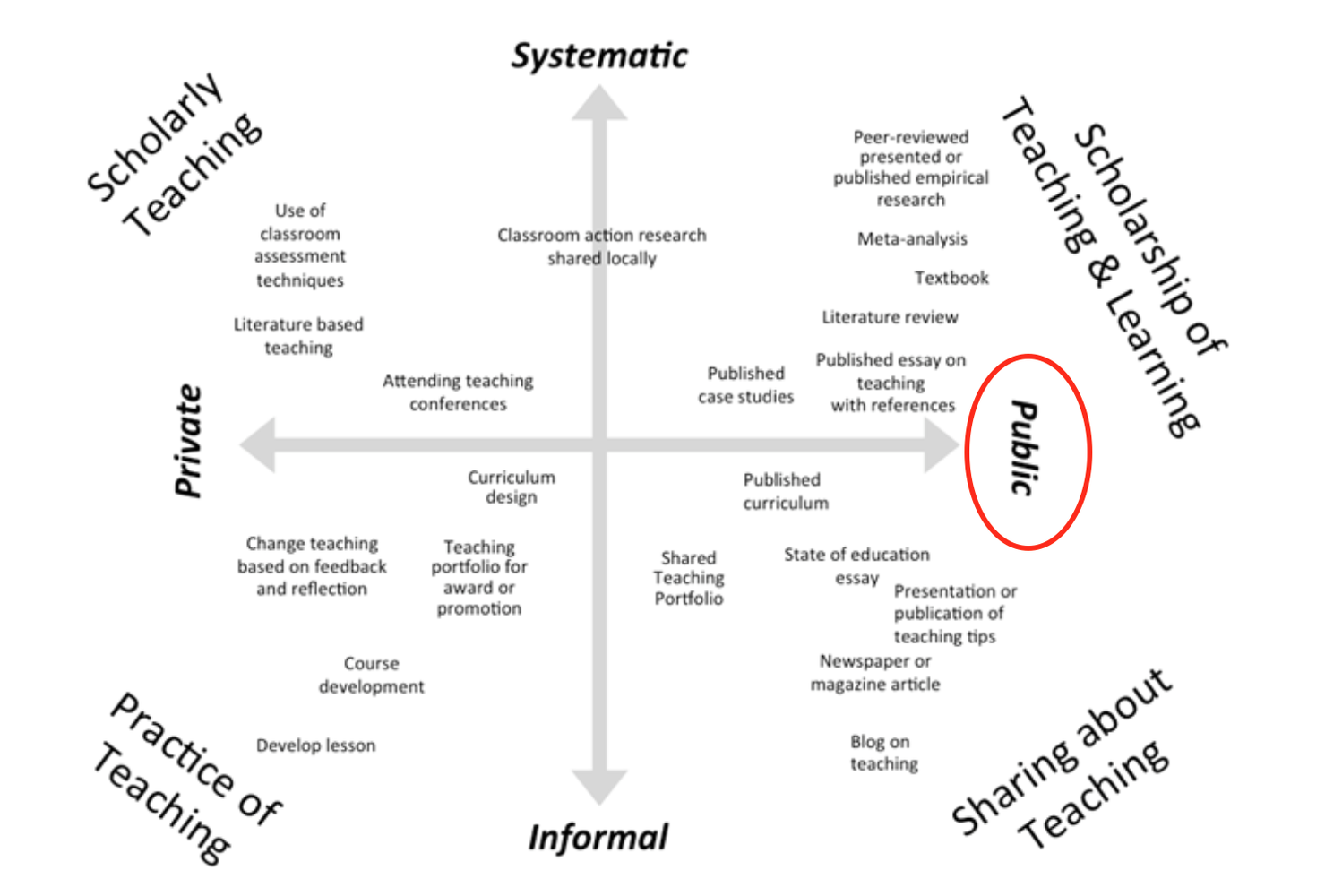
- Publish more of the proceedings. The abstract book [1] is handy, but it captures a small fraction of the data and Scholarship of Teaching and Learning (SoTL) from the conference. Authors should be publishing their slides too, figshare.manchester.ac.uk would be a relatively easy way to do that. Once authors have their paper accepted for publication, they could upload it to the repository, see an example at [2]. Scholarship is not really public if it isn’t a fully published PUBLIC-ation! An abstract is necessary but not sufficient, see figure 7.
- Tell us where the catchup is: When you miss an act at Glastonbury, you can catch-up later on BBC iPlayer bbc.co.uk/glastonbury. Some of the ITL talks were streamed using Zoom, but if they were recorded, I can’t find them published anywhere. There are a few I would liked to have seen from the 85% of the conference I wasn’t able to attend, speaking of which…
- Zoom out because we should stop using Zoom, we’ll probably be forced to next year anyway when IT services follow through on their warning about switching to Teams by the end of 2026. Some combination of meetings, webinars, and town halls on Microsoft Teams / 365 should do the trick – and this means there’s no more tedious zoom logins to worry about.
Anonymously peer-reviewUse better peer reviewing tools As the conference grows, it gets harder to get your paper accepted. More submissions are great, and will hopefully increase the quality of the conference to. But quantity is harder to manage,especially when it’s anonymously peer reviewed. There are good, free and cheap tools to do this like EasyChair see easychair.org. A Microsoft form populating an Excel spreadsheet isn’t adequate for managing conference proceedings on this scale –and it means the peer review is not anonymous.Post publication update, when I wrote this, I got the facts marked instrikethroughwrong, the conference IS anonymously peer-reviewed- Help us scale it up. It’s great to hear about innovative pedagogy which often occurs in small classes of less than 30 students. Much of our teaching at the University of Manchester involves classes much much bigger than that. it’s not unusual for classes to have between 300 and 500 students in first and second year. So a key question is, not just how do we teach innovatively, but how do we innovate at scale?
- Increase attendance and participation. Many colleagues don’t seem to know that ITL happening. Others aren’t willing or able to attend. While it was reassuring to see Pavlos Petoumenos and Stewart Blakeway, many of my Computer Science colleagues who would have attended were absent. For example, neither our Discipline Head of Education (DHoE) Andrea Schalk or Teaching & Learning Enhancement Lead (TLEL) Gareth Henshall have been able to attend any of the last FOUR conferences because it clashes with exam boards in Computer Science. These dates are fixed a long time in advance of the ITL conference. I might have missed them, but I didn’t see anyone from the Department of Physics and Astronomy (random example) – do they even know it is happening? Anna Scaife for example, is publishing lots of interesting positive (and evidence based) material on independent learning for undergraduate students at howtobeastudent.substack.com. Why aren’t there more people like Anna at the ITL conference?
So ITL is great, but there’s plenty of room for improvement next year.
Thanks Jenni, Hannah, Sarah, Holly, Freya and Nahid
If my criticism comes across as being ungrateful, I’m trying to be a constructive and critical friend so we can put on an even better event on next year. I’m very grateful to the huge team of people that worked extremely hard to make the conference happen again. Thanks Jennie Blake, Hannah Cobb, Sarah Dyer, Freya Corrywright, Holly Dewsnip, Nahid Farzalizadeh and many more for putting on another fantastic event. Thanks also to the photographer who took most of the photos that I’ve used to illustrate this report.
I look forward to ITL returning in 2027, hope to see you there. In the meantime, join us at the Teaching and Scholarship Network (TaSN), we’re a friendly bunch and our members include inspiring people like Karen Lander, Rachel Studd, Nick Weise PFHEA IFNTF, Reimala Sivalingam, Sally Hickson, Lindsey Jones, Thomas Rodgers, Grazyna (Grace) Lipowska-Bhalla, PhD, SFHEA, Anna Goatman, Ali Owrak, Dr Rachel Parker-Strak, Doron Cohen, David Schultz, Nikesh Solanki and many more.
Come and join us! We organise and host regular events throughout the year about the Scholarship of Teaching & Learing (SoTL), in between the big Institute for Teaching and Learning (ITL) annual event.
References
- Jennie Blake (2026) University of Manchester Teaching and Learning Conference 2026 (Abstract Booklet) figshare DOI:10.48420/32802033
- Duncan Hull, Suzanne Embury, Tom Carroll, Christopher Page and Ben Possible (2026) Partner-enabled learning with local and global software engineers from Manchester to the world, Figshare DOI:10.48420/32745048.v2
- Beth Kern, Gwendolyn Mettetal, Marcia D. Dixson, and Robin K. Morgan (2015) The Role of SoTL in the Academy:Upon the 25th Anniversary of Boyer’s Scholarship Reconsidered Journal of the Scholarship for Teaching and Learning, Vol. 15, No. 3, pp. 1 – 14. doi: 10.14434/josotl.v15i3.13623
You can cite this article using the full DOI:10.59350/yp7qd-g4532 or the shorter doi.org/rhmn, both of which identify this same article.
This post is also published at linkedin.com/pulse/celebrating-teaching-learning-glastonbury-festival-2026-hull–dvjae