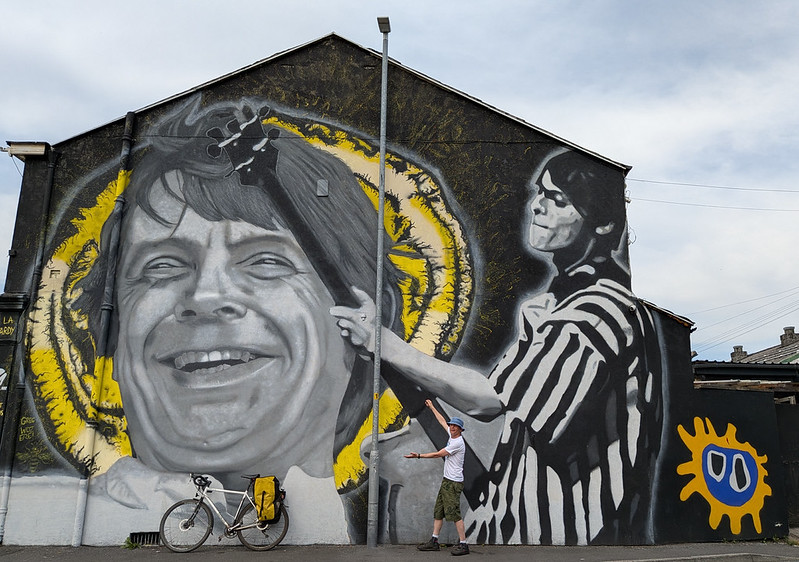
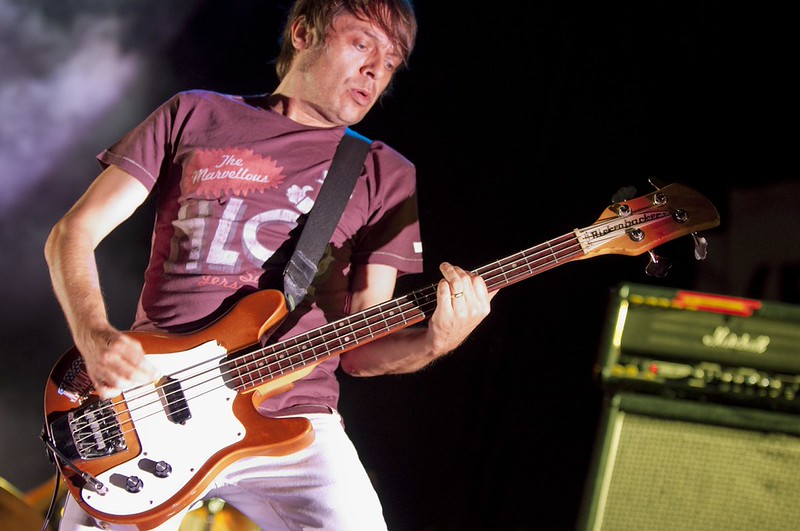
Conventional wisdom states that you should never meet your heroes because they will probably fall off whatever pedestal you’ve put them on. So what would you do if you bumped into your hero or heroine in the supermarket? This happened to me while stocking up on essential groceries in a Tescos store. I’m there buying some milk, minding my own business in the dairy section and I’m joined by Mani, bass guitarist of the Stone Roses and Primal Scream (see Figure 1) who is doing the same. I’m star-struck and a little tongue-tied.
So what should I do? There’s a few options that sprung to mind:
Respect his privacy, let him go peacefully about his business without being mobbed by yet another idiotic fanatic like me?
… but then regret not taking the opportunity to say something…?
Ask for a selfie and then send it to all my mates who are big fans of the Stone Roses and Primal Scream?
Tell him how awesome his bass lines to She Bangs the Drums, Swastika Eyes, Fool’s Gold, Kill All Hippies and I Am the Resurrection are [1,2]? Not only is the bass awesome, there’s some great lyrics to accompany them too: “Kiss me where the sun don’t shine the past was yours but the future’s mine” … and … “I’m no clown, I won’t back down, I don’t need you to tell me what’s going down. Down, down, down, down, down, down, down, down…”
Invite him to join our band / choir’s next performance as a very special guest bass guitarist?
I’m pretty sure Mani, like many celebrities, must get sick of people getting into cliched conversations like that, especially when he’s just buying some milk.
The BA55 NOD: BASS NOD?
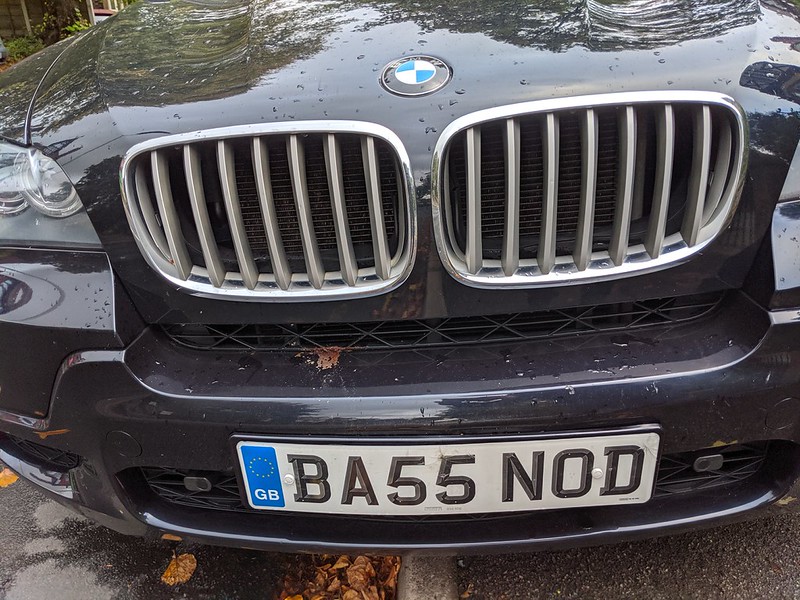
Instead of mithering Mani with cliches, I opt for something different. I’ve clocked him driving around Manchester with an unusual personalised registration plate on his car, which is currently parked outside the supermarket. The plate is BA55 NOD, see Figure 2.
Figure 2: Mani’s number plate: Can I ride with you in your BMW? You can sail with me in my yellow submarine but what is the BA55 NOD all about? 🇪🇺
Now I think I know what BA55 NOD is referring to, but it would be good to confirm my theory, to get the truth directly from the owner of the number plate. So I ask him, what’s the story with the number plate? What is a bass nod exactly? What’s the Story, Rosey Glory?
Thankfully, Mani happily confirms that the bass nod is exactly what you might expect. It’s the move you do with your head, when you’re playing (or listening to) bass lines. Pick out the bass line, and nod your head in time. Easy. This is a useful dance move, if like me, you’re not known for your dancing skills. Just nod your head in time to the funky bass lines. It’s easy and can even look good too, you don’t need to be rock star superstar to carry it off.
Supermarkets aren’t the kind of places you expect to meet your heroes and heroines, but even rockstars have to pop out to buy some milk sometimes. So what would you do if you bumped into yours while shopping for groceries?
Figure 3: CC BY-SA picture of Mani performing circa 2009 by LivePict via Wikimedia Commons w.wiki/WkS7
John Leckie and Peter Hook (1989) The Stone Roses, The Stone Roses, Silvertone Records
Brendan Lynch, Jagz Kooner, David Holmes, Hugo Nicolson, The Chemical Brothers, Kevin Shields, Tim Holmes and Dan the Automator (2000) XTRMNTR, Creation Records Limited
Last month I attended a three day Training of Trainers (ToT) course at the University of Glasgow. Run as an interactive workshop, the course was designed to help leaders of Wikipedia training events to improve their delivery and organisation. Having participated and run several Wikipedia events in the past, such an Ada Lovelace event earlier this year, I was keen to learn how do things better. Here’s a report on the workshop, with some bonus extra curricular Glasgow goodies thrown in for good measure. Thanks again Sara Thomas and Bhavesh Patel for organising and delivering the course.
… work in partnership with organisations from the cultural and education sectors and beyond in order to unlock content, remove barriers to knowledge, develop new ways of engaging with the public and enable learners to benefit fully from the educational potential of the Wikimedia projects.
Most of the workshop participants (pictured top right) were from Gallery, Library, Archive and Museum (GLAM) institutions and a few educational and charitable ones too. Over the three days, here is what we covered:
The second day revisited design skills while touching on delivery skills and group work. This covered elocution, voice projection, body language and an examination the range of experiential activities that can be utilised in workshops. We also discussed aspects of Dave Meier’s accelerated learning (with feedback) and finished the day up with teams preparing for activities for day three.
Day three: The Show Must Go On
The final day of the course finished with the participants divided into four small teams. Each presented a on hour mini-session and had it critiqued by peers. This enabled us to learn from;
Our own mistakes
Other peoples mistakes
Copying / stealing other peoples good ideas, of which there were plenty. Thanks Abd, Daria, Doug, Eoin, Ian, Tara, Ian, Madeleine, Marianne, Saeeda, Tore, Sara and Bhav!
Overall, this was a really useful and memorable training course, one of the best training courses I’ve been on. The content, participants, location were all great and I felt empowered by taking the course as well as making useful contacts from a range of different organisations. It had a clearly defined purpose, well chosen activities and participants, with nothing irrelevant presented. There were tonnes of practical ideas to put into practice straight away which I look forward to doing in 2020. If you’d like to do the course, get in touch with Wikimedia UK.
While in Glasgow, it would be rude not to take advantage of all the bonus extra curricular activities the city has to offer:
Bonus 1: People Make Glasgow Hospitable 🏴
They say that People Make Glasgow, and Glaswegians are very hospitable. In between training sessions our host Sara showed us around the city, including the University cloisters (etc), Inn Deep on the banks of the River Kelvin and Curlers Rest in the West End. Sara’s impressive knowledge of Glasgow and its history is wikipedian in its depth and breadth.
Bonus 2: Glaswegian-Mancunian connections 🇬🇧
To me, Glasgow and Manchester feel like sibling cities separated at birth. If you’re English, Glasgow can feel like a Scottish Manchester. Perhaps Manchester feels like an English Glasgow to the Scots? Here is the case:
Second city syndrome 🥈: As second cities, both Glasgow and Manchester live in the shadow of their more famous capitals, Edinburgh and London. Both cities are the “belly and guts” of their respective nations. Glasgow had its docks, Manchester had its cotton. While both trades are long gone, they leave similar post-industrial legacies on the culture and infrastructure of their respective cities.
Shipping 🚢: Ships, shipping, docks, ports, quays and wharfs run deep in both cities. Glasgow built ships on the River Clyde while Manchester used ships for export and import of goods on its Ship Canal.
Football ⚽: Love it or loathe it, the fitbaw connection between Glasgow and Manchester is strong [1,2]. Scrolling through the list of Manchester United managers I count not just one, two or even three but FOUR Glaswegians. Matt Busby (Belshill is basically Glasgow), Tommy Docherty, Alex Ferguson and David Moyes. Is this a coincidence or catholicism? [1,2] Who knows, but my hypothesis is that being shouted at in a strong Glaswegian accent can make teams perform better (although it didn’t work very well for Moyes). I wonder how many Glasgow kisses Alex Ferguson gave his overpaid prima donna squad to keep them in line? Strangely, the fitbaw manager connection isn’t reciprocated: I can’t find any Mancunians in the list of Celtic managers or the list of Rangers managers
Bonus 3: King Tut’s Wah Wah Hut 🎸
Glasgow is home to the legendary King Tut’s Wah Wah Hut. This humble venue, relatively small with a capacity of only 300, has hosted an impressive range artists including Coldplay, Radiohead, Oasis, Blur, Pulp, Manic Street Preachers, you name it, they’ve played King Tut’s. Curious to find out what all the fuss was about, I arranged to meetup with an old Glaswegian friend for a drink at the venue. Assuming the gig that night would be sold out we asked at the bar who was playing. Turns out they had a handful of tickets left, so we spontaneously bought a pair to see Blanco White. Mixing Andalusian and Latin American influences, Blanco White play melancholic but beautiful tunes using a variety of instruments including the Charango [3]. Part of the reason King Tut’s is legendary is Glaswegian audiences are lively, and it was fun to see the band visibly moved by what Josh Edwards, the lead singer told us was: “easily the best reception we’ve had in months of touring”.
Bonus 4: Like a Brudge over troubled water 🌊
Looking for a walk, run or ride in Glasgow? There are some great routes around the city like the Glasgow River Clyde Bridges, with at least 21 bridges to cross the Clyde on. On an early morning run, I couldn’t find any of the “bridges”, but there were plenty of “brudges” and some fantastic scenery along the Clyde. Och aye!
John Peel comtemplating Drum & Bass via bhikku on Flickr.
If you’ve filled your boots with the wall-to-wall glastonbury festival coverage, you might find it curious that many people have little or no interest in new music, choosing instead to listen to the artists they liked in their formative years and loyally sticking with them for life. John Peel put it another way:
People do find it curious that a chap of my age* likes the things that I like but I do honestly feel that it’s one of those situations where everyone’s out of step except our John, because in any other area of human activity – theatre, literature or something like that, you’re not supposed to live eternally in the past, you know, you’re supposed to take an interest in what’s happening now and what’s going happening next and this really all that I do, it seems to be a perfectly normal and natural thing to do.
*John Peel was a spritely 50 years of age at the time of the interview where he said that in 1990 [1]. Isn’t it curious that, as Peel said, new music is largely considered to be the exclusive domain of “younger people”, while new theatre, new technology, new art, new science and new anything-else is not? Wonder why that is?