O'Really?

July 2, 2025

What’s the Story, Learning Glory? How we can start telling better stories about teaching in Higher Education

All your dreams are made, when you’re chained to the lecture and the teaching trade. Was that lecture, lab or lesson a dream or a nightmare? Exactly what did you learn from the experience? When you reflect on it, how will you tell yourself and others the stories of your study?

The stories students tell about what they have learned, the teaching they experience and research they are exposed to are a key part of the story of every University. These stories demonstrate the value that a University adds to society through the people that it educates, the knowledge, skills and abilities that students at that organisation acquire alongside the research that the institution does.

How are teaching and learning represented in stories online? We analysed the frequency of the keywords TEACH*, LEARN*, STUDENT*, RESEARCH* and SCHOLAR* in ten years of stories summarised in annual press releases. These stories were published by the University of Manchester every December from 2015 to 2024. The main results of the analysis were presented this week [1,2,3] at the Institute of Teaching and Learning (ITL) conference are shown below in Figure 1. There is bad news and good news:

Figure 1: Average frequency of keywords per article over ten years, 2015-2024. On average the words TEACH* and LEARN* occurred just 1.3 and 0.6 times per article in comparison to STUDENT* and RESEARCH* which occurred more than 9 and 15 times in each press release respectively. In theory, teaching has parity of esteem with research, but in practice, this is clearly not the case when counting words in press releases. See [1] for full data.


The BAD NEWS is, the words in our press releases are a long long way off from the words in our strategic vision. [4] This will be disappointing and demoralising for anyone who cares about teaching and learning because our press releases mis-represent a huge amount of important learning done by thousands of our students. They also under-represent massive amounts of teaching delivered by our colleagues across the University. As Duygu Candarli and Steven Jones have shown, this a common pattern repeated across the Higher Education sector. [5] This isn’t just a Mancunian problem, there is a lack of integrity in much of the UK HE sector, what Steven Jones calls “integrity deficits”. [6]

However, the GOOD NEWS is there’s plenty we can do to improve the narrative, by getting on what Sue Beckingham calls the Scholarship of Teaching and Learning (SoTL) staircase [7]. There are some simple and easy steps we can take to tell better stories that represent more accurately what our University (and wider HE sector) actually does. There is a good chance these steps could lead us upwards towards better teaching and scholarship, with students learning more skills and knowledge to prepare them for the world beyond University.

The presentation makes some suggestions for how academic staff can go about climbing the SoTL staircase to deliver even better teaching and an even better learning experience for students. For example, you could:

These are small steps that go in the right direction towards rebalancing the imbalance above. So whatever you are learning and whoever you are teaching, what’s your story, learning glory?

References

  1. Hull, D. (2025) What’s the Story, Learning Glory: Why we need to hear more stories about teaching and learning at the University of Manchester, White paper DOI:10.5281/zenodo.15684409
  2. Hull, D. (2025) What’s the Story, Learning Glory: How we can get better at telling teaching stories at the University of Manchester, Poster presentation #ITLConf25 DOI:10.48420/29360969.v4 (Low resolution screenshot below, for higher resolution use the DOI above)
  3. Blake, J (2025) University of Manchester Teaching and Learning Conference: Abstract Booklet, DOI:10.48420/29371811.v1
  4. Rothwell, N. (2024) Our future: vision and strategic plan. manchester.ac.uk/about/vision
  5. Candarli, D., & Jones, S. (2022). The representation of students in undergraduate prospectuses between 1998 and 2021: a diachronic corpus-assisted discourse study. Critical Discourse Studies. DOI:10.1080/17405904.2022.2130952
  6. Jones, S. (2022) Universities Under Fire: Hostile Discourses and Integrity Deficits in Higher Education. (Palgrave Critical University Studies). Palgrave Macmillan. DOI:10.1007/978-3-030-96107-7
  7. Beckingham, S (2025) SoTL Staircase, National Teaching Repository. Figure. DOI:10.25416/NTR.29438096.v1

You can cite this blog post using DOI:10.59350/oreilly.11284 and get Digital Object Identifiers (DOIs) for your blog posts at rogue-scholar.org


Thanks to Hannah Cobb and Jennie Blake for organising the conference. There is some extra commentary, acknowledgements and discussion of this post at linkedin.com/pulse/whats-story-learning-glory-how-we-can-start-telling-better-hull–dwyxe

December 10, 2019

Thank you Sara and Bhav at Wikimedia UK

320px-TtT_Group_Shot_2

Participants in the Training of Trainers workshop at the University of Glasgow, November 2019. Picture by Sara Thomas (WMUK) [CC BY-SA 4.0 commons.wikimedia.org/wiki/File:TtT_Group_Shot_2.jpg

Last month I attended a three day Training of Trainers (ToT) course at the University of Glasgow. Run as an interactive workshop, the course was designed to help leaders of Wikipedia training events to improve their delivery and organisation. Having participated and run several Wikipedia events in the past, such an Ada Lovelace event earlier this year, I was keen to learn how do things better. Here’s a report on the workshop, with some bonus extra curricular Glasgow goodies thrown in for good measure. Thanks again Sara Thomas and Bhavesh Patel for organising and delivering the course.

As a charity, Wikimedia UK (WMUK) is part of the global Wikimedia movement. WMUK organises events in order to:

… work in partnership with organisations from the cultural and education sectors and beyond in order to unlock content, remove barriers to knowledge, develop new ways of engaging with the public and enable learners to benefit fully from the educational potential of the Wikimedia projects.

Most of the workshop participants (pictured top right) were from Gallery, Library, Archive and Museum (GLAM)  institutions and a few educational and charitable ones too. Over the three days, here is what we covered:

Day one: Getting started

We kicked off with some introductory activities including “head, heart & hands” from Waldorf education. We looked at needs analysis (Who are the participants? What is the purpose?), adult learning (particularly Howard Gardners theory of multiple intelligences) and design skills (using David Kolb’s experiential learning and Bernice McCarthy’s 4MAT).

Day two: From theory to practice

The second day revisited design skills while touching on delivery skills and group work. This covered elocution, voice projection, body language and an examination the range of experiential activities that can be utilised in workshops. We also discussed aspects of Dave Meier’s accelerated learning (with feedback) and finished the day up with teams preparing for activities for day three.

Day three: The Show Must Go On

The final day of the course finished with the participants divided into four small teams. Each presented a on hour mini-session and had it critiqued by peers. This enabled us to learn from;

  • Our own mistakes
  • Other peoples mistakes
  • Copying / stealing other peoples good ideas, of which there were plenty. Thanks Abd, Daria, Doug, Eoin, Ian, Tara, Ian, Madeleine, Marianne, Saeeda, Tore, Sara and Bhav!

Overall, this was a really useful and memorable training course, one of the best training courses I’ve been on. The content, participants, location were all great and I felt empowered by taking the course as well as making useful contacts from a range of different organisations. It had a clearly defined purpose, well chosen activities and participants, with nothing irrelevant presented. There were tonnes of practical ideas to put into practice straight away which I look forward to doing in 2020. If you’d like to do the course, get in touch with Wikimedia UK.

While in Glasgow, it would be rude not to take advantage of all the bonus extra curricular activities the city has to offer:

Bonus 1: People Make Glasgow Hospitable 🏴󠁧󠁢󠁳󠁣󠁴󠁿

They say that People Make Glasgow, and Glaswegians are very hospitable. In between training sessions our host Sara showed us around the city, including the University cloisters (etc), Inn Deep on the banks of the River Kelvin and Curlers Rest in the West End. Sara’s impressive knowledge of Glasgow and its history is wikipedian in its depth and breadth.

Bonus 2: Glaswegian-Mancunian connections 🇬🇧

To me, Glasgow and Manchester feel like sibling cities separated at birth. If you’re English, Glasgow can feel like a Scottish Manchester. Perhaps Manchester feels like an English Glasgow to the Scots? Here is the case:

  • Second city syndrome 🥈: As second cities, both Glasgow and Manchester live in the shadow of their more famous capitals, Edinburgh and London. Both cities are the “belly and guts” of their respective nations. Glasgow had its docks, Manchester had its cotton. While both trades are long gone, they leave similar post-industrial legacies on the culture and infrastructure of their respective cities.
  • Shipping 🚢: Ships, shipping, docks, ports, quays and wharfs run deep in both cities. Glasgow built ships on the River Clyde while Manchester used ships for export and import of goods on its Ship Canal.
  • Football ⚽: Love it or loathe it, the fitbaw connection between Glasgow and Manchester is strong [1,2]. Scrolling through the list of Manchester United managers I count not just one, two or even three but FOUR Glaswegians. Matt Busby (Belshill is basically Glasgow), Tommy Docherty, Alex Ferguson and David Moyes. Is this a coincidence or catholicism? [1,2] Who knows, but my hypothesis is that being shouted at in a strong Glaswegian accent can make teams perform better (although it didn’t work very well for Moyes). I wonder how many Glasgow kisses Alex Ferguson gave his overpaid prima donna squad to keep them in line? Strangely, the fitbaw manager connection isn’t reciprocated: I can’t find any Mancunians in the list of Celtic managers or the list of Rangers managers

Bonus 3: King Tut’s Wah Wah Hut 🎸

Glasgow is home to the legendary King Tut’s Wah Wah Hut. This humble venue, relatively small with a capacity of only 300, has hosted an impressive range artists including Coldplay, Radiohead, Oasis, Blur, Pulp, Manic Street Preachers, you name it, they’ve played King Tut’s. Curious to find out what all the fuss was about, I arranged to meetup with an old Glaswegian friend for a drink at the venue. Assuming the gig that night would be sold out we asked at the bar who was playing. Turns out they had a handful of tickets left, so we spontaneously bought a pair to see Blanco White. Mixing Andalusian and Latin American influences, Blanco White play melancholic but beautiful tunes using a variety of instruments including the Charango [3]. Part of the reason King Tut’s is legendary is Glaswegian audiences are lively, and it was fun to see the band visibly moved by what Josh Edwards, the lead singer told us was:  “easily the best reception we’ve had in months of touring”.

Bonus 4: Like a Brudge over troubled water 🌊

Looking for a walk, run or ride in Glasgow? There are some great routes around the city like the Glasgow River Clyde Bridges, with at least 21 bridges to cross the Clyde on. On an early morning run, I couldn’t find any of the “bridges”, but there were plenty of “brudges” and some fantastic scenery along the Clyde. Och aye!

Bonus 5: The Glasgow Bucket List ☑️

There is still loads on my personal Glasgow bucket list for future visits, like the Kelvingrove Art Gallery and Museum, St. Mungo’s Cathedral, the Riverside Museum, Glasgow City Chambers, People’s Palace and the Glasgow Science Centre. What a great place Glasgow is, if you’ve never been, what are you waiting for?

References

    1. Frank Worrall (2007) Celtic United: Glasgow and Manchester – Two Football Clubs, One Passion, Mainstream publishing ISBN: 9781845962760
    2. Kieran Cunningham (2016) Alex Ferguson: The Irish Connection The Irish Daily Star, buzz.ie ☘️
    3. Blanco White: Olalla, more than a name…

June 23, 2017

Nine ideas for teaching Computing at School from the 2017 CAS conference

CAS

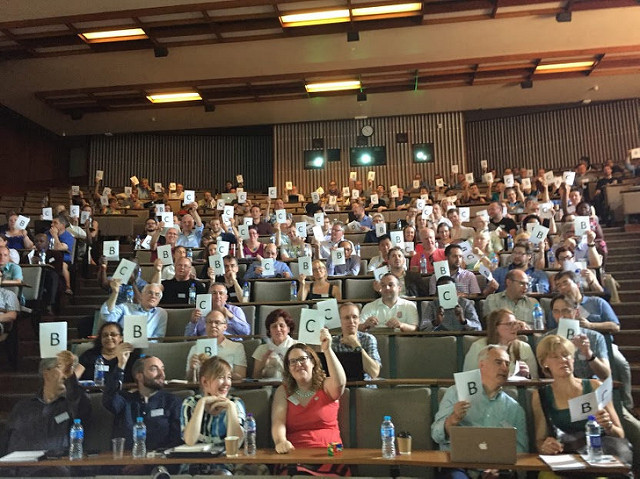
Delegates at the Computing at School conference 2017 #CASConf17 answering diagnostic questions, picture by Miles Berry.

The Computing At School (CAS) conference is an annual event for educators, mostly primary and secondary school teachers from the public and private sector in the UK. Now in its ninth year, it attracts over 300 delegates from across the UK and beyond to the University of Birmingham, see the brochure for details. One of the purposes of the conference is to give teachers new ideas to use in their classrooms to teach Computer Science and Computational Thinking. I went along for my first time (*blushes*) seeking ideas to use in an after school Code Club (ages 7-10) I’ve been running for a few years and also for approaches that undergraduate students in Computer Science (age 20+) at the University of Manchester could use in their final year Computer Science Education projects. So here are nine ideas (in random brain dump order) I’ll be putting to immediate use in clubs, classrooms, labs and lecture theatres:

  1. Linda Liukas demonstrated some intriguing ideas from her children’s books and HelloRuby.com that are based on Montessori education. I shall be trying some of these out (particularly the storytelling stuff) at code club to keep girls involved
  2. Sue Sentance and Neil Brown from King’s College London gave an overview of some current research in pedagogy.  They discussed research questions that can be tackled in the classroom like (for example) do learners make more progress using visual programming languages (like Scratch and Blockly) or traditional text-based languages (like Python and Java etc)? Many of these research questions would make good projects for undergraduate students to investigate in secondary schools, see research on frame based editors, for example.
  3. Michel Wermelinger from the Open University demonstrated using iPython notebooks for teaching data literacy at the Urban Data School. Although I’m familiar with iPython, it had never occurred to me to actually use iPython in school for teaching. It is a no-brainer, when you think about it, even for primary, because you have your code, inputs and outputs all in one window, and can step through code execution instead of (or as well as) using more conventional tools like Trinket, Thonny or IDLE. Data literacy is fun to teach.
  4. Miles Berry from the University of Roehampton demonstrated Diagnostic Questions in Project Quantum. These are a collection of high quality quizzes to use interactively for example as hinge questions, where teaching is adapted depending on answers given, like this multiple choice question:
    Consider the following Python code:
    
    a = 20
    b = 10
    a = b
    
    What are the values of a and b?
    
    A: a = 10, b = 10
    B: a = 20, b = 20
    C: a = 30, b = 10
    D: a = 10, b = 20
    

    You’ll have to try these five questions to check your answer. The useful thing here is that DiagnosticQuestions.com (the platform on which this is built) allows you to see lots of responses, for example each answer (A, B, C or D) above was selected by 25% of participants. You can also view explanations which illuminate common misconceptions (e.g. the classic mistake of confusing assignment with equality) as well as providing a bank of free questions for use in the classroom.

  5. Mark Guzdial from GeorgiaTech discussed using learning sciences to improve computing teaching. He demonstrated predictive questions (e.g. ask students What do you think will happen when we run this code? before actually executing it) alongside what he called subgoal labelling. These are simple ideas (with proven benefits) that can be put to use immediately. I’ll also be trying the Live Coding (with Sonic Pi) and Media Computation he demonstrated asap.
  6. Laurence Rogers demonstrated Insight: Mr. Bit  this looks like a good app for using BBC microbits in the classroom, connected to a range of sensors, provided you’ve got access to iPads.
  7. A copy of Hello World magazine was in the conference bag. The summer 2017 issue has an unusual article from Ian Benson from Kingston University and Jenny Cane describing their use of the Haskell programming language to teach 5-7 year olds to reason symbolically and learn algebra before arithmetic with help from Cuisenaire rods. The Scratch Maths project at University College London are doing similar things, building mathematical knowledge using Scratch, rather than Haskell. These are experimental ideas you could try out on unsuspecting (junior) family members.
  8. Lee Goss from Barefoot Computing, described the free CPD for primary school teachers on offer from BT. I’ve signed up and hope to plug some of the shortcomings in the Code Club Curriculum.
  9. Richard Jarvis demonstrated appJar, a handy Python library for teaching Graphical User Interfaces (GUIs). That’s Jar as in Jarvis and Jam, not JAR as in Java ARchive BTW. I’ve not tried GUIs at code club yet, but appJar looks like a good way to do it.

There were lots more people and projects at the conference not mentioned here including tonnes of workshops. If you’re interested in any of the above, the CAS conference will be back in 2018. Despite the challenging problems faced by Computer Science at GCSE level, it was reassuring and inspiring to meet some members of the vibrant, diverse and friendly community pushing the boundaries of computing in schools across the United Kingdom. Thanks again to everyone at CAS for putting on another great event, I will definitely consider attending next year and maybe you should too.

Blog at WordPress.com.