O'Really?

July 2, 2025

What’s the Story, Learning Glory? How we can start telling better stories about teaching in Higher Education

All your dreams are made, when you’re chained to the lecture and the teaching trade. Was that lecture, lab or lesson a dream or a nightmare? Exactly what did you learn from the experience? When you reflect on it, how will you tell yourself and others the stories of your study?

The stories students tell about what they have learned, the teaching they experience and research they are exposed to are a key part of the story of every University. These stories demonstrate the value that a University adds to society through the people that it educates, the knowledge, skills and abilities that students at that organisation acquire alongside the research that the institution does.

How are teaching and learning represented in stories online? We analysed the frequency of the keywords TEACH*, LEARN*, STUDENT*, RESEARCH* and SCHOLAR* in ten years of stories summarised in annual press releases. These stories were published by the University of Manchester every December from 2015 to 2024. The main results of the analysis were presented this week [1,2,3] at the Institute of Teaching and Learning (ITL) conference are shown below in Figure 1. There is bad news and good news:

Figure 1: Average frequency of keywords per article over ten years, 2015-2024. On average the words TEACH* and LEARN* occurred just 1.3 and 0.6 times per article in comparison to STUDENT* and RESEARCH* which occurred more than 9 and 15 times in each press release respectively. In theory, teaching has parity of esteem with research, but in practice, this is clearly not the case when counting words in press releases. See [1] for full data.


The BAD NEWS is, the words in our press releases are a long long way off from the words in our strategic vision. [4] This will be disappointing and demoralising for anyone who cares about teaching and learning because our press releases mis-represent a huge amount of important learning done by thousands of our students. They also under-represent massive amounts of teaching delivered by our colleagues across the University. As Duygu Candarli and Steven Jones have shown, this a common pattern repeated across the Higher Education sector. [5] This isn’t just a Mancunian problem, there is a lack of integrity in much of the UK HE sector, what Steven Jones calls “integrity deficits”. [6]

However, the GOOD NEWS is there’s plenty we can do to improve the narrative, by getting on what Sue Beckingham calls the Scholarship of Teaching and Learning (SoTL) staircase [7]. There are some simple and easy steps we can take to tell better stories that represent more accurately what our University (and wider HE sector) actually does. There is a good chance these steps could lead us upwards towards better teaching and scholarship, with students learning more skills and knowledge to prepare them for the world beyond University.

The presentation makes some suggestions for how academic staff can go about climbing the SoTL staircase to deliver even better teaching and an even better learning experience for students. For example, you could:

These are small steps that go in the right direction towards rebalancing the imbalance above. So whatever you are learning and whoever you are teaching, what’s your story, learning glory?

References

  1. Hull, D. (2025) What’s the Story, Learning Glory: Why we need to hear more stories about teaching and learning at the University of Manchester, White paper DOI:10.5281/zenodo.15684409
  2. Hull, D. (2025) What’s the Story, Learning Glory: How we can get better at telling teaching stories at the University of Manchester, Poster presentation #ITLConf25 DOI:10.48420/29360969.v4 (Low resolution screenshot below, for higher resolution use the DOI above)
  3. Blake, J (2025) University of Manchester Teaching and Learning Conference: Abstract Booklet, DOI:10.48420/29371811.v1
  4. Rothwell, N. (2024) Our future: vision and strategic plan. manchester.ac.uk/about/vision
  5. Candarli, D., & Jones, S. (2022). The representation of students in undergraduate prospectuses between 1998 and 2021: a diachronic corpus-assisted discourse study. Critical Discourse Studies. DOI:10.1080/17405904.2022.2130952
  6. Jones, S. (2022) Universities Under Fire: Hostile Discourses and Integrity Deficits in Higher Education. (Palgrave Critical University Studies). Palgrave Macmillan. DOI:10.1007/978-3-030-96107-7
  7. Beckingham, S (2025) SoTL Staircase, National Teaching Repository. Figure. DOI:10.25416/NTR.29438096.v1

You can cite this blog post using DOI:10.59350/oreilly.11284 and get Digital Object Identifiers (DOIs) for your blog posts at rogue-scholar.org


Thanks to Hannah Cobb and Jennie Blake for organising the conference. There is some extra commentary, acknowledgements and discussion of this post at linkedin.com/pulse/whats-story-learning-glory-how-we-can-start-telling-better-hull–dwyxe


December 10, 2019

Thank you Sara and Bhav at Wikimedia UK

320px-TtT_Group_Shot_2

Participants in the Training of Trainers workshop at the University of Glasgow, November 2019. Picture by Sara Thomas (WMUK) [CC BY-SA 4.0 commons.wikimedia.org/wiki/File:TtT_Group_Shot_2.jpg

Last month I attended a three day Training of Trainers (ToT) course at the University of Glasgow. Run as an interactive workshop, the course was designed to help leaders of Wikipedia training events to improve their delivery and organisation. Having participated and run several Wikipedia events in the past, such an Ada Lovelace event earlier this year, I was keen to learn how do things better. Here’s a report on the workshop, with some bonus extra curricular Glasgow goodies thrown in for good measure. Thanks again Sara Thomas and Bhavesh Patel for organising and delivering the course.

As a charity, Wikimedia UK (WMUK) is part of the global Wikimedia movement. WMUK organises events in order to:

… work in partnership with organisations from the cultural and education sectors and beyond in order to unlock content, remove barriers to knowledge, develop new ways of engaging with the public and enable learners to benefit fully from the educational potential of the Wikimedia projects.

Most of the workshop participants (pictured top right) were from Gallery, Library, Archive and Museum (GLAM)  institutions and a few educational and charitable ones too. Over the three days, here is what we covered:

Day one: Getting started

We kicked off with some introductory activities including “head, heart & hands” from Waldorf education. We looked at needs analysis (Who are the participants? What is the purpose?), adult learning (particularly Howard Gardners theory of multiple intelligences) and design skills (using David Kolb’s experiential learning and Bernice McCarthy’s 4MAT).

Day two: From theory to practice

The second day revisited design skills while touching on delivery skills and group work. This covered elocution, voice projection, body language and an examination the range of experiential activities that can be utilised in workshops. We also discussed aspects of Dave Meier’s accelerated learning (with feedback) and finished the day up with teams preparing for activities for day three.

Day three: The Show Must Go On

The final day of the course finished with the participants divided into four small teams. Each presented a on hour mini-session and had it critiqued by peers. This enabled us to learn from;

  • Our own mistakes
  • Other peoples mistakes
  • Copying / stealing other peoples good ideas, of which there were plenty. Thanks Abd, Daria, Doug, Eoin, Ian, Tara, Ian, Madeleine, Marianne, Saeeda, Tore, Sara and Bhav!

Overall, this was a really useful and memorable training course, one of the best training courses I’ve been on. The content, participants, location were all great and I felt empowered by taking the course as well as making useful contacts from a range of different organisations. It had a clearly defined purpose, well chosen activities and participants, with nothing irrelevant presented. There were tonnes of practical ideas to put into practice straight away which I look forward to doing in 2020. If you’d like to do the course, get in touch with Wikimedia UK.

While in Glasgow, it would be rude not to take advantage of all the bonus extra curricular activities the city has to offer:

Bonus 1: People Make Glasgow Hospitable 🏴󠁧󠁢󠁳󠁣󠁴󠁿

They say that People Make Glasgow, and Glaswegians are very hospitable. In between training sessions our host Sara showed us around the city, including the University cloisters (etc), Inn Deep on the banks of the River Kelvin and Curlers Rest in the West End. Sara’s impressive knowledge of Glasgow and its history is wikipedian in its depth and breadth.

Bonus 2: Glaswegian-Mancunian connections 🇬🇧

To me, Glasgow and Manchester feel like sibling cities separated at birth. If you’re English, Glasgow can feel like a Scottish Manchester. Perhaps Manchester feels like an English Glasgow to the Scots? Here is the case:

  • Second city syndrome 🥈: As second cities, both Glasgow and Manchester live in the shadow of their more famous capitals, Edinburgh and London. Both cities are the “belly and guts” of their respective nations. Glasgow had its docks, Manchester had its cotton. While both trades are long gone, they leave similar post-industrial legacies on the culture and infrastructure of their respective cities.
  • Shipping 🚢: Ships, shipping, docks, ports, quays and wharfs run deep in both cities. Glasgow built ships on the River Clyde while Manchester used ships for export and import of goods on its Ship Canal.
  • Football ⚽: Love it or loathe it, the fitbaw connection between Glasgow and Manchester is strong [1,2]. Scrolling through the list of Manchester United managers I count not just one, two or even three but FOUR Glaswegians. Matt Busby (Belshill is basically Glasgow), Tommy Docherty, Alex Ferguson and David Moyes. Is this a coincidence or catholicism? [1,2] Who knows, but my hypothesis is that being shouted at in a strong Glaswegian accent can make teams perform better (although it didn’t work very well for Moyes). I wonder how many Glasgow kisses Alex Ferguson gave his overpaid prima donna squad to keep them in line? Strangely, the fitbaw manager connection isn’t reciprocated: I can’t find any Mancunians in the list of Celtic managers or the list of Rangers managers

Bonus 3: King Tut’s Wah Wah Hut 🎸

Glasgow is home to the legendary King Tut’s Wah Wah Hut. This humble venue, relatively small with a capacity of only 300, has hosted an impressive range artists including Coldplay, Radiohead, Oasis, Blur, Pulp, Manic Street Preachers, you name it, they’ve played King Tut’s. Curious to find out what all the fuss was about, I arranged to meetup with an old Glaswegian friend for a drink at the venue. Assuming the gig that night would be sold out we asked at the bar who was playing. Turns out they had a handful of tickets left, so we spontaneously bought a pair to see Blanco White. Mixing Andalusian and Latin American influences, Blanco White play melancholic but beautiful tunes using a variety of instruments including the Charango [3]. Part of the reason King Tut’s is legendary is Glaswegian audiences are lively, and it was fun to see the band visibly moved by what Josh Edwards, the lead singer told us was:  “easily the best reception we’ve had in months of touring”.

Bonus 4: Like a Brudge over troubled water 🌊

Looking for a walk, run or ride in Glasgow? There are some great routes around the city like the Glasgow River Clyde Bridges, with at least 21 bridges to cross the Clyde on. On an early morning run, I couldn’t find any of the “bridges”, but there were plenty of “brudges” and some fantastic scenery along the Clyde. Och aye!

Bonus 5: The Glasgow Bucket List ☑️

There is still loads on my personal Glasgow bucket list for future visits, like the Kelvingrove Art Gallery and Museum, St. Mungo’s Cathedral, the Riverside Museum, Glasgow City Chambers, People’s Palace and the Glasgow Science Centre. What a great place Glasgow is, if you’ve never been, what are you waiting for?

References

    1. Frank Worrall (2007) Celtic United: Glasgow and Manchester – Two Football Clubs, One Passion, Mainstream publishing ISBN: 9781845962760
    2. Kieran Cunningham (2016) Alex Ferguson: The Irish Connection The Irish Daily Star, buzz.ie ☘️
    3. Blanco White: Olalla, more than a name…

July 5, 2019

Are Liverpool and Manchester still in Lancashire?

Red_Rose_Badge_of_Lancaster.svg

The Red Rose of Lancaster is the county flower of Lancashire. 🌹Image by Sodacan, created with Inkscape. [CC BY-SA 3.0] via Wikimedia Commons.

Once upon a time, there were two football teams, a Northern one (Liverpool F.C.) and a Southern one, (Tottenham Hotspur F.C.). They were due to meet each other in a historic and lucrative match: the 2019 UEFA Champions League Final in Madrid. The biggest prize in European club football would be awarded to whichever team triumphed on the 1st June 2019. As with all zero-sum games, only one team could be crowned champions of Europe.

This particular match posed a cruel dilemma for football supporters across the North of England. Which team to support? The local Northern team or the Southern London one, on the other side of the North-South divide?

Scousers or Cockneys?

For football supporters in Manchester, this dilemma had an added dimension. Both of the Mancunian teams: United and City had been knocked out shortly beforehand. A woeful United were humiliated by superior spaniards from FC Barcelona (4-0) while City lost to Spurs during a dramatic game. The video assistant referee (VAR) judged that Raheem Sterling hadn’t scored the winning goal in the dying minutes of the game because he was offside. Ouch. With both Mancunian teams out of the running, the Champions League final was simply a question of which team you hated less, the scousers from Liverpool or the cockneys from London? A difficult choice, especially for Mancunians.

Mancs and Scousers: Sibling rivalry

Now Manchester and Liverpool have a long rivalry, not just in sport, arts and science but in commerce too. For example, when Mancunian traders got fed up with paying the duties charged by Liverpool for using their docks to export goods, they decided to bypass them by building the Manchester Ship Canal. This transformed Manchester into a port – even though it is more than 30 miles from the sea. The new ship canal gave the Port of Liverpool the finger: sibling rivalry on an industrial scale. You want to rip us off? We’ll just route around you bro!

Liverpool, Lancashire: Manchester, Mancashire

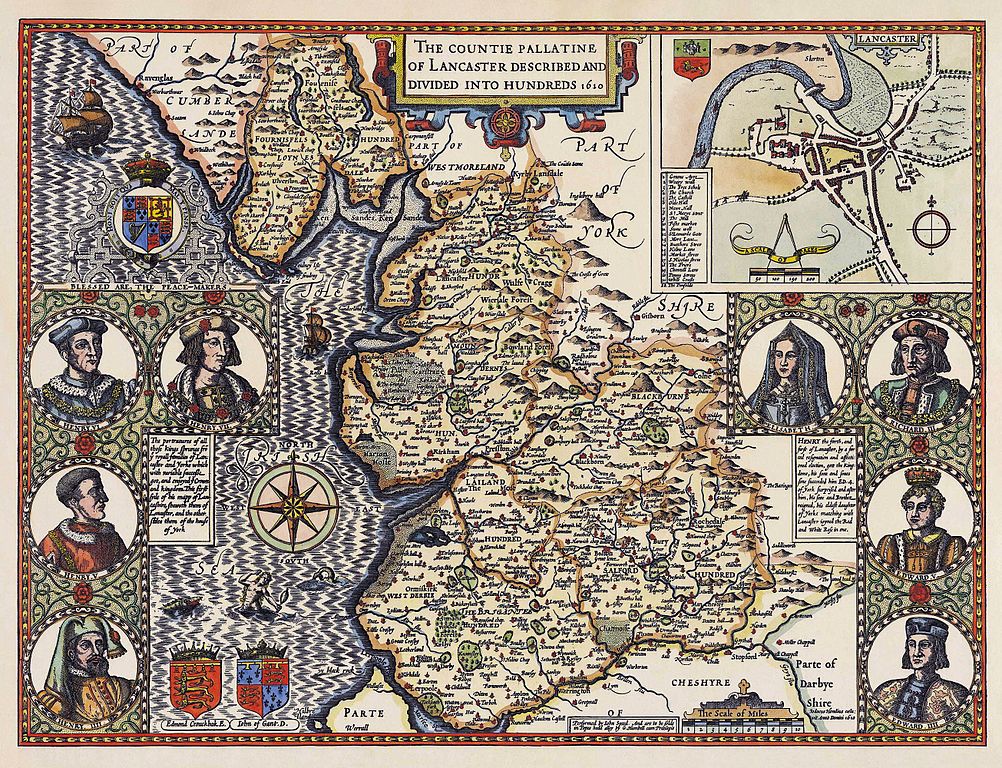
Like many siblings, the twin cities of Manchester and Liverpool have much in common. They are both joined by the River Mersey and share a common commercial and cultural rival: the megacity of London. As well as being on the same river, both Manchester and Liverpool are in the same county too; Lancashire. Symbolised since the Wars of the Roses by the Red Rose of Lancaster.🌹 Historically, there’s a strong argument for Mancunian supporters to back Liverpool over London. We are brothers in arms, sisters in arms, siblings from the House of Lancaster, two red roses from the very same rootstock.🌹

Lancashire_1610_Speed_Hondius_-_Restoration

John Speed’s map of the County Palatine of Lancaster (Lancashire) in 1610. The River Mersey joins Manchester to Liverpool along the bottom of the map and separates Lancashire in the North from Cheshire in the South. The Pennines roughly separate Lancashire in the West from Yorkshire in the East. Picture by Jodocus Hondius, engraved by John Speed, and restored by Adam Cuerden. This is a retouched picture, digitally altered from its original version. Public domain picture from Wikimedia Commons.

An organisation called the Friends of Real Lancashire (FORL) @FORLancashire puts it another way on their website forl.co.uk (emphasis mine):

“Friends of Real Lancashire are concerned to promote the true identity of our county which has been extremely confused in the minds of some people, especially those working in the broadcasting and newspaper industries, since the local government reorganisation of 1974.

The Government at that time stated that the “new counties” were administrative areas only, and that the boundaries of traditional counties such as Lancashire had not been changed. Unfortunately, the media refer to these administrative areas all too frequently and ignore the fact that places such as Barrow-in-Furness, Liverpool, Manchester, Warrington, etc. are still in Lancashire.

If administrative areas had not been called counties much of this confusion would have been avoided. The Royal Mail has at last dropped the use of administrative county names in postal addresses, and names such as Cumbria and Merseyside do not appear in the current Royal Mail Postal Address Book.”

Lucifer over Lancashire

As a follower of Manchester United, I backed our Lancastrian siblings from Liverpool. As someone with Lancashire roots, it is red roses all the way, any day and I was happy when Liverpool got the victory they deserved. Like Andy Burnham, we’re not anti-London, just pro-North. Come on Lancashire, ‘AVE IT!

My fellow United supporters didn’t see it that way. They looked at me like I was the devil incarnate, or Lucifer over Lancashire, as Mark E. Smith used to sing. How could I support Liverpool, a scouse football team? They called me a traitor, a scally and lots of other names that can’t be repeated here. Such is the sibling rivalry between LFC and MUFC. When Alex Ferguson arrived as a new manager of United in 1986 he said:

 “My greatest challenge is not what’s happening at the moment, my greatest challenge was knocking Liverpool right off their f****ng perch. And you can print that.

Which sums it up. Forget Lancashire, forget The North, forget George Osborne’s Northern Powerhouse. United and City fans should support Spurs, the Southern Powerhouse team, because they’re not Liverpool. Support anyone you like, absolutely anyone, apart from Liverpool. Or so they told me…

Conclusion

So are Manchester and Liverpool still in Lancashire? It depends who you ask:

  • If you consult a map, the answer you’ll get will depend on who made the map and when it was made.
  • If you type a Mancunian or Scouse postcode into the Royal Mail postcode & address finder it won’t mention Lancashire, Greater Manchester, Merseyside or even Cheshire so you’ll be none the wiser.
  • If you ask a football fan, they will probably be too blinded by bitter sporting rivalry to give you a sensible answer.
  • If you ask the government, they are preoccupied at the moment, and have more important international borders to think about.
  • If you ask the Friends of Real Lancashire they’ll tell you absolutely YES without question, Manchester and Liverpool are still in Lancashire, because they never left. Our county is called LANCASHIRE, not “Cumbria”, “Greater Manchester”, “Merseyside” or “part of Cheshire”. I’m inclined to agree with them. 🌹

 References

NOTE: Here’s a good related pub quiz question which will sort the wheat from the chaff: Which football team plays closest the River Mersey? (Google it.)

December 10, 2013

Manchester or Mamchester? You’re twistin’ my melon mam!

Filed under: tom-foolery — Duncan Hull @ 6:14 pm
Tags: , , , , , , , ,

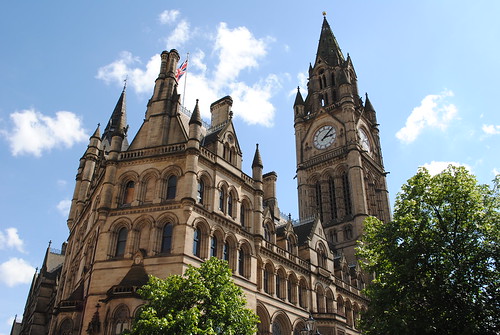
Manchester Town Hall

Manchester Town Hall by Richard Hopkins, creative commons licensed picture via Flickr

The term Manchester is a misnomer, mutated from it’s original form. The name Mamchester might be more appropriate, but only if the pedants get their way.

The Man in Manchester is misleading and has little to do with Manhood or Masculinity. Instead, the word is thought to come from the name given to city by the romans of “Mamucium”, meaning breast-shaped hill. Somewhere down the line Mamucium morphed into Manchester and the Mam became a Man. That’s mam, not man, as in Mammary or as the Miserable Mancunian Morrissey put it,

Let me get my hands on your mammary glands.”

So don’t be a boob, remember the Man in Manchester is a Mam. Mamchester, you talk so hip, you’re twistin my melon man

May 10, 2012

The Lovelock Laboratory: A fantasy workplace in the West Country

έροτας : love, as described by an implicit heart curve (x²  + y²  − 1)³ − x² y³ = 0

An equation of love (x² + y² − 1)³ − x² y³ = 0

Former Mancunian James Lovelock runs the kind of a laboratory most scientists can only fantasise about working in as they grind through the humdrum bureaucracy of peer-review and never-ending grant applications. Lovelock is fortunate enough to run a completely independent, self-funded lab located in the beautiful West Country. There’s a fascinating interview with him on The Life Scientific with Jim Al-Khalili where he says lots of interesting things about elocution lessons, nuclear power, climate change and his grand theory of planet earth, Gaia [1,2,3]. When asked, he also made this interesting comment about being an indepedendent scientist [4]:

“It’s the most wonderful thing to do [being independent]. I keep on saying that scientists are just like artists if they are creative. If you were an artist, would you want to spend your life in an institute for fine art, quibbling with other academics about the different styles of painting? You’d rather be in your garage doing your masterpiece and selling a lot of art to some tourists to pay the way. That’s been my life as a scientist. ”

The audio file of the broadcast is available for download or just click on the play icon below:

So to become a truly independent scientist, you either need to win the lottery, nobel prize or possibly invent the modern equivalent of electron capture detection to bankroll running a lab from the bottom of your garden.

Well if nothing else, it’s an entertaining fantasy to while away dull moments in the real world…

References

  1. James Lovelock (2009). The Vanishing Face of Gaia: A Final Warning ISBN:1846141850, Penguin
  2. Andrew Watson (2009). Final warning from a sceptical prophet: James Lovelock fears that humanity faces widespread death and mass migration as Earth’s systems become further unbalanced by climate change Nature, 458 (7241), 970-971 DOI: 10.1038/458970a
  3. John Gribbin and Mary Gribbin (2009) He Knew He Was Right: The Irrepressible Life of James Lovelock and Gaia, ISBN:1846140161, Allen Lane
  4. Matthew Reisz (2012) Free-range thinkers: Independent scholars can confound, complement and challenge the work of their campus counterparts. Times Higher Education

Blog at WordPress.com.