O'Really?

July 16, 2025

…from my students I have learned most of all


I have learned much from my teachers and even more from my friends, but from my students I have learned most of all

From left to right, Minahil, Sambbhav and Muna, the latest graduand (now graduate) guests on the Hearing Your Future podcast. As of July 2025, there’s twenty one lessons (aka episodes) that students have taught me, maybe you’ll learn something from them too. 🎧

Graduation is one of the most enjoyable milestones in the academic calendar. It’s a chance for everyone to celebrate and reflect on what students have learned and how they have grown during the time they have spent at University. What makes it special (and possible) is the help of friends, families, speakers and supporters who come to mark the occasion with style and substance.

For the last three years, I’ve been hosting a fringe graduation event with graduands and graduates from a studio in the the Kilburn building, as part of an ongoing audio podcast. [1] The latest three episodes of the podcast are now available including:

Thanks to Minahil, Sambbhav and Muna for taking part, it’s always a pleasure to record these episodes, hear your stories and learn from the unique journeys you are taking. Listen or subscribe at:

Unless you count programming languages, I’m agnostic when it comes to religion, but the quote at the top of this page about learning most from your students comes from the Talmud. [2]

P.S. Sambbhav is looking for work in the UK, if you’re looking for engineers with experience, adaptability, good communication skills and intelligence, you should invite him to interview before somebody else snaps him up! linkedin.com/in/khare-sambbhav

References

  1. Hull, Duncan (2023). Amplifying student voices on employability with podcasts. figshare. Presentation. DOI:10.6084/m9.figshare.23726541.v1
  2. Chanina, Rabbi (Various dates) en.wikipedia.org/wiki/Talmud (Taanis 7a) 

Cite this blog post using DOI:10.59350/oreilly.11426 from rogue-scholar.org

February 1, 2025

One hundred albums you might enjoy listening to

Filed under: joshua tree,music,wikipedia — Duncan Hull @ 4:14 pm
Tags: , , , , ,

Any list of 100 best anything is going to be riddled with biases, flaws and omissions, but here’s a list of albums you might enjoy listening to from 100best.music.apple.com. I’ve posted them here because my family are listening to three albums a week throughout 2025, and discussing them as we go. The albums are listed in reverse order of “greatness“ below, as we’re starting from the top. The №’s link to music and listening notes on Apple, other streaming services are available. The rest of the links go to the English Wikipedia article for the album in question. What’s missing and what’s in the wrong order? What doesn’t deserve to be mentioned on this list? There’s a strong American bias, with 65% of artists hailing from the USA and 24% from the UK. There’s only 1% representation of artists from each of Jamaica, Iceland, Ireland, Puerto Rico, Sweden, Germany and France and a big fat 0% for many others.†

Public domain image of a One Hundred Dollar bill from 1862 via Wikimedia Commons w.wiki/Cwbe

When it comes to music, Your Mileage May Vary (YMMV), actually your mileage will definitely vary. So here’s an opinionated view from Apple Park on the ”definitive list of the greatest albums ever made” assembled with the help of ”artists and experts”. There’s plenty of bangers in here, amongst the clangers. Judge for yourself:

  1. 🇸🇪 № 100 (2010) en.wikipedia.org/wiki/Body_Talk_(Robyn_album)
  2. 🇺🇸 № 99 (1976) en.wikipedia.org/wiki/Hotel_California_(album)
  3. 🇺🇸 № 98 (2018) en.wikipedia.org/wiki/Astroworld_(album)
  4. 🇺🇸 № 97 (1992) en.wikipedia.org/wiki/Rage_Against_the_Machine_(album)
  5. 🇳🇿 № 96 (2013) en.wikipedia.org/wiki/Pure_Heroine
  6. 🇺🇸 № 95 (2004) en.wikipedia.org/wiki/Confessions_(Usher_album)
  7. 🇬🇧 № 94 (2007) en.wikipedia.org/wiki/Untrue_(album)
  8. 🇺🇸 № 93 (2016) en.wikipedia.org/wiki/A_Seat_at_the_Table
  9. 🇺🇸 № 92 (2017) en.wikipedia.org/wiki/Flower_Boy
  10. 🇬🇧 № 91 (1990) en.wikipedia.org/wiki/Listen_Without_Prejudice_Vol._1
  11. 🇦🇺 № 90 (1980) en.wikipedia.org/wiki/Back_in_Black
  12. 🇺🇸 № 89 (2009) en.wikipedia.org/wiki/The_Fame_Monster
  13. 🇺🇸 № 88 (1965) en.wikipedia.org/wiki/I_Put_a_Spell_on_You_(album)
  14. 🇬🇧 № 87 (1991) en.wikipedia.org/wiki/Blue_Lines
  15. 🇺🇸 № 86 (1994) en.wikipedia.org/wiki/My_Life_(Mary_J._Blige_album)
  16. 🇺🇸 № 85 (2018) en.wikipedia.org/wiki/Golden_Hour_(Kacey_Musgraves_album)
  17. 🇺🇸 № 84 (1993) en.wikipedia.org/wiki/Doggystyle
  18. 🇺🇸 № 83 (1975) en.wikipedia.org/wiki/Horses_(album)
  19. 🇺🇸 № 82 (2003) en.wikipedia.org/wiki/Get_Rich_or_Die_Tryin’
  20. 🇨🇦 № 81 (1970) en.wikipedia.org/wiki/After_the_Gold_Rush
  21. 🇺🇸 № 80 (2000) en.wikipedia.org/wiki/The_Marshall_Mathers_LP
  22. 🇺🇸 № 79 (2019) en.wikipedia.org/wiki/Norman_Fucking_Rockwell!
  23. 🇬🇧 № 78 (1973) en.wikipedia.org/wiki/Goodbye_Yellow_Brick_Road
  24. 🇺🇸 № 77 (1989) en.wikipedia.org/wiki/Like_a_Prayer_(album)
  25. 🇵🇷 № 76 (2022) en.wikipedia.org/wiki/Un_Verano_Sin_Ti
  26. 🇺🇸 № 75 (1997) en.wikipedia.org/wiki/Supa_Dupa_Fly
  27. 🇺🇸 № 74 (1994) en.wikipedia.org/wiki/The_Downward_Spiral
  28. 🇺🇸 № 73 (1977) en.wikipedia.org/wiki/Aja_(album)
  29. 🇺🇸 № 72 (2022) en.wikipedia.org/wiki/SOS_(SZA_album)
  30. 🇩🇪 № 71 (1977) en.wikipedia.org/wiki/Trans-Europe_Express_(album)
  31. 🇺🇸 № 70 (1989) en.wikipedia.org/wiki/Straight_Outta_Compton
  32. 🇺🇸 № 69 (1986) en.wikipedia.org/wiki/Master_of_Puppets
  33. 🇺🇸 № 68 (2001) en.wikipedia.org/wiki/Is_This_It
  34. 🇬🇧 № 67 (1994) en.wikipedia.org/wiki/Dummy_(album)
  35. 🇬🇧 № 66 (1986) en.wikipedia.org/wiki/The_Queen_Is_Dead
  36. 🇺🇸 № 65 (1989) en.wikipedia.org/wiki/3_Feet_High_and_Rising
  37. 🇺🇸 № 64 (1997) en.wikipedia.org/wiki/Baduizm
  38. 🇺🇸 № 63 (1967) en.wikipedia.org/wiki/Are_You_Experienced
  39. 🇺🇸 № 62 (1996) en.wikipedia.org/wiki/All_Eyez_on_Me
  40. 🇬🇧 № 61 (1992) en.wikipedia.org/wiki/Love_Deluxe
  41. 🇺🇸 № 60 (1967) en.wikipedia.org/wiki/The_Velvet_Underground_&_Nico
  42. 🇬🇧 № 59 (2013) en.wikipedia.org/wiki/AM_(Arctic_Monkeys_album)
  43. 🇬🇧 № 58 (1995) en.wikipedia.org/wiki/(What’s_the_Story)_Morning_Glory?
  44. 🇺🇸 № 57 (2000) en.wikipedia.org/wiki/Voodoo_(D’Angelo_album)
  45. 🇬🇧 № 56 (1989) en.wikipedia.org/wiki/Disintegration_(The_Cure_album)
  46. 🇺🇸 № 55 (2016) en.wikipedia.org/wiki/Anti_(album)
  47. 🇺🇸 № 54 (1965) en.wikipedia.org/wiki/A_Love_Supreme
  48. 🇬🇧 № 53 (1972) en.wikipedia.org/wiki/Exile_on_Main_St.
  49. 🇺🇸 № 52 (1987) en.wikipedia.org/wiki/Appetite_for_Destruction
  50. 🇺🇸 № 51 (1987) en.wikipedia.org/wiki/Sign_o’_the_Times
  51. 🇬🇧 № 50 (1985) en.wikipedia.org/wiki/Hounds_of_Love
  52. 🇮🇪 № 49 (1987) en.wikipedia.org/wiki/The_Joshua_Tree
  53. 🇺🇸 № 48 (1989) en.wikipedia.org/wiki/Paul’s_Boutique
  54. 🇨🇦 № 47 (2011) en.wikipedia.org/wiki/Take_Care
  55. 🇯🇲 № 46 (1977) en.wikipedia.org/wiki/Exodus_(Bob_Marley_and_the_Wailers_album)
  56. 🇮🇸 № 45 (1997) en.wikipedia.org/wiki/Homogenic
  57. 🇺🇸 № 44 (1973) en.wikipedia.org/wiki/Innervisions
  58. 🇺🇸 № 43 (1980) en.wikipedia.org/wiki/Remain_in_Light
  59. 🇺🇸 № 42 (1986) en.wikipedia.org/wiki/Control_(Janet_Jackson_album)
  60. 🇺🇸 № 41 (1998) en.wikipedia.org/wiki/Aquemini
  61. 🇺🇸 № 40 (1967) en.wikipedia.org/wiki/I_Never_Loved_a_Man_the_Way_I_Love_You
  62. 🇺🇸 № 39 (1994) en.wikipedia.org/wiki/Illmatic
  63. 🇺🇸 № 38 (1971) en.wikipedia.org/wiki/Tapestry_(Carole_King_album)
  64. 🇺🇸 № 37 (1993) en.wikipedia.org/wiki/Enter_the_Wu-Tang_(36_Chambers)
  65. 🇺🇸 № 36 (2013) en.wikipedia.org/wiki/Beyoncé_(album)
  66. 🇬🇧 № 35 (1979) en.wikipedia.org/wiki/London_Calling
  67. 🇺🇸 № 34 (1988) en.wikipedia.org/wiki/It_Takes_a_Nation_of_Millions_to_Hold_Us_Back
  68. 🇬🇧 № 33 (2000) en.wikipedia.org/wiki/Kid_A
  69. 🇺🇸 № 32 (1994) en.wikipedia.org/wiki/Ready_to_Die
  70. 🇨🇦 № 31 (1995) en.wikipedia.org/wiki/Jagged_Little_Pill
  71. 🇺🇸 № 30 (2019) en.wikipedia.org/wiki/When_We_All_Fall_Asleep,_Where_Do_We_Go?
  72. 🇺🇸 № 29 (1991) en.wikipedia.org/wiki/The_Low_End_Theory
  73. 🇬🇧 № 28 (1971) en.wikipedia.org/wiki/The_Dark_Side_of_the_Moon
  74. 🇬🇧 № 27 (1969) en.wikipedia.org/wiki/Led_Zeppelin_II
  75. 🇺🇸 № 26 (2010) en.wikipedia.org/wiki/My_Beautiful_Dark_Twisted_Fantasy
  76. 🇺🇸 № 25 (1959) en.wikipedia.org/wiki/Kind_of_Blue
  77. 🇬🇧 № 24 (1972) en.wikipedia.org/wiki/The_Rise_and_Fall_of_Ziggy_Stardust_and_the_Spiders_from_Mars
  78. 🇫🇷 № 23 (2001) en.wikipedia.org/wiki/Discovery_(Daft_Punk_album)
  79. 🇺🇸 № 22 (1975) en.wikipedia.org/wiki/Born_to_Run
  80. 🇬🇧 № 21 (1966) en.wikipedia.org/wiki/Revolver_(Beatles_album)
  81. 🇺🇸 № 20 (1966) en.wikipedia.org/wiki/Pet_Sounds
  82. 🇺🇸 № 19 (1992) en.wikipedia.org/wiki/The_Chronic
  83. 🇺🇸 № 18 (2014) wikipedia.org/wiki/1989_(Taylor’s_Version)
  84. 🇺🇸 № 17 (1971) en.wikipedia.org/wiki/What’s_Going_On_(album)
  85. 🇺🇸 № 16 (1971) en.wikipedia.org/wiki/Blue_(Joni_Mitchell_album)
  86. 🇬🇧 № 15 (2011) en.wikipedia.org/wiki/21_(Adele_album)
  87. 🇺🇸 № 14 (1965) en.wikipedia.org/wiki/Highway_61_Revisited
  88. 🇺🇸 № 13 (2001) en.wikipedia.org/wiki/The_Blueprint
  89. 🇬🇧 № 12 (2001) en.wikipedia.org/wiki/OK_Computer
  90. 🇬🇧 № 11 (1977) en.wikipedia.org/wiki/Rumours_(album)
  91. 🇺🇸 № 10 (2016) en.wikipedia.org/wiki/Lemonade_(album)
  92. 🇺🇸 № 9 (1991) en.wikipedia.org/wiki/Nevermind
  93. 🇬🇧 № 8 (2006) en.wikipedia.org/wiki/Back_to_Black
  94. 🇺🇸 № 7 (2012) en.wikipedia.org/wiki/Good_Kid,_M.A.A.D_City
  95. 🇺🇸 № 6 (1976) en.wikipedia.org/wiki/Songs_in_the_Key_of_Life
  96. 🇺🇸 № 5 (2016) en.wikipedia.org/wiki/Blonde_(Frank_Ocean_album)
  97. 🇺🇸 № 4 (1984) en.wikipedia.org/wiki/Purple_Rain_(album)
  98. 🇬🇧 № 3: (1969) en.wikipedia.org/wiki/Abbey_Road
  99. 🇺🇸 № 2 (1982) en.wikipedia.org/wiki/Thriller_(album)
  100. 🇺🇸 № 1 (1998) en.wikipedia.org/wiki/The_Miseducation_of_Lauryn_Hill

† NOTE: Some artists don’t fit into a neat singly rooted hierarchy, for example, are Fleetwood Mac British or American? Is Alanis Morissette Canadian or American? etc

Cite this post using DOI:10.59350/sf65z-3fc66 provided by The Rogue Scholar rogue-scholar.org

September 10, 2021

On this day, twenty years ago, 10th September 2001

The World Trade Center, New York in 2001, public domain image via Wikimedia Commons w.wiki/_z323

On this day twenty years ago, September 10th 2001, the following things did not exist:

  • Euro coins and banknotes; real physical €uro currency was released the following year in January 2002 [1]
  • The iPhone, iPad, iPod, iOS, smartphones and tablets. A new device called the “iPod” was released the following month in October 2001, swiftly followed by a tsunami of mobile devices and iThings. [2]
  • YouTube, Facebook, Twitter, Instagram, LinkedIn, WhatsApp, TikTok and indeed any form of social media. Do you sometimes wish we could go back to a world without social media? Oh Happy days!
  • Deadly viruses such as SARSMERS and SARS‑CoV‑2, the cause of the COVID-19 pandemic
  • Any kind of usable videotelephony service for the masses: Skype, Zoom, FaceTime, Teams, Whatever…

On this day twenty years ago, September 10th 2001, the following events were yet to take place:

On this day twenty years ago, September 10th 2001, the global average temperature was about ~0.5°C lower and the following things did exist in a significantly cooler global climate:

(As predicted, software has eaten the world, or at least it has taken a very big bite of our communication and commerce)

On this day twenty years ago, September 10th 2001, trillions of dollars were about to be spent fighting wars in which:

  • Thousands of civilians on all sides were killed
  • Thousands of combatants on all sides were killed

(May they rest in peace)

My ticket to the observation deck 09/01/93

On this day twenty years ago, September 10th 2001, the western world was a very different place. Did a lot more happen in the last twenty years (2001—2021), than in the preceding twenty years (1981—2001)? In retrospect, do the eighties and nineties look relatively uneventful when compared to the noughties and the teenies? As the globe warms and our climate changes, is politics getting hotter too?

  • Perhaps humanity is accelerating like never before? OR
  • Perhaps it’s just that life seems to speed up as you get older? OR
  • Perhaps we were just too young and not paying enough attention back then?

References

  1. Anon (2002) New Euro banknotes and coins introduced in 12 countriesEuropean Central Bank, Brussels
  2. Alicia Awbrey and Natalie Sequeira (2001) Apple Presents iPod: Ultra-Portable MP3 Music Player Puts 1,000 Songs in Your PocketApple Inc, Cupertino, California
  3. Simon Bowers (2001) Google hits on profit formulaThe Guardian, London

July 7, 2021

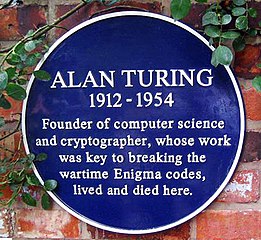
Would YOU want to live in Alan Turing’s house?

The blue plaque on Alan Turing’s house, commemorating his work in cryptography which founded both Computer Science and Artificial Intelligence as new disciplines. Picture by Joseph Birr-Pixton on Wikimedia Commons w.wiki/3aYW

The house where Computer Scientist Alan Turing spent his final years is currently up for sale. The estate agent describes the property on 43 Adlington Road, Wilmslow as a Victorian family residence of significant historical importance. Wilmslow and the surrounding Cheshire countryside is popular with Manchester commuters, including many Man United, Man City & England football stars. Even if you could afford its premier league price tag, would YOU want to live in the house where Turing’s life ended so tragically? 

Turing was found dead at this house, on the 8th June 1954 by his cleaner. The cause of his death the previous day was established as cyanide poisoning. He was just 41 years old. When his body was discovered, an apple lay half-eaten by his bedside. 

The coroner recorded a verdict of suicide.

At the end of his life Turing was suffering mentally and physically. The homophobic British authorities were using a form of legalised torture, known as forced chemical castration, to punish him for being homosexual. At the time, homosexuality was a crime. Turing put on a brave face and joked about his castration (“I’m growing breasts!), but it must have been horrible to endure.

If you’re feeling suicidal or tortured, you don’t have to struggle with difficult feelings alone. If you’re suffering from emotional distress or struggling to cope a Samaritan can face your problems with you. Whatever you’re going through, samaritans.org are available 24 hours a day, 365 days a year. They respond to around 10,000 calls for help every day. No judgement. No pressure. Call them free any time, from any phone on 116 123.

While everyone can have a good old nosey at Turing’s house through the estate agents window, no-one needs to suffer like its famous former resident did. Personally I think I’d find this property an enigmatically haunted house to live in, knowing that this was the place where a great man’s life ended in such tragedy. How about you?

Turing’s House: Copper Folly, 43 Adlington Road, Wilmslow, Cheshire, SK9 2BJ

  1. Rightmove details www.rightmove.co.uk/properties/109329428
  2. Savills.com details in a single pdf file bit.ly/alan-turings-house
  3. Turing’s house in Google maps goo.gl/maps/krMM3A2JfgTUVFfm8
  4. GCSE computing: Alan Turing: Creator of modern computing bbc.co.uk/teach/alan-turing-creator-of-modern-computing/zhwp7nb
  5. Alan Turing’s Manchester by Jonathan Swinton describes what it was like to make new friends and lovers in the smog-bound, bombed-out city of Manchester from 1948 to 1954 manturing.net
  6. Leslie Ann Goldberg, Simon Schaffer and Andrew Hodges discuss Turing’s ideas and life with Melvyn Bragg https://www.bbc.co.uk/programmes/m000ncmw
  7. Breast enlargement in men undergoing chemical castration https://en.wikipedia.org/wiki/Gynecomastia

Acknowledgements

Thanks to Alan O’Donohoe for spotting Turing’s house on the market and to Joseph Birr-Pixton for publishing his picture of Turing’s blue plaque on Wikimedia Commons.

February 24, 2021

Join us to discuss teaching social responsibility and justice in Computer Science on Monday 1st March at 2pm GMT

Scales of justice icon made by monkik from flaticon.com

With great power comes great responsibility. [1] Given their growing power in the twenty-first century, computer scientists have a duty to society to use that power responsibly and justly. How can we teach this kind of social responsibility and ethics to engineering students? Join us to discuss teaching social justice in computer science via a paper by Rodrigo Ferreira and Moshe Vardi at Rice University in Houston, Texas published in the sigcse2021.sigcse.org conference [2]. From the abstract of the preprint:

As ethical questions around the development of contemporary computer technologies have become an increasing point of public and political concern, computer science departments in universities around the world have placed renewed emphasis on tech ethics undergraduate classes as a means to educate students on the large scale social implications of their actions. Committed to the idea that tech ethics is an essential part of the undergraduate computer science educational curriculum, at Rice University this year we piloted a redesigned version of our Ethics and Accountability in Computer Science class. This effort represents our first attempt at implementing a “deep” tech ethics approach to the course.

Incorporating elements from philosophy of technology, critical media theory, and science and technology studies, we encouraged students to learn not only ethics in a “shallow” sense, examining abstract principles or values to determine right and wrong, but rather looking at a series of “deeper” questions more closely related to present issues of social justice and relying on a structural understanding of these problems to develop potential socio-technical solutions. In this article, we report on our implementation of this redesigned approach. We describe in detail the rationale and strategy for implementing this approach, present key elements of the redesigned syllabus, and discuss final student reflections and course evaluations. To conclude, we examine course achievements, limitations, and lessons learned toward the future, particularly in regard to the number escalating social protests and issues involving Covid-19.

This paper got me thinking:

Houston, we’ve had your problem!

After paging the authors in Houston with the message above there was initial radio silence.

Beep - beep - beep [white noise] Beep - beep - beep...

Hello Manchester, this is Houston, Can we join you?

So we’re delighted to be joined LIVE by the authors of the paper Rodrigo Ferreira and Moshe Vardi from Houston, Texas. They’ll give a lightning talk outlining the paper before we discuss it together in smaller break out groups.

Their paper describes a problem everyone in the world has had in teaching ethics in Computer Science recently. How can we make computing more ethical?

All welcome. As usual, we’ll be meeting on zoom, see sigcse.cs.manchester.ac.uk/join-us for details.

References

  1. Spider-Man (1962) https://en.wikipedia.org/wiki/With_great_power_comes_great_responsibility
  2. Rodrigo Ferreira and Moshe Vardi (2021) Deep Tech Ethics An Approach to Teaching Social Justice in Computer Science in Proceedings of the 52nd ACM Technical Symposium on Computer Science Education (SIGCSE ’21), March 13–20, 2021, Virtual Event, USA. ACM, New York, NY, USA. DOI:10.1145/3408877.3432449
  3. Jack Swigert (1970) https://en.wikipedia.org/wiki/Houston,_we_have_a_problem

December 20, 2018

Dry January: Can you switch off all your social media for a month? #DigitalDetox

socialmedia

Dry January: can you abstain from toxins like alcohol and social media for a month?

Here in the UK, there is an annual tradition known as Dry January. It’s pretty simple, in the wake of all the festive indulgence (🍻), around 4 million people voluntarily abstain from alcohol for the month of January. Why? Because they can save money, sleep better, lose weight [1] and even raise money for charity in the process. If you haven’t tried it yet, Dry January is an enlightening (and enlivening) challenge.

But dry January needn’t just stop at alcohol. Other toxic social lubricants are also available. Have you ever wondered what life would be like without the distraction of social media? Ever tried going without? Go dry by switching off all your social media for a month – just to see what happens. Is social media as toxic as alcohol? Could going cold turkey (🦃) for a month be beneficial to your health and those around you? Switch it all off, meaning:

  • No LinkedIn
  • No Facebook
  • No WhatsApp
  • No Instagram
  • No Twitter
  • No Blogging
  • No “voluntary panopticon
  • No [insert your favourite social media here]. How far you take it will depend on how you choose to define social media…

Abstention requires a bit of planning and preparation, but if you tell your friends now, you could experiment with switching off all your social media for the month of January. Will you be able to handle the Fear of Missing Out (FoMO) [2]? Will your quality of life improve?

The idea of digital detox has been around a while and there are several ways of doing it. You can either go the whole hog like Jaron Lanier and just delete everything [3]. If that’s too drastic for you, try using blockers or timers set to zero minutes. Since the most toxic forms of social media are typically found on smartphones, there’s a few options for detoxing:

Abstaining from alcohol can be beneficial for your physical and mental health. [2] Abstaining from social media could probably help too. Why not give it a whirl and see for yourself?

As this is last (and first!) post here for 2018, have yourselves a happy winterval and a healthy new year in 2019.

References

    1. https://en.wikipedia.org/wiki/Fear_of_missing_out
    2. De Visser, R.O., Robinson, E. & Bond, R., (2016) Voluntary temporary abstinence from alcohol during “Dry January” and subsequent alcohol use. Health Psychology, 35(3), pp.281–289. DOI:10.1037/hea0000297
    3. Lanier, Jaron (2018) Ten Arguments For Deleting Your Social Media Accounts Right Now. Bodley Head, ISBN: 978-1847925398 jaronlanier.com/tenarguments.html


June 23, 2017

Nine ideas for teaching Computing at School from the 2017 CAS conference

CAS

Delegates at the Computing at School conference 2017 #CASConf17 answering diagnostic questions, picture by Miles Berry.

The Computing At School (CAS) conference is an annual event for educators, mostly primary and secondary school teachers from the public and private sector in the UK. Now in its ninth year, it attracts over 300 delegates from across the UK and beyond to the University of Birmingham, see the brochure for details. One of the purposes of the conference is to give teachers new ideas to use in their classrooms to teach Computer Science and Computational Thinking. I went along for my first time (*blushes*) seeking ideas to use in an after school Code Club (ages 7-10) I’ve been running for a few years and also for approaches that undergraduate students in Computer Science (age 20+) at the University of Manchester could use in their final year Computer Science Education projects. So here are nine ideas (in random brain dump order) I’ll be putting to immediate use in clubs, classrooms, labs and lecture theatres:

  1. Linda Liukas demonstrated some intriguing ideas from her children’s books and HelloRuby.com that are based on Montessori education. I shall be trying some of these out (particularly the storytelling stuff) at code club to keep girls involved
  2. Sue Sentance and Neil Brown from King’s College London gave an overview of some current research in pedagogy.  They discussed research questions that can be tackled in the classroom like (for example) do learners make more progress using visual programming languages (like Scratch and Blockly) or traditional text-based languages (like Python and Java etc)? Many of these research questions would make good projects for undergraduate students to investigate in secondary schools, see research on frame based editors, for example.
  3. Michel Wermelinger from the Open University demonstrated using iPython notebooks for teaching data literacy at the Urban Data School. Although I’m familiar with iPython, it had never occurred to me to actually use iPython in school for teaching. It is a no-brainer, when you think about it, even for primary, because you have your code, inputs and outputs all in one window, and can step through code execution instead of (or as well as) using more conventional tools like Trinket, Thonny or IDLE. Data literacy is fun to teach.
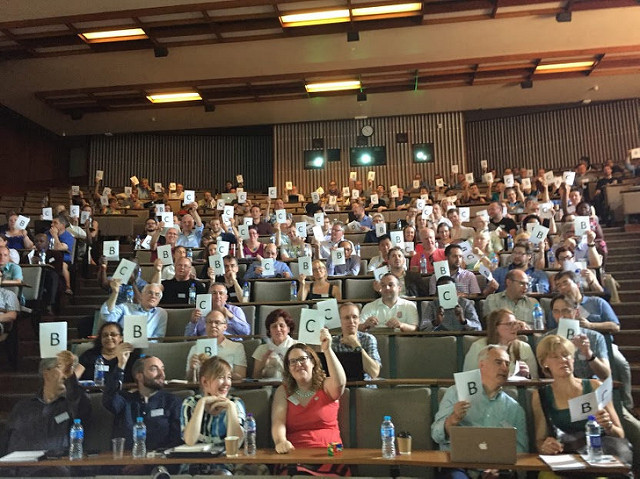
  4. Miles Berry from the University of Roehampton demonstrated Diagnostic Questions in Project Quantum. These are a collection of high quality quizzes to use interactively for example as hinge questions, where teaching is adapted depending on answers given, like this multiple choice question:
    Consider the following Python code:
    
    a = 20
    b = 10
    a = b
    
    What are the values of a and b?
    
    A: a = 10, b = 10
    B: a = 20, b = 20
    C: a = 30, b = 10
    D: a = 10, b = 20
    

    You’ll have to try these five questions to check your answer. The useful thing here is that DiagnosticQuestions.com (the platform on which this is built) allows you to see lots of responses, for example each answer (A, B, C or D) above was selected by 25% of participants. You can also view explanations which illuminate common misconceptions (e.g. the classic mistake of confusing assignment with equality) as well as providing a bank of free questions for use in the classroom.

  5. Mark Guzdial from GeorgiaTech discussed using learning sciences to improve computing teaching. He demonstrated predictive questions (e.g. ask students What do you think will happen when we run this code? before actually executing it) alongside what he called subgoal labelling. These are simple ideas (with proven benefits) that can be put to use immediately. I’ll also be trying the Live Coding (with Sonic Pi) and Media Computation he demonstrated asap.
  6. Laurence Rogers demonstrated Insight: Mr. Bit  this looks like a good app for using BBC microbits in the classroom, connected to a range of sensors, provided you’ve got access to iPads.
  7. A copy of Hello World magazine was in the conference bag. The summer 2017 issue has an unusual article from Ian Benson from Kingston University and Jenny Cane describing their use of the Haskell programming language to teach 5-7 year olds to reason symbolically and learn algebra before arithmetic with help from Cuisenaire rods. The Scratch Maths project at University College London are doing similar things, building mathematical knowledge using Scratch, rather than Haskell. These are experimental ideas you could try out on unsuspecting (junior) family members.
  8. Lee Goss from Barefoot Computing, described the free CPD for primary school teachers on offer from BT. I’ve signed up and hope to plug some of the shortcomings in the Code Club Curriculum.
  9. Richard Jarvis demonstrated appJar, a handy Python library for teaching Graphical User Interfaces (GUIs). That’s Jar as in Jarvis and Jam, not JAR as in Java ARchive BTW. I’ve not tried GUIs at code club yet, but appJar looks like a good way to do it.

There were lots more people and projects at the conference not mentioned here including tonnes of workshops. If you’re interested in any of the above, the CAS conference will be back in 2018. Despite the challenging problems faced by Computer Science at GCSE level, it was reassuring and inspiring to meet some members of the vibrant, diverse and friendly community pushing the boundaries of computing in schools across the United Kingdom. Thanks again to everyone at CAS for putting on another great event, I will definitely consider attending next year and maybe you should too.

March 4, 2014

CoderDojo, CodingDojo or CodeJo?

CC-BY licensed picture of a Hacker Dojo by Mitch Altman.

A dojo (or a dōjō) is an event where people train to perform a given task. So for example, software engineers organise code dojos to hone their skills in making software. The term has become widely adopted, so much so, that you’ll often find many flavours of dojo in your local area. In Manchester, there are at least three variants and these often get confused, usually by me. So here’s a quick explanation of what the different dojos do and how they are different.

CoderDojo: @coderdojo & @mcrcoderdojo etc

CoderDojo.com is an open source, volunteer led, global movement of free coding clubs for young people. You’ll find Coder Dojos all over the world, the Manchester Coder Dojo meets once a month in The Sharp Project, and like many coder dojos is very popular and frequently over-subscribed.

CodingDojo: @uomcodingdojo & @codingdojodotco

A group of students at the University of Manchester organise a Coding Dojo @uomcodingdojo see fb.com/uomcodingdojo. They practise problems in TopCoder and other puzzles [1-5] in order to compete in the ACM International Collegiate Programming Contest. They do this because it’s fun, improves their skill and prepares them for the kind’s of problems that are commonly found in a Coding Interviews  – a variant of the infamous Microsoft / Amazon / Google / Apple / Facebook / Twitter interviews. [6,7]

(The Manchester Coding Dojo are nothing to do with codingdojo.com  an outfit in Seattle and Silly Valley who claim to “teach you programming in 2 weeks” see @codingdojodotco.)

Codejo: @manc_codejo

The Manchester Codejo is monthly coding meetup in Manchester, where developers improve their skills by performing Katas – exercises designed to improve coding ability through repetition. So at their last meeting for example, Gemma Cameron @ruby_gem recently ran a Codejo session on the Class-responsibility-collaboration card at manchester.techhub.com.

In other words…

So @coderdojo ≠ @uomcodingdojo ≠ @manc_codejo ≠ @McrCoderDojo etc. Hope this clears up some confusion…

References

  1. http://en.wikipedia.org/wiki/Dining Philosophers
  2. http://en.wikipedia.org/wiki/Eight queens puzzle
  3. http://en.wikipedia.org/wiki/Tower of Hanoi
  4. http://en.wikipedia.org/wiki/Travelling salesman problem
  5. http://en.wikipedia.org/wiki/Two Generals’ problem
  6. McDowell, Gayle Laakman (2011) Cracking the Coding Interview: 150 Programming Questions and Solutions Career Cup ISBN:098478280X
  7. Poundstone, William (2013) Are You Smart Enough to Work at Google? Fiendish Puzzles And Impossible Interview Questions From The World’s Top Companies Oneworld Publications ISBN:1851689559

March 15, 2013

Creating with the Raspberry Pi vs. Consuming Apple Pie at the Manchester Raspberry Jamboree

MiniGirlGeek

Thirteen year old Amy Mather aka @MiniGirlGeek steals the show at Manchester Raspberry Jam 2013

Last Saturday, the first ever Raspberry Jamboree rolled into town, organised by the unstoppable force of nature that is Alan O’Donohoe (aka @teknoteacher). The jamboree looked at the educational value of the Raspberry Pi (a $25 computer) one year on from its launch on the the 29th February 2012. Here are some brief and incomplete notes on some of the things that happened in the main room, aka ‘Jamboree Central’. The workshops and other events have been covered by Jason Barnett @boeeerb.

A key feature of the Raspberry Pi foundation (and the Jamboree) was neatly summed up by Paul Beech (aka @guru) who compared the Raspberry Pi to various Apple iThings. Paul’s view is that when it comes to computing, Apple gives you a “sandy beach, sunbed and cocktail” to passively consume digital content with while the Raspberry Pi gives you a “desert, knife and a bottle” to actively create new things (see his tweet below).

Consuming Apple Pie on a sandy beach, with a sunbed and a cocktail

Engineering evangelist Rob Bishop used Apple Inc. to illustrate what the Raspberry Pi is about in his talk ‘one year on‘. Rob pointed out that a huge amount of effort at Apple Inc. is put into making Computing invisible and seamless. This is great if you’re consuming content on your iPad or iPhone, and what many users want – easy to use, with all the nasty internal gubbins tucked away, out of sight. This is tasty Californian Apple Pie, which many of consume in large amounts.

However, invisible computing is a problem for education, because it is difficult to demonstrate the Wonders of Computer Science (Brian Cox’s next TV series) with a device like the iPad.  Many of the internals of modern devices are completely inaccessible, and it’s non-trivial for budding young engineers to build anything very interesting with it particularly quickly.

In contrast, the Raspberry Pi can be challenging to setup, just getting the Operating System up and running isn’t always straightforward. However, there’s a ton of interesting stuff you can build with it: Nifty robotics, bionic bird boxes, musical hackery, twittering chickens, live train departure boards, internet radiossinging jelly babies and loads of other pideas. Try doing that with your iPad…

Creating with Raspberry Pi in the desert, using a knife and a bottle

Most of the jamboree focussed not on Apple but on the things that can be created with Raspberry Pi: the What and Why and When And How and Where and Who with keynotes from Steve Furber [1] and talks and panel sessions from:

A highlight of the jamboree was the closing keynote given by the thirteen year old Mini Girl Geek on what she’s been doing with her Raspberry Pi. MiniGirlGeek (aka Amy Mather pictured above) stole the show with her demo implementations of Conway’s Game of Life in Python. [update: see video below]

What’s interesting is that Conway’s Game of Life is used as an exercise for first year undergraduates in Computer Science at the University of Cambridge. So it’s great to see teenagers mastering the “knife” of Raspberry Pi, and reminds us that Raspberry Pi is no “sunbed and cocktail” but with a little patience, ambition and talent there’s plenty to capture the imagination of young people about Computing.

References

  1. Steve Furber et al (2012). Computing in Schools: Shut down or restart? Royal Society Report

June 22, 2012

The Silicon Valley Meme: Coming to a Technology Cluster Near You …

Oracle by (nz)dave

Oracle Inc. Headquarters, Silicon Valley, California. CC-licensed Picture by (nz)dave on Flickr.

… if it hasn’t done already

In California the streets aren’t paved with Gold, they are paved with Silicon. Many a Californian has made their fame and fortune from Silicon-based commerce. Facebook, Google, Twitter, Oracle, Apple the list goes on and on. Silicon paves the streets of Silicon Valley.

Silly Valley is often imitated but rarely bettered. Here is a small selection of imitators from a fully blown stamp collection of silicon valley places in wikipedia:

  • Silicon Alley, New York
  • Silicon Fen, Cambridge UK
  • Silicon Roundabout, London
  • Silicon Glen, Glasgow and Edinburgh, Bonnie Scotland
  • Silicon Gorge,  M4 Corridor-ish (Bristol, Swindon, Oxford etc)
  • Silicon Mill, Manchester and North West England
  • Silicon Shipyard, Newcastle, Middlesborough etc

If you don’t have a Silicon Valley cluster near where you live, there’s an easy part and a hard part to creating one. The easy part is, just prefix the name of your local area with the magic S word Silicon. Easy. The hard part is building the universities, businesses, technology, communities, start-ups and investment that makes a technology cluster like Silicon Valley successful [1,2,3]. How can it be done?

Refererences

  1. Mietek Jaroniec (2009). Silicon beyond the valley Nature Chemistry, 1 (2), 166-166 DOI: 10.1038/nchem.173
  2. Paul Graham (2006). How to be Silicon Valley paulgraham.com
  3. Chris Vallance (2012). Silicon Britain: Inside the country’s tech clusters BBC News
Next Page »

Blog at WordPress.com.